





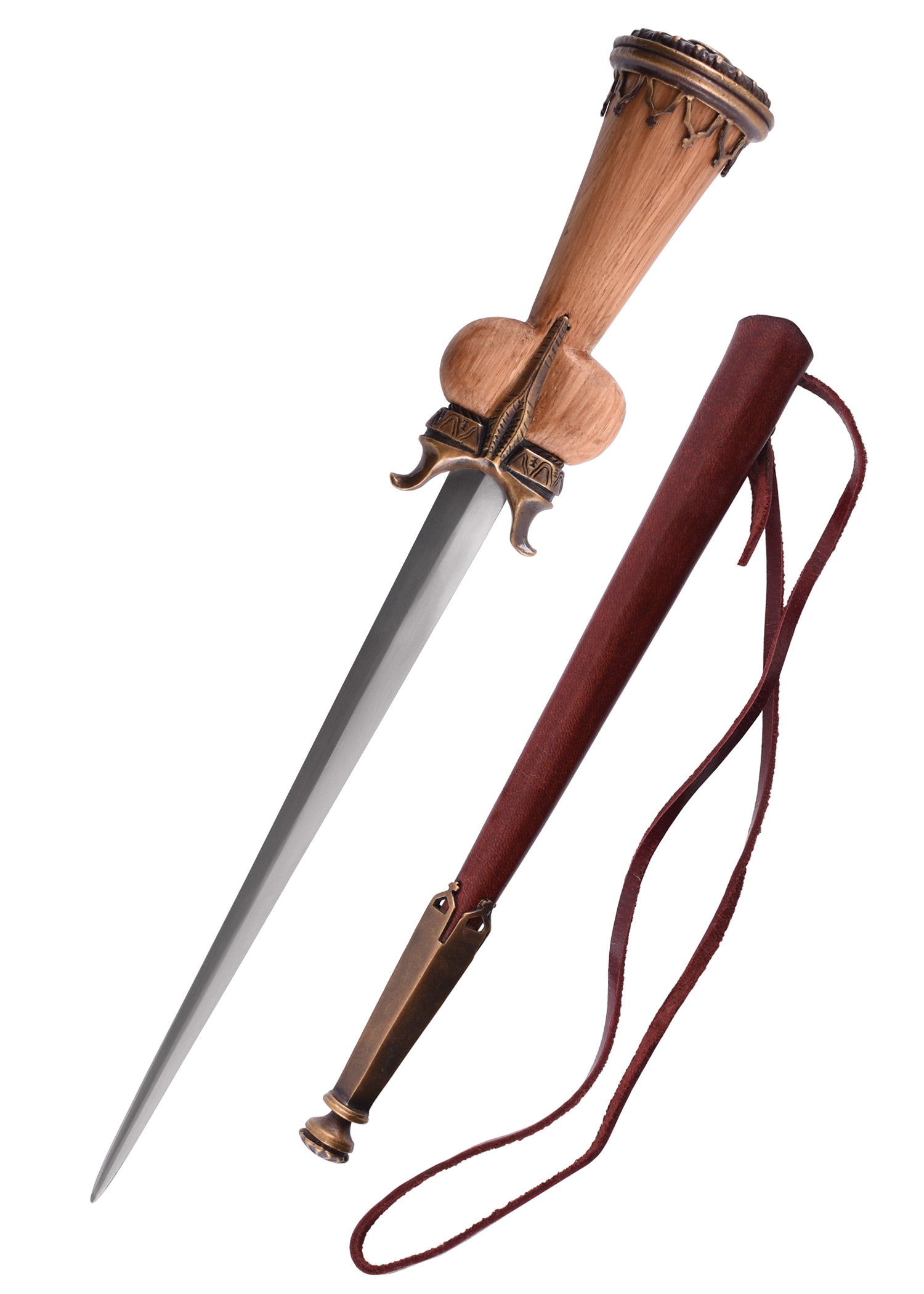
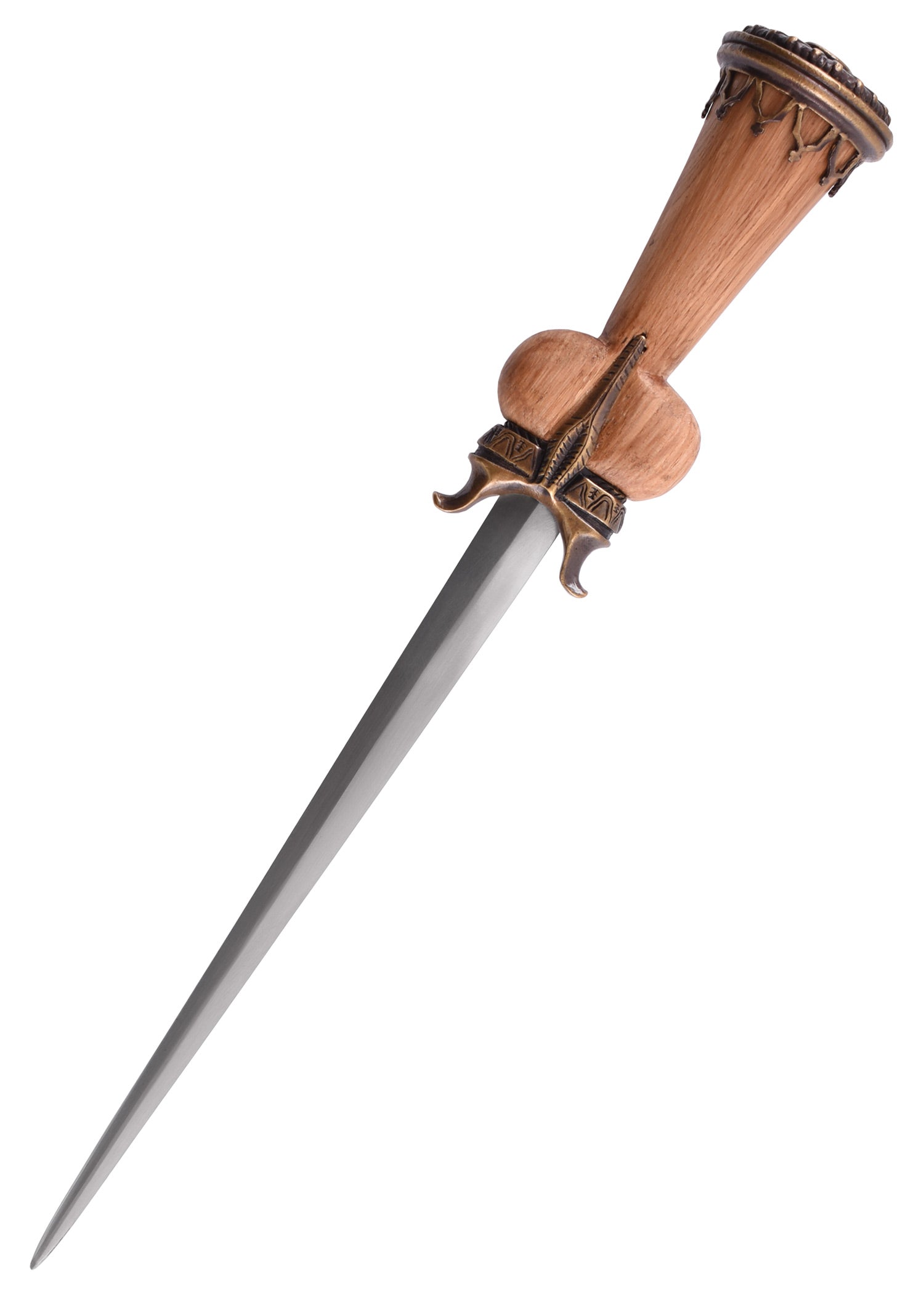
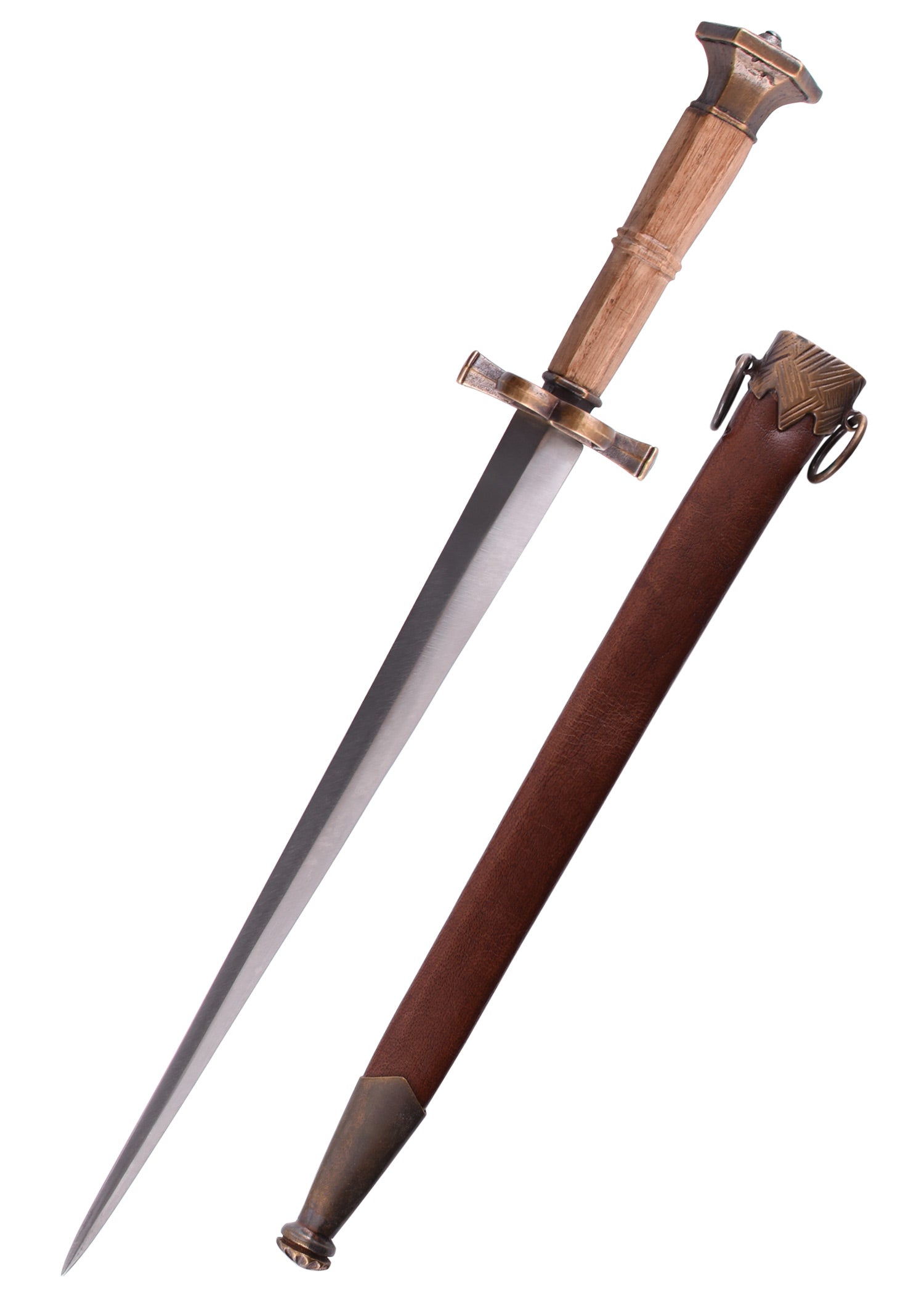

A dagger is a short-bladed, double-edged edged weapon, designed for hand-to-hand combat and precise stabbing at close range. Throughout history, it has served as a combat weapon, an everyday tool, and a status symbol, from the first flint pieces of prehistory to the steel daggers of medieval knights and nobles.
In this guide, we review what a dagger is, its origin and evolution, and the main types based on blade shape. If you are looking for pieces faithful to these historical designs, in our collection of medieval daggers you will find replicas of each type described in this article.

What is a dagger and what is its significance?
A dagger is a short-bladed, double-edged, and symmetrically pointed edged weapon, designed for close-quarters hand-to-hand combat. Unlike a knife, its main function is not to cut, but to pierce with precision.
Beyond combat, the dagger has historically been a status symbol, a ritual object, and a piece of prestige: medieval knights carried it as a sign of honor and bravery, while the working classes used it as an everyday tool for defense.
Difference between a dagger and a knife
The difference lies in the blade geometry: the dagger has a symmetrical, double-edged blade meant for stabbing, while the knife usually has a single edge and a more versatile cutting function.
Origin and evolution of the dagger: from prehistory to the Middle Ages
The dagger has accompanied humanity since prehistory. One of the first known forms has been dated to the Hallstatt region (Austria): a piece carved from flint about 20 cm long found in a Neolithic grave. The first daggers were made of stone, bone, or antler; with the arrival of the Bronze Age, they began to be forged from metal, and with the Iron Age, steel became widespread, which allowed for stronger and more durable blades.
What the dagger means in different cultures
The dagger has been present in practically every culture in the world, adapting to the tactical, technological, and symbolic needs of each era: from a prehistoric hunting tool to a status weapon in Antiquity and a symbol of honor in medieval Europe.
Uses of the dagger in medieval life
On the battlefield, the dagger was the weapon of last resort: when a sword broke, was lost, or proved impractical at close range, the warrior resorted to it to strike at the weak points in the enemy's armor. It was also used in duels, assaults, and self-defense, with specific techniques recorded in medieval fencing manuals, whether alone or combined with another weapon or a shield.
The misericorde dagger
The misericorde dagger, or "mercy dagger," was a medieval dagger specialized in the so-called "coup de grâce" to finish off wounded enemies in combat. Its long, narrow, and extremely sharp blade was designed to penetrate the joints of armor.
Anatomy of a medieval dagger
A typical medieval dagger consists of a blade (between 25 and 50 cm, with one or two edges), a guard or crossguard, a handle made of wood, bone, or metal, and a pommel, which balanced the weapon and served as a support when thrusting.

Types of daggers by shape
Over the centuries, the dagger has played a prominent role on the battlefield as well as in civil, ritual, or symbolic contexts. These are the most common types:
Straight-bladed dagger

The straight-bladed dagger is probably the most recognizable in medieval Europe.
Its symmetrical, sharp blade allows for a precise and powerful thrust.
During the Middle Ages and the Renaissance, these daggers were used as a complement to the sword, especially in duels or as a secondary defense.
The French main gauche, used with the left hand to block or deflect attacks, and the rondel, with its round guard, are two iconic variants of this category.
(Photo of Turín Main Gauche)
Curved-bladed dagger

This design is characteristic of regions such as the Middle East, North Africa, and Central Asia.
The curved blade favors wide and fast cuts.
A prominent example is the Arab khanjar, which combines elegance and lethality. Its "S"-shaped blade and richly decorated handle also make it a status symbol.
The Persian pesh-kabz, with a slightly curved blade and reinforcement on the spine, was designed to penetrate mail armor, revealing its tactical effectiveness.
Triangular-bladed dagger

With a triangular or, in some cases, rhomboidal cross-section, these daggers were especially useful for piercing padded armor or leather seams.
Its narrow blade concentrates force on a small point, causing deep wounds that are difficult to treat.
Some versions were used in trench warfare or as a last-defense weapon by officers.
Wavy-bladed dagger

The Southeast Asian kris is the most well-known example.
Its serpentine blade not only serves an aesthetic or symbolic function, but can also produce irregular and severe wounds.
In many Indonesian and Malaysian cultures, the kris is considered a spiritual object, blessed in rituals and passed down as a family heirloom.
The waviness can also deflect enemy blows, adding a defensive dimension.
(Photo of Kris Dagger, Cold Steel)
Short, wide-bladed dagger

These daggers are similar to combat knives, with a robust design, a thick blade, and a sharp point.
They were common in naval and colonial settings, where versatility was essential.
The Anglo-Saxon seax, although longer, represents an antecedent to these weapons, used for both cutting and stabbing.
(Photo of the Short Sax (Seax) with Bone Handle and Leather Sheath).
Stiletto dagger

The Italian stiletto emerged during the Renaissance and was perfected as a concealed weapon.
Its blade is long, narrow, and very pointed, specialized for precise stabbing.
Unsuitable for cutting, this dagger was ideal for piercing clothing and vulnerable areas of the body.
Its design influenced many modern self-defense weapons.
(Photo of Stiletto)
Ceremonial and ritual daggers

In many cultures, the dagger has moved beyond its martial function to become a ritual object.
Examples such as the Scottish sgian-dubh, worn in the sock during celebrations, or Tibetan daggers used in tantric rituals, demonstrate how the design also responds to symbolic needs.
These daggers are usually richly ornamented and laden with spiritual or identity-based meaning.
(Image of Sgian Dubh with Sheath)
Today, ceremonial daggers retain a mainly symbolic function: they are worn in parades, official acts, and gala uniforms, and remain present in military academies, high-ranking police forces, and Masonic or religious lodges.
Historical and cultural changes reflected in steel
The morphology of the dagger is as varied as its history. From the lethal precision of the stiletto to the ritual breadth of the kris, each blade type responds to a specific need, whether military, ceremonial, or social.
This diversity makes the dagger one of the most versatile and symbolically significant weapons in human history.
Frequently asked questions about daggers
What is a dagger?
A dagger is a short-bladed, double-edged, and symmetrically pointed edged weapon, designed for close-quarters hand-to-hand combat. Unlike the knife, which usually has a single edge and more versatile uses, the dagger is intended almost exclusively for stabbing.
What does a dagger mean?
Beyond its function as a weapon, the dagger has historically signified status, honor, and prestige. Medieval knights carried it as a sign of bravery, while in many cultures ceremonial daggers represented lineage, loyalty, or membership in an order.
What is the difference between a dagger and a knife?
The dagger has a symmetrical double-edged blade oriented toward piercing; the knife usually has a single edge and a more practical cutting function. That distinct geometry is what separates both weapons, even if at first glance they may look similar.
What is the misericorde?
It was a medieval dagger specialized in the so-called "coup de grâce," used to finish off enemies wounded in combat. Its long, narrow, and very sharp blade was designed to penetrate the joints of plate armor.
What are the main types of daggers by shape?
They are classified into straight-bladed, curved, triangular, wavy (like the Asian kris), short and wide (seax type), stiletto, and ceremonial or ritual daggers. Each shape responds to a different function: combat, armor penetration, or symbolism.
Where does the dagger come from and how has it evolved?
Its earliest forms date back to prehistory, with flint pieces like the one found in Hallstatt (Austria). With the Bronze Age, it began to be manufactured in metal, and with the Iron Age, steel became widespread, giving rise to the medieval daggers we know today.


