







The Order of the Temple: Guardians of Faith and Sword
Milites Christi — The Soldiers of Christ who forged the history of the Crusades
Founded in Jerusalem in 1119 by Hugues de Payens and eight Frankish knights, the Order of the Temple became the most powerful military-religious institution of the Middle Ages. For nearly two centuries, they dominated the battlefields of the Holy Land, from the plains of Hattin (1187) to the walls of Acre (1291), bearing the iconic white mantle with the red cross pattée as a symbol of their dual vocation: prayer and warfare. Their dissolution by Philip IV of France and Pope Clement V in 1312 only served to heighten their legend.
Templar Swords
The quintessential weapon of the Templar knight was the hand-and-a-half sword, known as a bastard sword, with blades forged in carbon steel measuring between 80 and 100 cm. Designed for both mounted and foot combat, these swords combined balance, sharpness, and force, becoming the most recognizable symbol of the Order’s power and faith on the battlefields of the Holy Land and the Iberian Peninsula.
Crusader Daggers
The misericorde dagger was the Templar's indispensable secondary weapon. Used in close-quarters combat when the sword proved ineffective against enemy armor, its narrow, rigid blade allowed it to penetrate between the joints of chainmail hauberks and metal plates. A weapon of lethal precision, as functional as it was charged with symbolism in the context of the Crusades from the 12th to the 14th century.
Templar Shields
The Templar shield was both a tactical and symbolic piece. Made of wood reinforced with hardened leather, it bore the unmistakable red cross pattée on a white background, the regulation colors of the Order according to the Latin Rule of the Temple. Its shape evolved from the elongated Norman shield of the 12th century toward more compact and manageable forms throughout the 13th century, adapting to the demands of combat in Outremer.
Crusader Helmets
The evolution of the Templar helmet reflects two centuries of military innovation. From the conical nasal helmet of the 12th century, heir to the Norman tradition, to the great helm that completely covered the face in the 13th century, the Templar's head protection adapted to new combat tactics and enemy weaponry on the battlefields of Syria, Palestine, and Egypt.
Templar Attire
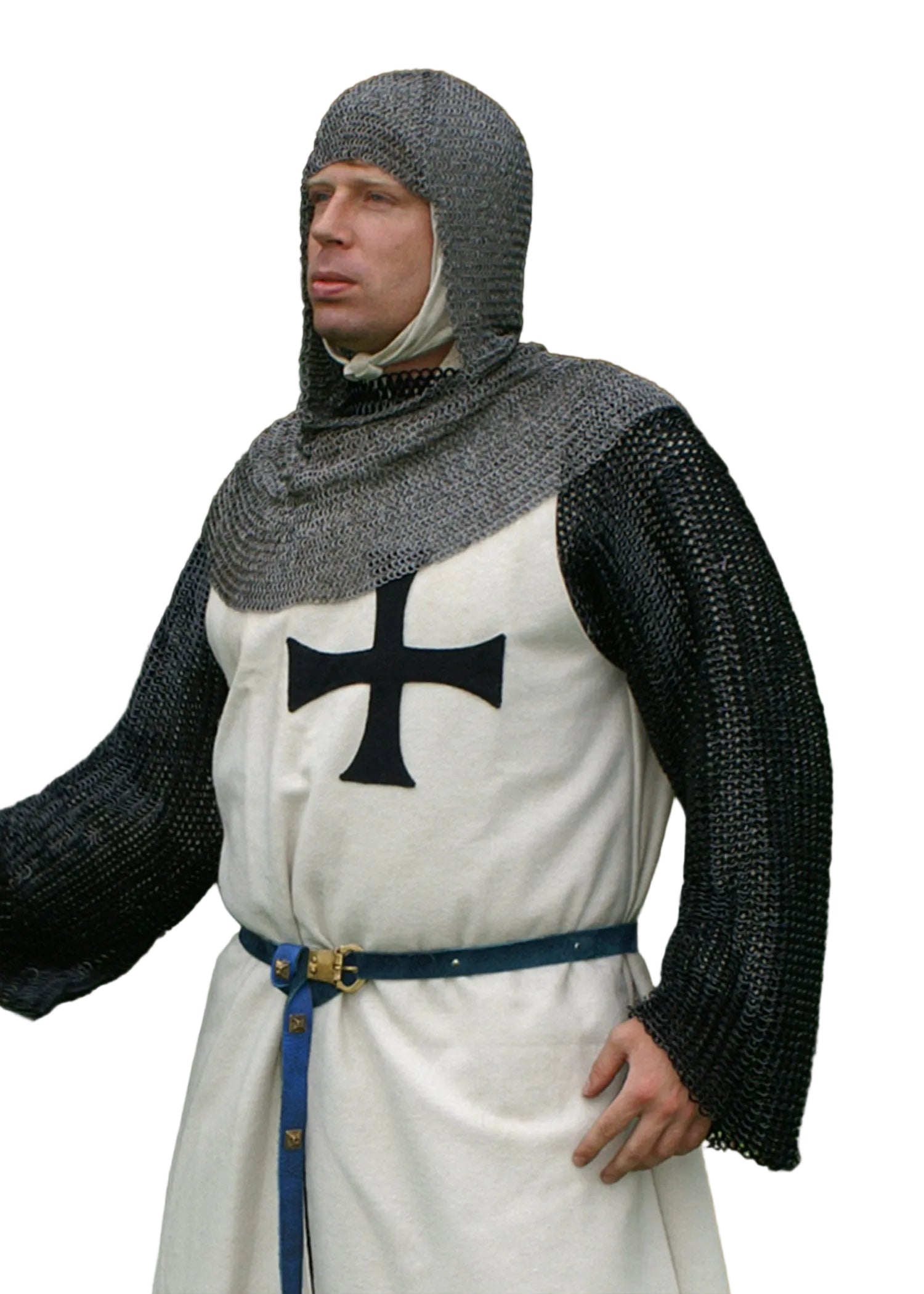
The white mantle with a red cross was the Order’s most recognizable insignia, reserved for professed knights. Beneath it, the Templar wore a linen tunic, a chainmail hauberk, and, in combat, a padded gambeson for additional protection. Sergeants wore black or brown mantles. This attire, regulated in detail by the Rule of the Temple, turned the knight into a living symbol of medieval militant faith.
Your Templar Legacy Awaits at Todo Medieval
At Todo Medieval, we have gathered a rigorous selection of pieces inspired by the Order of the Temple, designed for discerning collectors, historical reenactors, and passionate historians. Each piece reflects the authenticity and historical rigor deserved by one of the most fascinating military orders of medieval history. Discover the weaponry, clothing, and symbols that defined the Milites Christi.
