
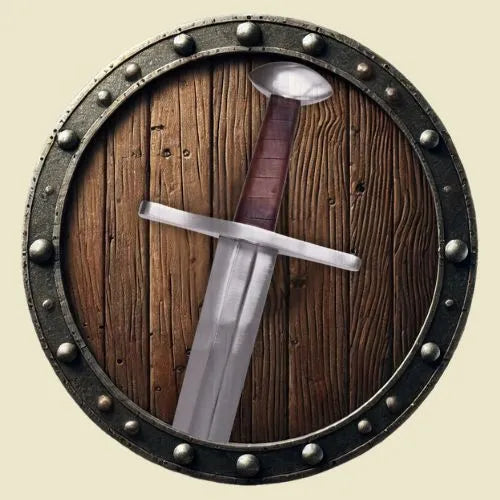



Early Viking Godfred Sword with Scabbard, Category-B Damascus Blade
€399,96 EUR


Early Viking Godfred Sword with Scabbard, Category-B Damascus Blade
In stock
Consigue envío gratuito
Península Ibérica
Unión Europea
Importe estimado al añadir este producto. Sujeto al destino de entrega.
Este productos se enviará: Shipping 7-10 Days
Otros clientes también compraron...

Choose options
In stock
Consigue envío gratuito
Península Ibérica
Unión Europea
Importe estimado al añadir este producto. Sujeto al destino de entrega.
Este productos se enviará: Shipping 7-10 Days
Otros clientes también compraron...
In stock
Consigue envío gratuito
Península Ibérica
Unión Europea
Importe estimado al añadir este producto. Sujeto al destino de entrega.
Este productos se enviará: Shipping 7-10 Days
Otros clientes también compraron...
Treat Yourself to the Godfred Early Viking Sword with Scabbard, Damascus Blade
Godfred early Viking sword with scabbard, Damascus blade
The original of this beautiful reconstruction belonged to the feared Danish king Godfred (also called Gudfred or Gudrød). King Godfred lived in Haithabu (near Schleswig), the most important Viking settlement in Jutland, until his death in 810.
The sword dates back to the 8th century and has the typical shape of an early medieval Viking sword: a short cross-guard slightly curved forward, a straight, double-edged blade with a wider fuller, and a three-lobed pommel.
br
This sword is made exclusively by hand. The cross-guard and the three-lobed pommel are made of forged and heat-treated cast iron. The 100-layer Damascus steel blade extends to the pommel, where it is hand-riveted. The handle is wrapped with a wide leather strap. The blade has a pronounced fuller, which gives the sword great elasticity and lightness at the same time. The edges of the blade are not sharpened.
The sword comes with a very beautiful wooden-core leather scabbard with a leather belt.
The term Damascus steel, Damascus steel or simply Damascus refers to a composite steel made from two or more different types of steel. The name is derived from the Syrian city of Damascus, which is considered an ancient stronghold and origin of Damascus steel production.
Typically, a hard high-carbon steel and a soft low-carbon steel are joined through repeated forge welding and folding. The high-carbon steel provides greater hardness, better hardenability, and greater edge retention, while the softer steel gives the blade greater elasticity and higher resistance to breakage. With this technology, which was developed in a time of poor and changing steel qualities, the positive properties of different steels can be combined. Due to the different colors with varying carbon contents, impressive patterns of alternating layers are created, such as the so-called twist Damascus or rose Damascus. Due to these patterns, Damascus swords from the Middle Ages were said to have an inherent magic. The Edda describes a damascened sword as a blood-worm or a poisonous snake.
We also offer the same sword in two versions with spring steel blades:
- Regular version: item no. 0116696618
- Battle-ready version: item no. 0116696606
Details:
- Blade material: Damascus steel, 100 layers
- Overall length: approx. 94.5 cm
- Blade length: approx. 79.5 cm
- Maximum blade width: approx. 43 mm
- Center of gravity: approx. 16 cm in front of the guard
- Includes wooden and leather scabbard and sword belt.
- Weight without scabbard: approx. 1250 g
At Todo Medieval we have thousands of products from the medieval period and other eras. Discover them!