




Viking Dybäck Sword With Scabbard, Hardened Carbon Steel Blade
€329,96 EUR



Viking Dybäck Sword With Scabbard, Hardened Carbon Steel Blade
In stock
Consigue envío gratuito
Península Ibérica
Unión Europea
Importe estimado al añadir este producto. Sujeto al destino de entrega.
Este productos se enviará: 7-10 Day Shipping
Otros clientes también compraron...

Choose options
In stock
Consigue envío gratuito
Península Ibérica
Unión Europea
Importe estimado al añadir este producto. Sujeto al destino de entrega.
Este productos se enviará: 7-10 Day Shipping
Otros clientes también compraron...
In stock
Consigue envío gratuito
Península Ibérica
Unión Europea
Importe estimado al añadir este producto. Sujeto al destino de entrega.
Este productos se enviará: 7-10 Day Shipping
Otros clientes también compraron...
Gift The Dybäck Viking Sword With Scabbard, Hardened Carbon Steel Blade
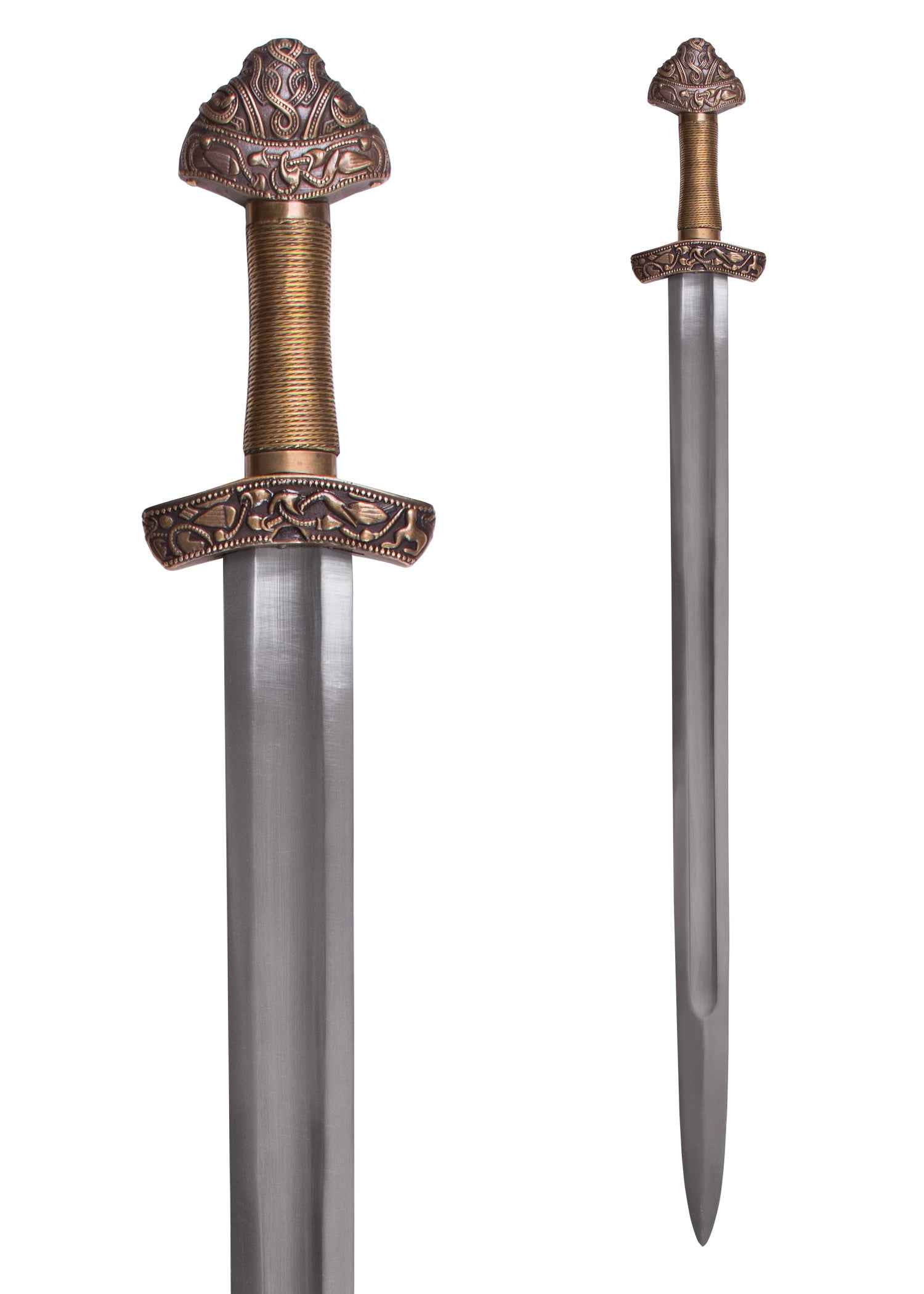
Dybäck Viking sword with scabbard, 11th century, tempered blade
This magnificent one-handed Viking sword is based on an archaeological find made around 1870 in a peat bog in Dybäck - also Dyback, Dybek or Dybeck - in Scania (Skåne, still part of Denmark during the Viking Age, now Sweden). The original piece can now be admired at the Historical Museum - Historiska Museet - in Stockholm (exhibit SHM 4515).
Although the top of the pommel is missing, the brass-wire-wrapped grip, the lower part of the pommel, and the guard (both made of gold-plated silver), as well as the scabbard's locket, which has fused with the guard over time, are still remarkably well preserved. All sections of the hilt are decorated with elaborately engraved motifs of birds, snakes, fantastic creatures, and intertwined vine scrolls.
This finely crafted piece of Viking history, dating to approximately 1000 AD, is classified as Type Z according to the Petersen typology for Viking swords and is generally considered one of the finest specimens of a Viking Age sword ever found in Scandinavia. The animal and plant ornamentation, which corresponds to the Anglo-Saxon Winchester style (8th-11th centuries), suggests that the sword originated in England or was at least heavily influenced by that country's goldsmithing style. Given that this style of ornamentation was particularly popular among the Scandinavian nobility, who had frequent contact with England in the late 10th and early 11th centuries, and given the precious materials and high quality of the craftsmanship used, this sword is believed to have been the prestige or show weapon of a wealthy Norse nobleman or a person of high status.
The reconstruction offered here has a straight, double-edged blade made of tempered EN45 spring steel with a wide fuller and unsharpened edges. The hilt consists of a short cross-guard, slightly curved downwards, a grip section tightly wrapped with brass wire, and a generous pommel with a slightly upward-curved base and a three-lobed cap. The guard and the pommel base reproduce the highly detailed engraved motifs and patterns that adorn the original artifact as faithfully as possible. As with many historical examples from this period that have been preserved, the pommel of this sword is a two-part construction: the full-length blade tang is bolted to the lower section and the upper cap is attached to the base with two rivets.
This early medieval one-handed sword is delivered with a brown wood/leather scabbard with an antique-finish brass locket, chape, and belt loop (maximum belt width 6 cm).
This sword is designed as a collector's piece or decorative object and is also ideal as an accessory, for example to complete your costume.
A Damascus steel version of this sword is also available in our shop (item no. 0116040900).
Details:
- Material: EN45 spring steel blade (carbon steel, not stainless), grip with brass wire wrapping, cast brass guard and pommel
- Total length: approx. 92 cm
- Blade length: approx. 74 cm
- Blade thickness: approx. 4 mm (cutting edges approx. 1 mm)
- Handle length: approx. 18 cm (grip section approx. 9.5 cm)
- Maximum blade width: approx. 4.5 cm
- Center of gravity: approx. 12.5 cm in front of the guard
- Incl. wooden scabbard with genuine leather cover and brass fittings
- Weight without scabbard: approx. 1.1 kg
- Weight with scabbard: approx. 1.7 kg
The above specifications may vary slightly from specimen to specimen.
The steel used here is not stainless and may show slight signs of corrosion. We recommend caring for the blade regularly, for example with Ballistol, a universal oil that is ideal for preserving steel products.
At Todo Medieval we have thousands of medieval products and items from other eras. Discover them!