




Vendel Period Sword with Scabbard, Brass Hilt, Category-B Damascus Steel
€449,96 EUR



Vendel Period Sword with Scabbard, Brass Hilt, Category-B Damascus Steel
Consigue envío gratuito
Península Ibérica
Unión Europea
Importe estimado al añadir este producto. Sujeto al destino de entrega.
Este productos se enviará: Shipping 7-10 Days
Otros clientes también compraron...

Choose options
Consigue envío gratuito
Península Ibérica
Unión Europea
Importe estimado al añadir este producto. Sujeto al destino de entrega.
Este productos se enviará: Shipping 7-10 Days
Otros clientes también compraron...
Consigue envío gratuito
Península Ibérica
Unión Europea
Importe estimado al añadir este producto. Sujeto al destino de entrega.
Este productos se enviará: Shipping 7-10 Days
Otros clientes también compraron...
Delight in Vendel Period Sword with Scabbard, Brass Hilt, Damascus Steel
Scandinavian Vendel period sword with brass hilt, Damascus blade
This beautiful Vendel sword is a reconstruction of a finely crafted and richly decorated ship burial find from a boat grave near Uppsala, Sweden. Due to its magnificent and sophisticated decoration, it is believed to date back to the 7th/8th century. The find, dating back to the 19th century, was once the ceremonial or prestige weapon of a Swedish tribal chief, nobleman, or elite warrior. Numerous finds from the Vendel period (the period of Swedish history between the Migration Period and the Viking Age) bear witness to the high quality of craftsmanship of the time.
In terms of design, this one-handed sword is a classic example of a Nordic weapon. The double-edged blade with a wider fuller is forged from Damascus steel*. The cutting edges are not sharpened, and the blade's full tang is riveted to the pommel.
The highly detailed engraved motifs and patterns that adorned the hilt of the original artifact have been reproduced as faithfully as possible with the approximately 9 cm long and 1.5 cm thick crossguard and the generous antique-finished brass pommel. Pewter details create a nice contrast. As is the case with many examples from the Vendel period, the pommel here also consists of several riveted parts. The upper cap of the pommel has red enamel inlays, reminiscent of authentic garnet stones. The wood-core handle is wrapped in brown leather.
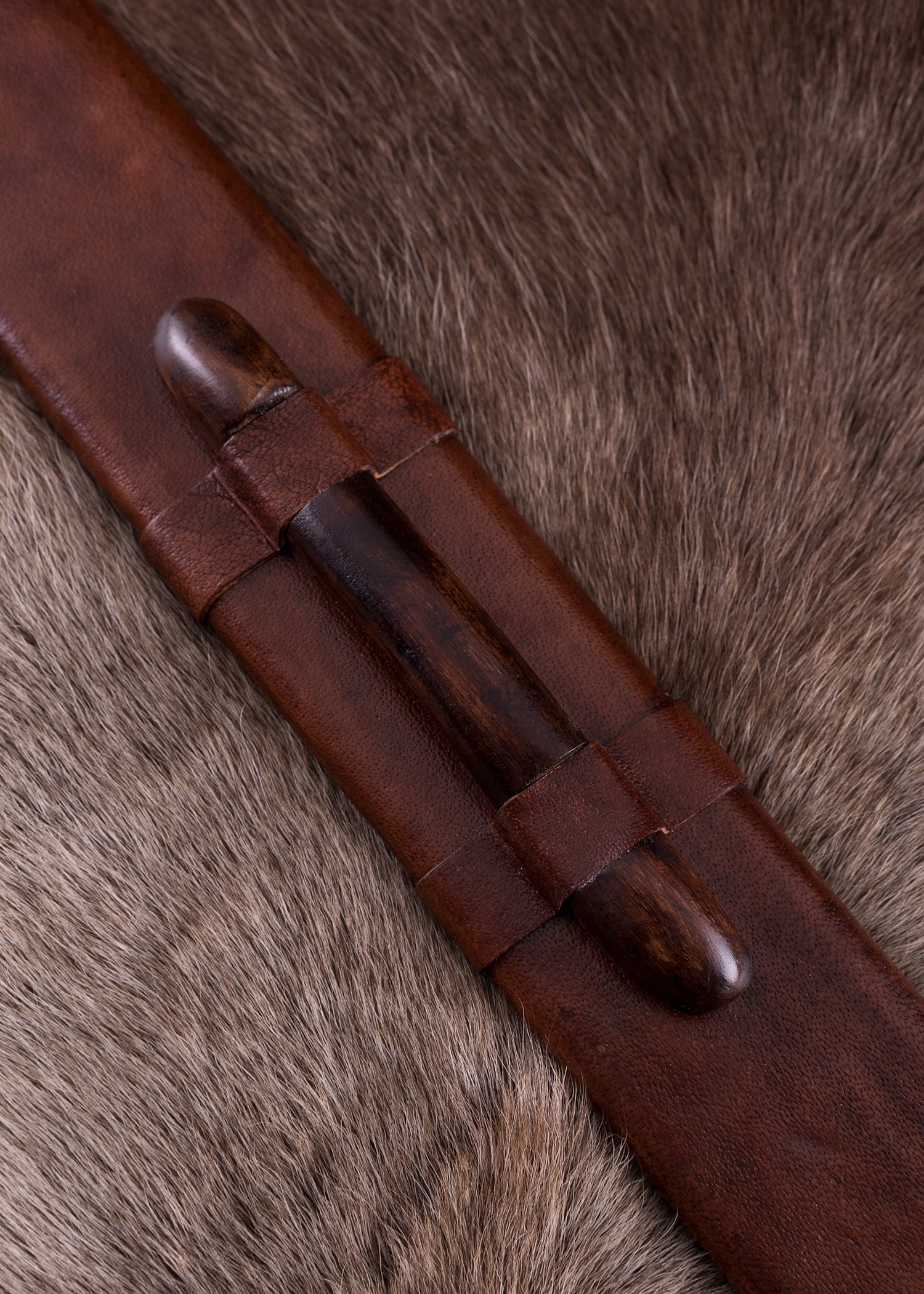
This one-handed sword from the Vendel period is delivered with a brown wood/leather scabbard with a wooden belt loop (maximum belt width of 5 cm) and an antique-finished brass chape and locket.
This sword is designed as a collector's item or decorative object and is also ideal as an accessory, for example, to complete your costume.
A regular version of the sword with an EN45 spring steel blade (item no. 0116041200) is also available in our shop.
Details:
- Material: Damascus steel blade (carbon steel, not stainless), brass guard and pommel, wooden handle with leather wrap
- Total length: approx. 89.5 cm
- Blade length: approx. 73 cm
- Blade thickness: approx. 4 mm (cutting edges approx. 1 mm)
- Handle length: approx. 16.5 cm (grip section approx. 11 cm)
- Maximum blade width: approx.
- Center of gravity: approx. 13 cm in front of the guard
- Incl. wooden scabbard with genuine leather cover and brass fittings
- Weight without scabbard: approx. 1.55 kg
- Weight with scabbard: approx. 1.9 kg
The above specifications may vary slightly from one specimen to another.
The steel used here is not stainless and may show slight signs of corrosion. We recommend caring for the blade and scabbard regularly, for example with Ballistol, a universal oil ideal for preserving steel products.
*The term Damascus steel, Damascus steel or simply Damascus refers to a composite steel made from two or more different types of steel. The name derives from the Syrian city of Damascus, which is considered an ancient stronghold and the origin of Damascus steel production. Typically, a hard high-carbon steel and a soft low-carbon steel are joined by repeated forge welding and folding. The high-carbon steel provides greater hardness, better hardenability, and higher edge retention, while the softer steel gives the blade greater elasticity and higher resistance to breakage. With this technology, which was developed in an era of poor and changing steel qualities, the positive properties of different steels can be combined. Due to the different colors with varying carbon contents, stunning patterns of alternating layers are created, such as the so-called twist Damascus or rose Damascus. Because of these patterns, Damascus swords from the Middle Ages were said to have inherent magic.
At Todo Medieval we have thousands of products from the medieval and other eras. Discover them!