





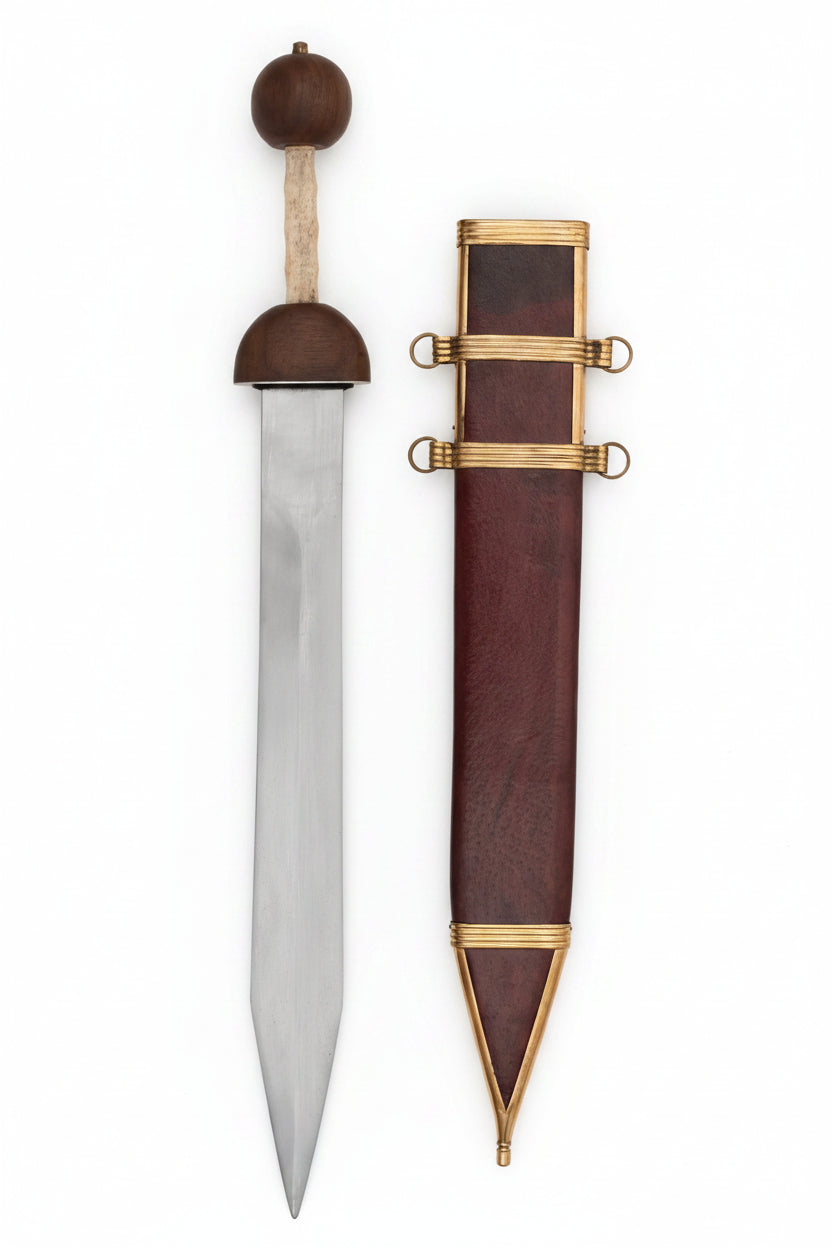


Gladius - The Sword That Conquered the Ancient World
The gladius was the standard-issue weapon of Roman legionaries for over five centuries, from the Republican era to the Late Empire. Short, robust, and lethal in hand-to-hand combat, the Roman sword was the instrument with which Rome forged its dominion over Europe, the Mediterranean, and the Near East. It was not just a weapon: it was the symbol of Roman discipline, power, and civilization. At Todo Medieval, you will find replicas of the main historical types of gladius, ranging from collector's and decorative pieces to functional versions for historical reenactment and HEMA.
Historical Context and Use of the Roman Gladius
The gladius evolved over the centuries, adapting to the tactical needs of the legions. With a blade between 45 and 68 cm, it was designed for combat in closed formation: the famous testudo and the shield wall made the gladius the perfect weapon for quick, precise thrusts. Each type reflects a different era, region of manufacture, and combat style, making the gladius one of the most studied and collected weapons in ancient military history.
Pompeii Type Gladius
The Pompeii type is the most recognizable and widespread gladius, used between the 1st and 3rd centuries AD. Its blade features parallel sides and a short, triangular tip, which made it ideal for direct thrusting. It owes its name to the specimens found in the excavations of Pompeii. Available in Category B versions for stage combat, Category C for light use, and versions with a scabbard from the Windlass brand.
Mainz Type Gladius
The Mainz type—also called after Mainz, the great legionary fortress on the Rhine—is the oldest of the imperial gladius types, used primarily in the 1st century AD. It is distinguished by its blade with a slight central constriction and a long, pronounced tip, perfect for both cutting and thrusting. Available in artisan replicas, Category B versions from the Cóndor brand, and collector's editions.
Fulham Type Gladius
The Fulham type represents the transition between the Mainz and the Pompeii, dating back to the 1st century AD. Its name comes from a specimen recovered from the River Thames in the London borough of Fulham, a testimony to the Roman presence in Britannia. It combines the long tip of the Mainz with a narrower and more stylized blade. Available in a Category B version for historical reenactment.
Xanten Type Gladius
The Xanten type—originating from the Roman city of Castra Vetera in present-day Germany—is the latest gladius, used in the 3rd century AD during the period of the Late Empire. Its blade is longer and narrower than previous types, anticipating the evolution toward the spatha. Available in a Category C version, ideal for display and collection.
Republican Delos Gladius
The Republican Delos type is the oldest in our selection, originating from the Roman Republican era (3rd–1st centuries BC). Found on the Greek island of Delos, it reflects the influence of the Hispanic sword—the gladius hispaniensis—which the Romans adopted after the Punic Wars. With a wide blade and a pronounced tip, it is a reference piece for collectors and historians. Available in a Category B version.
Roman Legionary Gladius
Under this heading, we group replicas of the generic 1st-century AD legionary gladius, faithful to the standard armament of the Roman legion in its heyday. These are versatile, historically documented pieces available in Category B and C versions, with and without scabbards, designed for historical reenactment as well as decoration and collection.
Your Gladius Awaits at Todo Medieval
From the legionary who marched along the Rhine to the gladiator who roared in the Colosseum, the gladius is the weapon that defined an era. At Todo Medieval, you will find the widest variety of Roman gladii: combat swords, decorative pieces with luxury finishes, collector's editions with scabbards and brass fittings, historical artisan replicas from museums and archaeological sites, carbon steel versions for reenactment and HEMA, and stainless steel models for durable display. Quality, historical rigor, and attention to detail that no other catalog can match. Choose your gladius. Feel the weight of Rome.
