





Medieval Store Blog General

Edad Media
The Hundred Years' War: causes, development, and consequences of a decisive conflict in medieval Europe
The Hundred Years' War was a long conflict that pitted the kingdoms of England and France against each other between 1337 and 1453.
Originating from dynastic, territorial, and economic disputes, th...
Political context of Europe in the 14th century
The so-called Hundred Years' War was one of the most prolonged confl...

Edad Media
The Battle of Covadonga: context, causes, and consequences
March 18, 722, is traditionally cited as the date of the Battle of Covadonga, a symbolic confrontation between local Asturian forces and Umayyad authorities.
Led by Don Pelayo, the resistance fight...
Historical background: the peninsula after the Muslim conquest
At the beginning of the 8th century, the Iberian Peni...

Edad Media
Medieval March: Decisive Episodes in Peninsular History
March was the scene of decisive episodes in medieval peninsular history.
From the exile of Rodrigo Díaz de Vivar to the Cortes of León and the death of Peter I of Castile, these events reflect dyna...
March 4, 1081 – The Exile of El Cid Campeador
Rodrigo Díaz de Vivar, known as El Cid Campeador, was exiled from Cas...

Edad Media
15th-century two-handed swords: power, design, and combat
Fifteenth-century two-handed swords represented a key evolution in European medieval weaponry.
Used by knights in full armor, they combined reach, power, and control in combat.
Their design, with l...
Two-handed swords were iconic weapons of the 15th century, used primarily by European knights wearing full plate arm...
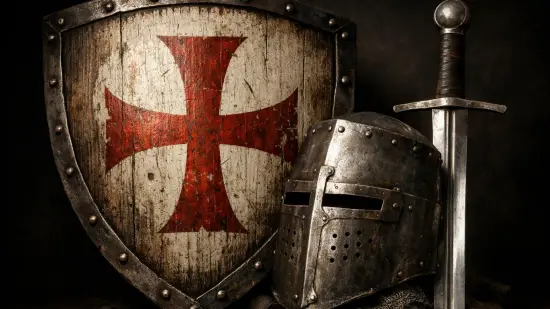
caballero
Dissolution of the Knights Templar: causes, context, and consequences
The dissolution of the Order of the Temple in 1312 was the result of political tensions, royal debts, and pressure on the papacy.
Founded in 1119 and having become a powerful military and financial...
Historical context of the Order of the Temple
The Order of the Temple was founded around 1119 in the Kingdom of Jeru...

Edad Media
Events in Medieval Europe during March: power, war, and cultural transformation
March was a key month in the history of medieval Europe. From the Viking siege of Paris in 845 to the imperial consolidation of Frederick I Barbarossa, through the crusading diplomacy of Frederick ...
845 - The Viking Siege of Paris
On March 28, 845 AD, a Viking fleet led by the chieftain Ragnar—identified in Frank...

armas
The rapier and the dagger: two essential Renaissance weapons
The rapier and the left-hand dagger established themselves as fundamental weapons of the European Renaissance, especially in Spain, Italy, and France.
Adapted to an urban context and the decline of...
During the end of the Middle Ages and, especially, throughout the Renaissance, the evolution of warfare and civil co...

curiosidades
History of Viking Civilization: Winter Expansion
Winter played a key role in Viking expansion, with winter campaigns in France, England, and Ireland.The Vikings established strategic bases, strengthened trade routes, and transformed local politic...
The winter period held significance in Viking civilization, marked by military incursions, trade, and strategic sett...

Cuchillos
The seax: the iconic knife of the Germanic and Viking world
The seax, also known as the sax, was an essential knife in the Germanic and Viking world between the 5th and 11th centuries.
Archaeologically documented in Scandinavia and the British Isles, it com...
The seax—also spelled sax—was one of the most characteristic knives of the Germanic and Scandinavian peoples between...
