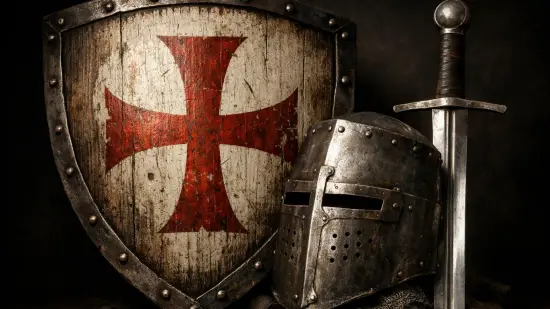
Two-handed swords were iconic weapons of the 15th century, used primarily by European knights wearing full plate armor.
Their design allowed for a combination of reach, strength, and protection in combat, establishing them as a key development in the evolution of medieval weaponry toward the Early Modern period.
These swords are also known as longswords or Zweihänder in the Germanic tradition, while in Spain they were commonly referred to as war swords, two-handed swords, or heavy combat swords.

Characteristics of two-handed swords
Swords of this type were distinguished by their long and pronounced blade, which frequently exceeded a meter in length.
This length offered the warrior the ability to maintain distance from the enemy, being especially useful against soldiers armed with spears, halberds, or longswords.
The crossguard, typically cross-shaped, could incorporate parrying rings designed to protect the hand, and eventually evolved into more complex guards during the Renaissance.
The long handle allowed them to be gripped with both hands, increasing the power of cuts and thrusts.
These handles were frequently covered with leather and, at times, steel wire to improve grip.
The tang, which extended to the pommel, ensured the solidity of the blade, allowing the weapon to withstand heavy blows without fracturing.
This combination of design and materials reflected the technological sophistication of 15th-century European forging.
The combat sword: lightness and elasticity
Despite their size, two-handed swords were surprisingly flexible and manageable.
The fuller or longitudinal groove along the blade increased elasticity without adding unnecessary weight, facilitating quick maneuvers in combat.
This made the weapon effective in both offensive and defensive attacks.
Knights trained in these weapons could use the full length of the sword, blocking blows and counterattacking with precision and force.

Use in combat and weaponry
These swords were employed in field battles, assaults on fortresses, and duels between nobles.
Their size and design made them especially effective against enemies in full plate armor, where cutting force and penetration capacity were fundamental.
Fencing treatises of the 15th and 16th centuries, such as those of Johannes Liechtenauer in Germany or those of the Swiss mercenaries, describe specific techniques for handling these swords, including thrusts, upward cuts, and high and low guard defenses.
Ceremonial function and symbolism
Beyond military use, some two-handed swords had ceremonial value.
They were a symbol of status and power among the chivalric nobility and were often decorated with engravings, geometric shapes on the guard, and ornate hilts.
These swords reflected the importance of the knight as a warrior, defender of the feudal order, and prominent member of Christian society.
Historical legacy
Two-handed swords left a significant legacy in the history of European weaponry.
Their development marked the transition between traditional medieval swords and lighter Renaissance rapiers and weapons.
Today, numerous examples are preserved in museums and archaeological collections, providing valuable information on combat techniques, forging processes, metallurgy, and the military culture of the 15th century.
Their study remains fundamental for historians, reenactors, and experts in historical fencing.
The legacy of these imposing weapons does not belong only to museums: it is now within the reach of those who feel the call of history, with high-quality replicas that reproduce every detail of the original design and convey the strength and presence of an authentic two-handed sword.