







Birka Long Sax, Viking Sax Knife, Damascus Steel
Sold outImporte estimado al añadir este producto. Sujeto al destino de entrega.
Este productos se enviará: 7-10 Day Shipping
Shipping and returns
Shipping Policy
DELIVERY TIMES
Our products are delivered through several shipping companies (Seur, Correos, Gls, Fedex or Nacex) using express home delivery. Delivery times range from 24 hours to several weeks depending on:
- Available stock.
- Product manufacturing (some products are made to order, which takes longer than usual)
- Product customization (Some products that are already manufactured or in stock can be customized, therefore increasing the shipping time)
- Workload (There are dates when the volume of orders exceeds our resources, such as Black Friday, although we usually reinforce our staff)
- Causes beyond the company's control (For shipments, we depend on companies such as Nacex, Correos, and others that may have their own complications; there are also customs issues, weather conditions, and other factors that are outside EYM's direct control)
European Union Orders
Todo Medieval reserves the right to deduct shipping costs and associated costs from the refund if:
-The customer has opened the package and the products show damage or wear from use, a proportional part or nothing will be refunded depending on the condition of the product(s).
The refund will not be issued until the order is received and its condition is checked.
International Orders
Todo Medieval, located in Spain, considers any country that is not a member of the European Union as international shipping.
The company is not responsible for the customs costs of each country; it is the customer's responsibility to find out about and resolve these costs generated at their borders. Todo Medieval reserves the right to deduct shipping costs and associated costs from the refund if:
-The customer refuses to pay the customs fees.
-The customer has opened the package and the products show damage or wear from use, a proportional part or nothing will be refunded depending on the condition of the product(s).
The refund will not be issued until the order is received and its condition is checked.
Warranty
RETURNS POLICY
We have an after-sales service to resolve any problem that arises during the shipping of our items or shipments, keeping our customers informed at all times.
If for any reason you are not satisfied with your order, you have a period of 14 calendar days, starting from the date of delivery of the order, to process your return by withdrawal.
The right of withdrawal will not apply to products handmade to order, products modified according to the specifications requested by the buyer or clearly personalized, except in case of defect or manufacturing error, the delivery time of products made to order or personalized may take longer than usual depending on the workload at that time
You can rescind the purchase contract you made in our online store by sending an email within the period indicated above.
You must send us the item or items by your own means. Shipments with Collect on Delivery will not be accepted.
If you wish to make a return you must download this document from Withdrawal, fill it out and send it to our offices located at C/ Santa Lucía 4b nave4, Oyon, Álava. CP:01320, or via email at [email protected]
The Customer is granted the right to withdraw from the order, within a period of 14 calendar days counted from its receipt. Outside of said period, revocations of orders will not be accepted, nor will they be accepted for orders for the supply of goods made to the Customer's specifications or clearly personalized, or that, by their nature, cannot be returned or may deteriorate or expire quickly, etc. that have been unsealed and/or used by the Customer. The Customer must communicate their withdrawal to THE ENTITY through the Withdrawal Form (Link to the Document) by email, postal mail, or fax, within that period of 14 days. The cost of return shipping will be borne by the Customer. The products must be in the same condition in which they were received, with the original packaging and must not have been used. The refund will be made using the same payment method that was used by the Customer.
Secure payment
At Todo Medieval, we comply with the strictest payment regulations in force.
We accept the following payment methods:
- Visa and MasterCard Credit/Debit Cards
- Bank Transfer (instructions at Checkout)
- Bizum
- SeQura
- Cash on Delivery (Mainland Iberian Peninsula Only; Spain and Portugal. Islands, Ceuta and Melilla are not included)
Choose options
Importe estimado al añadir este producto. Sujeto al destino de entrega.
Este productos se enviará: 7-10 Day Shipping
Shipping and returns
Shipping Policy
DELIVERY TIMES
Our products are delivered through several shipping companies (Seur, Correos, Gls, Fedex or Nacex) using express home delivery. Delivery times range from 24 hours to several weeks depending on:
- Available stock.
- Product manufacturing (some products are made to order, which takes longer than usual)
- Product customization (Some products that are already manufactured or in stock can be customized, therefore increasing the shipping time)
- Workload (There are dates when the volume of orders exceeds our resources, such as Black Friday, although we usually reinforce our staff)
- Causes beyond the company's control (For shipments, we depend on companies such as Nacex, Correos, and others that may have their own complications; there are also customs issues, weather conditions, and other factors that are outside EYM's direct control)
European Union Orders
Todo Medieval reserves the right to deduct shipping costs and associated costs from the refund if:
-The customer has opened the package and the products show damage or wear from use, a proportional part or nothing will be refunded depending on the condition of the product(s).
The refund will not be issued until the order is received and its condition is checked.
International Orders
Todo Medieval, located in Spain, considers any country that is not a member of the European Union as international shipping.
The company is not responsible for the customs costs of each country; it is the customer's responsibility to find out about and resolve these costs generated at their borders. Todo Medieval reserves the right to deduct shipping costs and associated costs from the refund if:
-The customer refuses to pay the customs fees.
-The customer has opened the package and the products show damage or wear from use, a proportional part or nothing will be refunded depending on the condition of the product(s).
The refund will not be issued until the order is received and its condition is checked.
Shipping and returns
Shipping Policy
DELIVERY TIMES
Our products are delivered through several shipping companies (Seur, Correos, Gls, Fedex or Nacex) using express home delivery. Delivery times range from 24 hours to several weeks depending on:
- Available stock.
- Product manufacturing (some products are made to order, which takes longer than usual)
- Product customization (Some products that are already manufactured or in stock can be customized, therefore increasing the shipping time)
- Workload (There are dates when the volume of orders exceeds our resources, such as Black Friday, although we usually reinforce our staff)
- Causes beyond the company's control (For shipments, we depend on companies such as Nacex, Correos, and others that may have their own complications; there are also customs issues, weather conditions, and other factors that are outside EYM's direct control)
European Union Orders
Todo Medieval reserves the right to deduct shipping costs and associated costs from the refund if:
-The customer has opened the package and the products show damage or wear from use, a proportional part or nothing will be refunded depending on the condition of the product(s).
The refund will not be issued until the order is received and its condition is checked.
International Orders
Todo Medieval, located in Spain, considers any country that is not a member of the European Union as international shipping.
The company is not responsible for the customs costs of each country; it is the customer's responsibility to find out about and resolve these costs generated at their borders. Todo Medieval reserves the right to deduct shipping costs and associated costs from the refund if:
-The customer refuses to pay the customs fees.
-The customer has opened the package and the products show damage or wear from use, a proportional part or nothing will be refunded depending on the condition of the product(s).
The refund will not be issued until the order is received and its condition is checked.
Warranty
RETURNS POLICY
We have an after-sales service to resolve any problem that arises during the shipping of our items or shipments, keeping our customers informed at all times.
If for any reason you are not satisfied with your order, you have a period of 14 calendar days, starting from the date of delivery of the order, to process your return by withdrawal.
The right of withdrawal will not apply to products handmade to order, products modified according to the specifications requested by the buyer or clearly personalized, except in case of defect or manufacturing error, the delivery time of products made to order or personalized may take longer than usual depending on the workload at that time
You can rescind the purchase contract you made in our online store by sending an email within the period indicated above.
You must send us the item or items by your own means. Shipments with Collect on Delivery will not be accepted.
If you wish to make a return you must download this document from Withdrawal, fill it out and send it to our offices located at C/ Santa Lucía 4b nave4, Oyon, Álava. CP:01320, or via email at [email protected]
The Customer is granted the right to withdraw from the order, within a period of 14 calendar days counted from its receipt. Outside of said period, revocations of orders will not be accepted, nor will they be accepted for orders for the supply of goods made to the Customer's specifications or clearly personalized, or that, by their nature, cannot be returned or may deteriorate or expire quickly, etc. that have been unsealed and/or used by the Customer. The Customer must communicate their withdrawal to THE ENTITY through the Withdrawal Form (Link to the Document) by email, postal mail, or fax, within that period of 14 days. The cost of return shipping will be borne by the Customer. The products must be in the same condition in which they were received, with the original packaging and must not have been used. The refund will be made using the same payment method that was used by the Customer.
Warranty
RETURNS POLICY
We have an after-sales service to resolve any problem that arises during the shipping of our items or shipments, keeping our customers informed at all times.
If for any reason you are not satisfied with your order, you have a period of 14 calendar days, starting from the date of delivery of the order, to process your return by withdrawal.
The right of withdrawal will not apply to products handmade to order, products modified according to the specifications requested by the buyer or clearly personalized, except in case of defect or manufacturing error, the delivery time of products made to order or personalized may take longer than usual depending on the workload at that time
You can rescind the purchase contract you made in our online store by sending an email within the period indicated above.
You must send us the item or items by your own means. Shipments with Collect on Delivery will not be accepted.
If you wish to make a return you must download this document from Withdrawal, fill it out and send it to our offices located at C/ Santa Lucía 4b nave4, Oyon, Álava. CP:01320, or via email at [email protected]
The Customer is granted the right to withdraw from the order, within a period of 14 calendar days counted from its receipt. Outside of said period, revocations of orders will not be accepted, nor will they be accepted for orders for the supply of goods made to the Customer's specifications or clearly personalized, or that, by their nature, cannot be returned or may deteriorate or expire quickly, etc. that have been unsealed and/or used by the Customer. The Customer must communicate their withdrawal to THE ENTITY through the Withdrawal Form (Link to the Document) by email, postal mail, or fax, within that period of 14 days. The cost of return shipping will be borne by the Customer. The products must be in the same condition in which they were received, with the original packaging and must not have been used. The refund will be made using the same payment method that was used by the Customer.
Secure payment
At Todo Medieval, we comply with the strictest payment regulations in force.
We accept the following payment methods:
- Visa and MasterCard Credit/Debit Cards
- Bank Transfer (instructions at Checkout)
- Bizum
- SeQura
- Cash on Delivery (Mainland Iberian Peninsula Only; Spain and Portugal. Islands, Ceuta and Melilla are not included)
Secure payment
At Todo Medieval, we comply with the strictest payment regulations in force.
We accept the following payment methods:
- Visa and MasterCard Credit/Debit Cards
- Bank Transfer (instructions at Checkout)
- Bizum
- SeQura
- Cash on Delivery (Mainland Iberian Peninsula Only; Spain and Portugal. Islands, Ceuta and Melilla are not included)
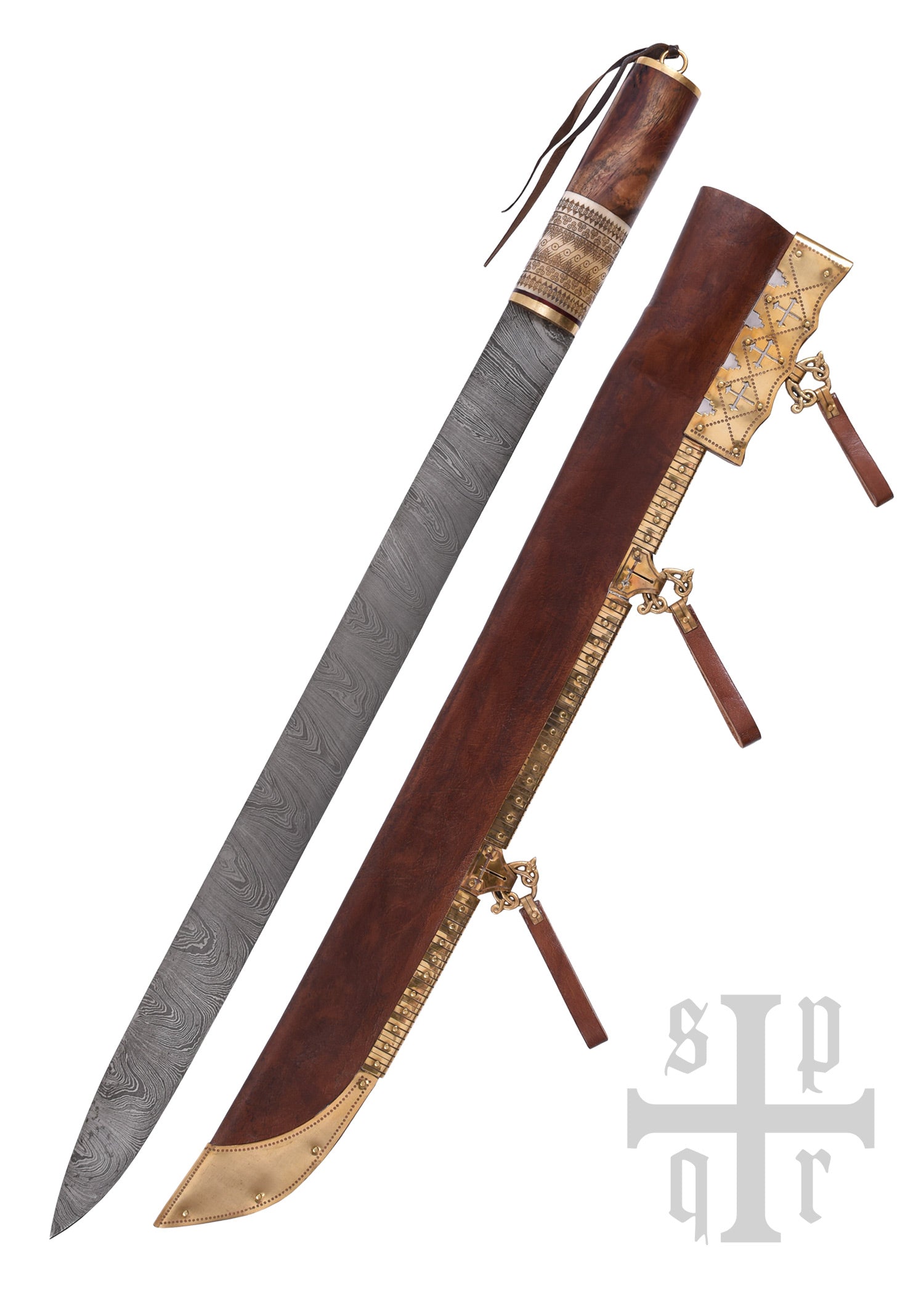
Birka Long Seax, Viking Seax Knife, Damascus Steel
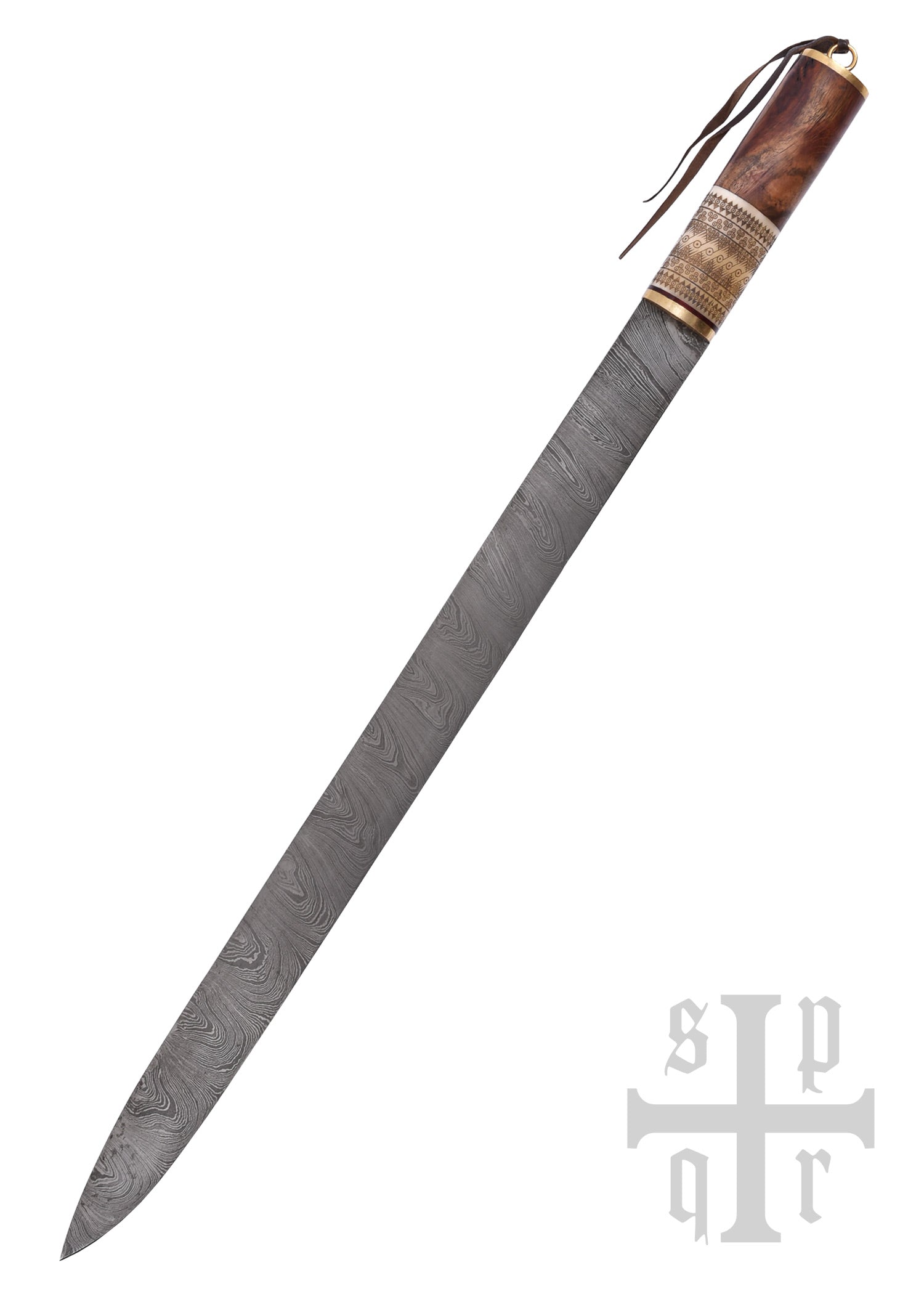
Long Seax crafted in Birka, Viking Seax knife with Damascus blade and wood/bone handle
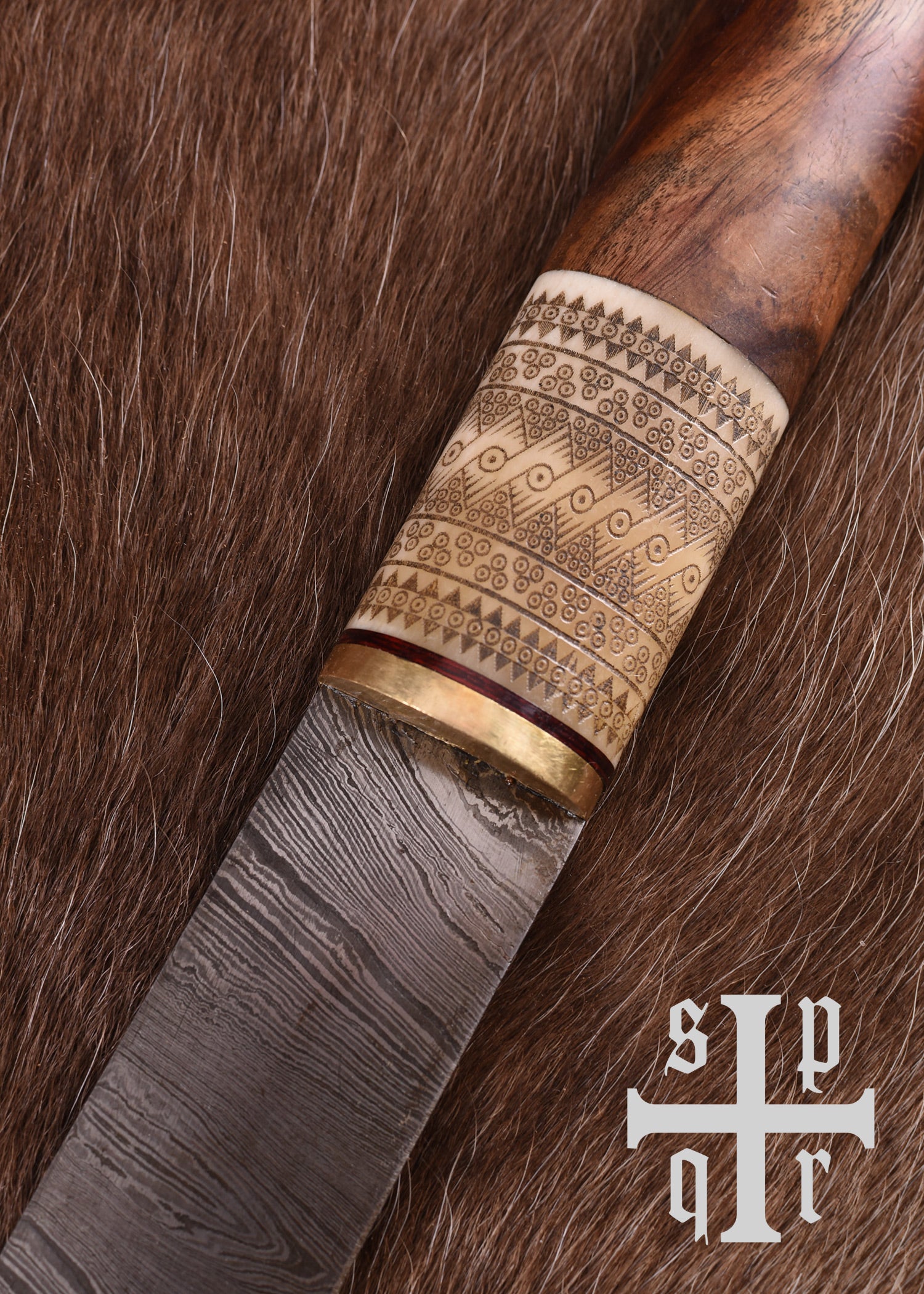
This Viking Age knife with a sharp blade made of 256-layer Damascus steel* is based on finds from Björkö/Birka (Grave 944), Sweden. The wood and bone handle has an oval cross-section and thus fits firmly in the hand. The brass pommel is equipped with a practical lanyard hole (leather strap included). The bone handle is adorned with elaborate and elegant details. Since this scramasax is entirely handmade, these decorations may vary slightly from one specimen to another. Please also note that bone is a natural product and variations in color and/or grain are quite common. Therefore, no two handles of this Birka Seax are the same and the images above are for illustrative purposes only.
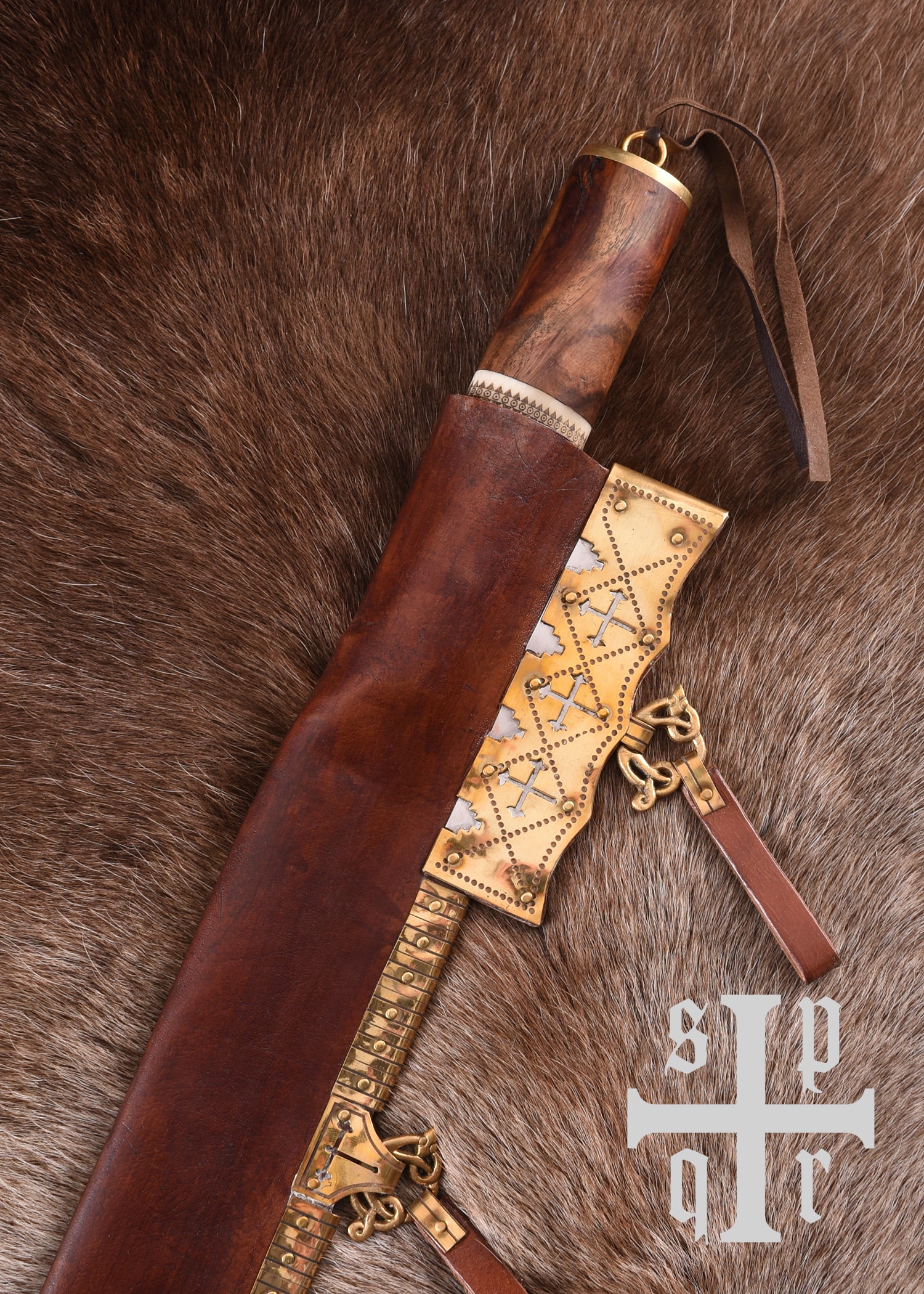
The beautiful sheath is made of vegetable-tanned, hand-dyed leather and decorated with elegant brass fittings. Thanks to three leather loops attached to brass rings, the knife can be worn horizontally on the belt in the typical Viking style. The original Birka finds also served as a model for the stylized details of the sheath.
*The term Damascus steel refers to a composite steel made from two or more different types of steel. The name derives from the Syrian city of Damascus, which is considered a former stronghold and the origin of Damascus steel production. Typically, a hard high-carbon steel and a soft low-carbon steel are joined by repeated forge welding and folding. The high-carbon steel provides greater hardness, better temperability, and greater edge retention, while the softer steel gives the blade greater elasticity and resistance to breakage. With this technology, which was developed in a time of poor and changing steel qualities, the positive properties of different steels can be combined. Due to the different colors with varying carbon contents, impressive patterns of alternating layers are created, such as the so-called twist Damascus or rose Damascus. Because of these patterns, Damascus swords of the Middle Ages were said to have inherent magic.
Details:
- Blade material: Damascus steel (4340 and 1070 steel, 256 layers), sharp edge
- Also available in a standard version with a carbon steel blade (item no. 0364002551)
- Handle material: wood, animal bone, brass
- Overall length: approx. 60 cm
- Blade length: approx. 47 cm
- Weight: approx. 500 g (approx. 820 g with sheath)
- Vegetable-tanned leather sheath with brass fittings and carrying loops
The above specifications may vary slightly from copy to copy.
The steel used here is not stainless and may show slight signs of corrosion. We recommend maintaining the blade regularly, for example with Ballistol, a universal oil ideal for preserving steel products.
At Todo Medieval we have thousands of medieval and historical products. Discover them!
