





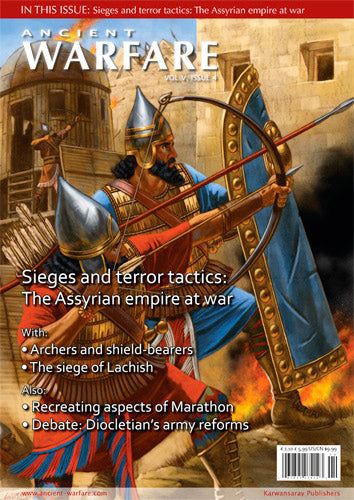
Ancient Warfare Review Vol V - 4 - Sieges and Terror Tactics
Sold outEste productos se enviará: Shipping 7-10 Days
Choose options
Este productos se enviará: Shipping 7-10 Days
Este productos se enviará: Shipping 7-10 Days
Gift Ancient Warfare Magazine Vol V - 4 - Sieges and Terror Tactics
Ancient warfare v.4, 2011
Theme: sieges and terrorist tactics: the Assyrian empire at war
Introduction: Mark Schwartz, 'Introduction to the theme'.
In the realm of warfare, the Assyrians were unrivaled in innovations, new weapons, and institutional organization. Their military exploits were engraved in stone reliefs that once adorned the legendary palaces of Nineveh, Khorsabad, and Nimrud. Archaeologists and historians can turn to inscriptions, chronicles, and correspondence between Assyrian kings and their vassals to reconstruct the history of the empire.
The source: Edwin Clifford-Coupe, 'The Pazarcik Stele - solving a border dispute'
During the construction of the Pazarcik dam in southern Turkey, an Assyrian stone stele was unearthed. It narrates the resolution of a border dispute between two Iron Age Anatolian kingdoms, arbitrated by two Assyrian kings between 805 and 775 BC. It was inscribed at two different times on the obverse and reverse in Akkadian cuneiform, the script and language of the great civilizations of Mesopotamia.
Theme: Nicholas Sekunda, 'Assyrian infantry tactics: shield-bearer and archer pairs'.
Historical evidence about the Assyrian army can be drawn from various sources. Clay tablets written in cuneiform script are generally, though not exclusively, administrative documents. They can shed light on aspects of how the Assyrian army was equipped, organized, and administered. The annals that list the achievements of various Assyrian monarchs and other historical documents can also be of great relevance, as they give us "an overview". They detail the way campaigns were fought, but are useful above all for
Their information on the strategic and operational functioning of the army.
Theme: Paul McDonnell-Staff, 'Assyrian siege machinery - breaking defenses'
The rapid rise of the last of the Assyrian empires (the Neo-Assyrian Empire, which lasted approximately between 911 and 612 BC) seems to have been greatly aided by the development of advanced siege engines. What little we know about them comes from archaeology and, more importantly, from the iconography of various palace friezes. In the latter, the Neo-Assyrian kings proudly recorded the successes of this "new technology" in their palaces in Nineveh and Nimrud.
Theme: Gareth Williams, 'Assyrian propaganda and the siege of Jerusalem - 'like a bird in a cage''. Illustrated by Johnny Shumate.
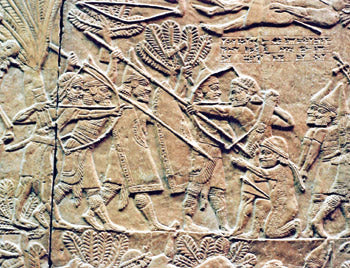
A walk through room 10 of the British Museum might seem, at first glance, to confirm the generally accepted impression about the Assyrians. The bas-reliefs from the walls of Sennacherib's palace in Nineveh are on display, depicting, in all their bloody detail, the siege and fall of the Jewish city of Lachish in 701 BC. People are depicted skinned alive, impaled captives displayed in front of the city walls; others plead for mercy before the enthroned figure of Sennacherib, while the most unfortunate are put to the sword. These reliefs reinforce the received reputation of the Assyrians, who are often portrayed as a martial and bloodthirsty society, glorying in combat while enjoying the savage destruction of their enemies.
Theme: Cliff Churgin, 'The siege of Lachish, 701 BC - taming the Judean rebels'. Illustrated by Jason Askew
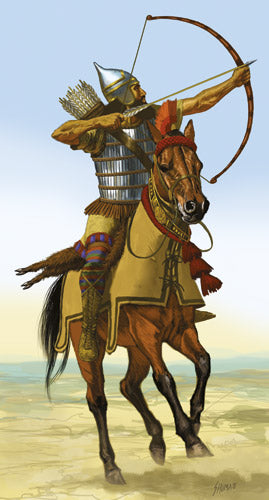
Assyrian cavalry in 701 BC, the Assyrian army launched a punitive campaign against the small kingdom of Judah, ruled by King Hezekiah. This campaign was one of many launched by the Assyrians and would be unremarkable except for the fascinating confluence of biblical texts and archaeology that have made this campaign an important case study on Assyrian methods of warfare and a surprising glimpse of the Bible as history.
Theme: Tyler Hewell, 'Battle tactics of the Neo-Assyrian army: an empire forged in blood', illustrated by Johnny Shumate.
Assyria possessed one of the most warlike cultures in the ancient Near East. This brutal culture was heavily influenced by the constant bloodshed that followed the founding of its first cities, such as Nineveh and Ashur. As Assyria became an empire, the defensive stance reduced by the constant attacks of its neighbors soon transformed into a need for offensive action. To undertake the massive campaigns that eventually extended the borders of the empire from the Mediterranean to the Persian Gulf, the Assyrians formed the first truly professional army in history.
Features
The Toledo helmet, the find: Murray Dahm, 'The Roman helmet from Toledo - the ring of truth'.
The Toledo Museum of Art in Ohio houses a fascinating (and divisive) silvered Roman helmet. The helmet is fascinating (and apparently unique) because of the material from which it is made and its circular crest is of a type not known to have survived, but which is shown in several artistic representations; divisive because many consider the helmet to be a forgery.
Special: Christopher Matthew, 'Using reenactment to understand the Battle of Marathon: testing Herodotus'.
The Battle of Marathon, fought in 490 BC, is one of those iconic events around which a major legend has emerged and which seems to mark the pages of history. The battle was the first major clash between the forces of the powerful Persian Empire in the East and the small, semi-independent Greek city-states in the West. It would produce repercussions that would influence the course of history for centuries to come.
The debate: Duncan B. Campbell, 'Did Diocletian overhaul the Roman army? - Restorer of the world'. Illustrated by Ángel García Pinto.
It is usually difficult to identify the watershed that marks the disappearance of an old system and the birth of a new one, but the year 284 AD is an iconic example. In that year, the rise of Diocletian marked the beginning of a new style of Roman government in which the emperor's official title, hitherto *princeps* (first citizen) or, more formally, *imperator caesar* (commander caesar), became *dominus noster* (our master). Along with this change in attitude, scholars have tried to identify changes in policy, and it is common to attribute the beginnings of a new style of Roman army to the reforming zeal of Diocletian. But was he really a reformer or did he simply strive to restore a broken system? Was he really an innovator or did he simply carry the old system to its logical conclusion?
At Todo Medieval we have thousands of medieval and other period products. Discover them!
Free shipping
The entire Iberian Peninsula from €60 (*Does not include islands) and worldwide shipping check our rates
Customer service
We are available from Monday to Friday to answer your questions.
Secure Payment
We comply with all regulations to ensure Secure Payment
Contact us
Need to contact us? Simply send us an email at [email protected]
