Imagen única de: Revista De Guerra Antigua Vol Iv -5 - Luchando Por Los Dioses

Ancient War Journal Vol IV -5 - Fighting For The Gods

Sale price€11,94 EUR
Only 3 units left

Este productos se enviará: 7-10 Day Shipping

Shipping and returns

Shipping Policy

DELIVERY TIMES

Our products are delivered via various courier agencies (Seur, Correos, Gls, Fedex, or Nacex) using express home delivery. Delivery times range from 24 hours to several weeks depending on:

  • Available stock.
  • Product manufacturing (some products are made to order, which entails a longer time than usual).
  • Product customization (There are products, whether manufactured or in stock, that can be customized, which may increase shipping time).
  • Workload (We have dates when order volume exceeds our resources, such as Black Friday, although we usually bolster our staff).
  • Reasons beyond the company's control (For shipments, we rely on companies like Nacex, Correos, and others that may have their own complications; there are also customs issues, weather-related causes, and other factors outside EYM's direct control).


European Union Orders

Todo Medieval reserves the right to deduct shipping and associated costs from the refund if:
-The customer has opened the package and the products show signs of damage or wear from use; a proportional amount or nothing will be refunded, depending on the condition of the product(s).


Refunds will not be issued until the order is received and its condition is verified.


International Orders

Todo Medieval, located in Spain, considers any country that is not a member of the European Union to be an international shipment.

The company is not responsible for the customs duties of each country; it is the customer's responsibility to investigate and settle these costs generated at their borders. Todo Medieval reserves the right to deduct shipping and associated costs from the refund if:

-The customer refuses to pay customs duties.

-The customer has opened the package and the products show signs of damage or wear from use; a proportional amount or nothing will be refunded, depending on the condition of the product(s).


Refunds will not be issued until the order is received and its condition is verified.

Warranty

RETURN POLICY

We provide an after-sales service to resolve any issues that may arise during the shipping of our items, keeping our customers informed at all times.

If for any reason you are not satisfied with your order, you have a period of 14 calendar days, starting from the date of delivery of the order, to process your return due to withdrawal.

The right of withdrawal will not apply to products made by hand to order, products modified according to specifications requested by the buyer, or those clearly personalized, except in the case of a defect or manufacturing error. The delivery time for products made to order or personalized may take longer than usual depending on the current workload.

You may terminate the purchase contract made in our online store by sending an email within the aforementioned period.

You must send the item or items back to us by your own means. Shipments sent "carriage forward" (cash on delivery for shipping) will not be accepted.

If you wish to make a return, you must download this Withdrawal Form, fill it out, and send it to our offices located at C/ Santa Lucía 4b nave 4, Oyon, Álava. Postal Code: 01320, or via email to [email protected]

The Customer is granted the right to withdraw from the order within 14 calendar days from the receipt thereof. Outside of this period, cancellations of orders will not be accepted, nor will they be accepted for orders involving the supply of goods made according to the Customer's specifications or clearly personalized, or which, by their nature, cannot be returned or may deteriorate or expire rapidly, etc., that have been unsealed and/or used by the Customer. The Customer must communicate their withdrawal to THE ENTITY via the Withdrawal Form (Link to Document) by email, postal mail, or fax, within that 14-day period. The cost of return shipping shall be borne by the Customer. Products must be in the same condition in which they were received, with the original packaging, and cannot have been used. The refund will be made using the same payment method used by the Customer.

Secure payment

At Todo Medieval, we comply with the strictest current payment regulations.
We accept the following payment methods:

  • Visa and MasterCard Credit/Debit cards
  • Bank Transfer (instructions at Checkout)
  • Bizum
  • SeQura
  • Cash on Delivery (Iberian Peninsula only; Spain and Portugal. Islands, Ceuta, and Melilla are excluded)

Enjoy Ancient Warfare Magazine Vol IV-5 - Fighting for the Gods


Ancient Warfare IV.5, Oct/Nov 2010


Released on October 25th.


Theme: Fighting for the gods - war and religion


Introduction: P. Lindsay Powell, 'Introduction to the theme'

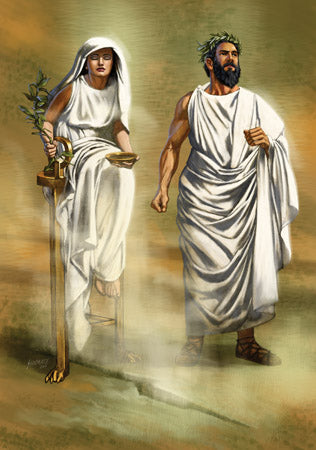
For the Greeks and Romans of the Archaic and Classical periods, wars were often fought when oaths and treaties, sacred because they were witnessed by the gods, were broken. They believed that who would win was a matter for the gods to decide. Before battle began, city-states, soldiers, and their senior officers actively sought the gods' favor to improve their odds of final victory, or at least survival. Studying how Greeks and Romans understood the relationship between gods and men provides vital insight into the mentality of the ancient warrior.


The Source: Paul Elliott, 'Inside a Mithraeum. Secrets of a military cult'

There is a large mound by the road along Hadrian’s Wall called Carrawburgh (pronounced 'kara-bura'), the Roman fort of Brocolitia, with an excavated stone temple dedicated to the god Mithras behind it. It is easy to miss, but it is a crucial part of the story of daily life on Hadrian’s Wall. The followers of Mithras formed a mystery cult, a secret society that was popular with some of the soldiers along Hadrian’s Wall. What was found at Carrawburgh gives us a rare glimpse into the workings of this military cult.


The Oracle of Delphi - artwork by Johnny Shumate Theme: Owen Rees, 'Sparta refuses to fight - Pious inaction during the Persian invasions'


There are many ways to tell a story. History has enjoyed telling the story of the great eastern oppressors of the 5th century who invaded the small but free Greek states, culminating in a David and Goliath-style victory of democracy over autocracy. The great victories at Marathon and Plataea, combined with the heroic resistance of Leonidas' 300 (ignoring the more than 2,000 Greeks who were present), have given rise to a popular, moral story of freedom versus control, good versus evil; of people standing up for what they consider right and fair. But there is a different story to tell. A story of cultural restraint, of political disputes, and of piety that resists the practical: this is the story of Sparta, no longer standing behind its mirage.


Theme: Corrado Re, 'Consular suicide - The practical aspects of devotio'

For the Romans, as for most ancient peoples, victory was as much a matter of divine favor as of military valor. They had various rites associated with war, most of which dated back to their earliest history. One of the most striking practices was the act of *devotio*. According to Livy and Cicero, it was enacted three times between the 4th and 3rd centuries BC. Each time, the actor was a consul named Publius Decius Mus: father, son, and grandson. This was likely an expression of the private religion and tradition of the *gens* (family). The first recorded *devotio* was performed at the Battle of Vesuvius, against a Latin army; the second at Sentinum, in the 'Battle of the Nations', against a coalition of Italic and Gallic peoples; and the final *devotio* took place at Asculum against Pyrrhus. We know the narrative, but what happened at such events?


Theme: Christopher Lilley, 'Epona in Roman service - Military worship of a horse goddess'

It is generally assumed that the goddess Epona is a Gallic deity from before the conquest whose cult was later spread beyond Gaul by local cavalry in Roman service. However, no inscriptions of Epona are known in the Gallic *alae* and *cohortes equitatae*. A connection with the *equites singulares augusti*, particularly under Hadrian, helps to solve this mystery.


Theme: Mark Woolmer, 'In the name of Ahuramazda - Darius' war against the Elamites and Scythians'

In September 522 BC, Darius I, along with six accomplices, took control of the Persian throne. Darius I, also known as Darius the Great, was the third great king of the Persian Empire who ruled at the peak of its power and influence. However, his seizure of power was met with rebellions throughout the empire that forced Darius to innovate in terms of his political, economic, religious, and military policies. Therefore, he reorganized the empire by dividing it into provinces and placing satraps (regional governors) to oversee them, introduced a new monetary system, made Aramaic the official language of the empire, and initiated a series of construction projects. To combat the insurrection, he used religion...


Theme: Alberto Pérez, 'Off with their heads! Headhunting and scalping in antiquity' Cast of a monument with severed heads found in Entremont


The beheading of fallen enemies was a common practice after battle in many cultures, from the moment men guessed or imagined a separation between body and soul, between the animated life whose seat is the former and the spiritual dimension of that life which embodies the latter. Peoples as diverse as the Assyrians and the Romans indulged in it, although of course the meaning of this act was not the same in every case. It is not easy to cut off a human head. In fact, it is very difficult to achieve it in combat with a single stroke of a sword,
Despite what Hollywood might show, it was usually done *post mortem*. Why bother with such a tedious action once your enemy is already dead?


Theme: Jona Lendering, 'Alexander the Invincible God - Uniting a diverse army through deification'

Although Alexander the Great was not the first human being to receive divine honors, his self-deification set an example for Hellenistic kings, Roman emperors, and other rulers. However, this would not have been the case if Alexander's self-deification had not been entirely rational and if it had not offered advantages that no ancient ruler could afford the luxury of ignoring.


Theme: Sidney Dean, 'The Frankish Constantine - The conversion of Clovis at Tolbiac'


Clovis I is known as the Frankish Constantine. Like the Eastern Roman emperor, this pagan Germanic king claimed victory in battle after swearing allegiance to the Christian deity. But the impact of Clovis' religious conversion went far beyond the battlefield of Tolbiac in 496 AD. His choice paved the way for Frankish domination over Europe and influenced the course of world history.


The Weapon: Paul McDonnell-Staff, 'The sign of Constantine’s vision: Religion and the Late Roman shield'

Of course, religion has always played an important role in war. As the modern saying goes: there are no atheists in a foxhole. From time immemorial, a man about to risk his life on a battlefield invokes the help of his gods. A particular and famous example of this occurred in 312 AD, just before the Battle of the Milvian Bridge, outside Rome, when Constantine, having been "raised to the purple" by his father's troops in York, faced Emperor Maxentius to decide who would rule the Western Empire.


Features

The latest evidence of the IX Hispana in Great Britain - artwork by Andrew Brozyna The Debate: Duncan B. Campbell,

'The fate of the Ninth. The curious disappearance of the Legio IX Hispana'


In 1954, Rosemary Sutcliff published a novel about Roman Britain. It captured the imagination of a whole generation of readers with its story of the Ninth Legion, destroyed in the mists of Scotland. A BBC dramatization captivated a new generation in 1977. And now a new film is set to rekindle interest in the story of the lost legion. But was it really destroyed in Britain during the reign of Hadrian? Or have we fallen for a myth that should have been dispelled fifty years ago?
At Todo Medieval we have thousands of medieval and other historical products. Discover them!

Shipping and returns

Add text about your shipping policy

Shipping and returns

Add text about your shipping policy

Warranty

Add text about your product warranty

Warranty

Add text about your product warranty

Secure payment

Add text about your payment

Secure payment

Add text about your payment

Free shipping

The entire Iberian Peninsula from €60 (*Does not include islands) and worldwide shipping check our rates

Customer service

We are available from Monday to Friday to answer your questions.

Secure Payment

We comply with all regulations to ensure Secure Payment

Contact us

Need to contact us? Simply send us an email at [email protected]