






Ancient War Magazine Vol. IV -2 - Blockade and Assault
Sold outEste productos se enviará: 7-10 Day Shipping
Choose options
Este productos se enviará: 7-10 Day Shipping
Este productos se enviará: 7-10 Day Shipping
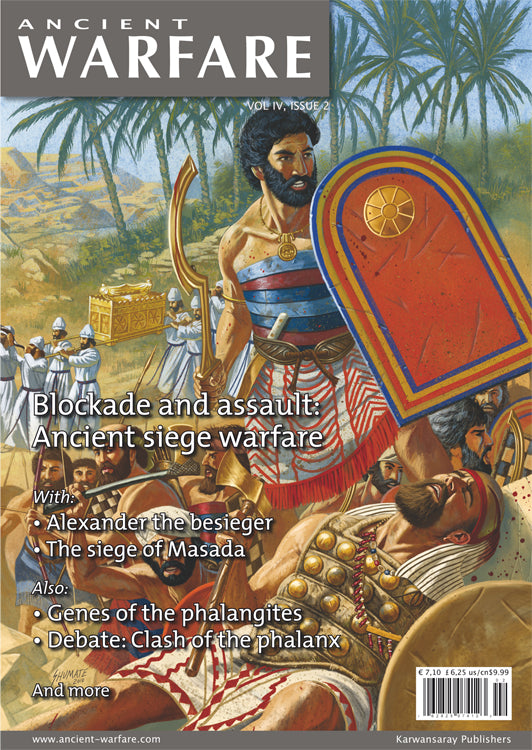
Enjoy Ancient Warfare Magazine Vol IV -2 - Blockade and Assault
Ancient Warfare IV.2, April/May 2010
Theme: blockade and assault - ancient siege warfare.
Introduction: Ross Cowan, 'Introduction to the theme'.
The siege was fundamental to the Greek and Roman art of war. The popular imagination may be dominated by images of epic battles in the field involving clashing phalanxes and dramatic cavalry charges, but victory in the field rarely results in a won war, and strategically located fortifications, which provide shelter to large communities and dominate lines of communication and trade routes, were often the main focal points of conflict. One side would retreat to their strongholds and challenge their enemies to waste their lives, finances, materials, and other resources attacking the walls.
The Source: Sean Hussmann, 'Eyewitness reports: Thucydides on the siege'. As a naval superpower in an era of triremes that had to be beached every night, Athens depended on the control of safe ports and anchorages throughout the Aegean. It was not just a purely military matter; Athens obtained most of its grain supply by sea, from the fertile lands surrounding the Black Sea. Therefore, protecting the maritime routes to the Dardanelles was a vital cornerstone in the foundation of its empire. If these routes had been interrupted by a rival power, the consequences for the Athenian population would have been deadly. In the winter of 424/423 BC, an Athenian strategos (general) named Thucydides was assigned the task of protecting the coastal region of Thrace against such threats.
Theme: Richard Evers, 'A wall of men, rather than bricks, is better. Success and failure in Spartan siege warfare.'
The Spartans are not famous for their fortifications or siege techniques. It is said that Sparta even refused to build a wall around the city when it adopted the precepts of Lycurgus. During the Peloponnesian War, the Spartans seem to have wandered around Attica aimlessly, not daring to attack the Long Walls of Athens. But there are some notable developments that show that Sparta had walls surrounding its city and engaged in siege warfare with considerable success.
Theme: Joseph Pietrykowski, 'With winged soldiers. Six victories of Alexander the Great.' Illustrated by Johnny Shumate.
Although best known as a battlefield commander of unmatched genius, Alexander the Great was also one of the most prolific and successful besiegers of antiquity. During the course of his eleven-year career of conquest, countless walled cities and fortresses from Greece to India and from Afghanistan to Egypt fell to his world-class siege train. In fact, Alexander was so extraordinarily successful at taking city after city that it was often said that no fortification could resist him.
Theme: Duncan B. Campbell, 'Capturing a desert fortress. Flavius Silva and the siege of Masada.' Illustrated by Igor Dzis and Andrew Brozyna
It is not often that the three disciplines of archaeology, ancient history, and epigraphy come together to shed light on a particular event. But this is precisely what happens in the case of Masada. The desert fortress built by Herod the Great is still surrounded by the remains of the Roman siege works built at the end of Rome's First Jewish War. And, while Josephus provides the historical narrative, a detailed inscription of a military career brings Masada's Roman captor to life.
Theme: Paul McDonnell-Staff, 'A war of logistics. The siege of Jerusalem, 66 AD.' Illustrated by Carlos de la Rocha
The campaign for Jerusalem in 66 AD was the worst defeat Rome had suffered since the Teutoburg Forest. How did this disaster come to Roman arms? Roman armies had a well-earned reputation for invincibility and Cestius Gallus was no fool. The answer lies in logistics, for that is where Gallus's real problems resided. Emperor Nero told the Roman people that the disaster had been caused by failed generalship, rather than Jewish valor, and in this he was undoubtedly correct. To see how this happened, we must examine the main factors that affected the campaign.
Reports
Special: Stephan Berry, 'Genes of the phalangites. Bioarchaeology and the ancient battlefield, part 2.' Illustrated by Andrew Brozyna
The mules of Varus's army died at exactly the right time, perhaps not from Varus's own point of view, but certainly from the point of view of modern archaeology. From a sophisticated chemical analysis of the animals' tooth enamel, zooarchaeologists have been able to date their deaths to late summer, fitting perfectly into the established date of 9 September AD for the Varian disaster in the Teutoburg Forest.
The Debate: Murray Dahm, 'The debate: 'the push' or not 'the push'.'
Illustrated by Andrew Brozyna
The term othismos (literally 'pushing' or 'shove' although there are countless
Other meanings) is generally considered to typify classical hoplite combat when two lines of hoplites faced each other in battle. It is commonly compared to a giant rugby football scrum. However, the debate continues over whether this othismos was real or metaphorical, literal or figurative, and scholars are basically divided
Into these two camps. And, although not as scathing as some academic debates, it has been expressed in the quasi-religious terminology of orthodoxy and heresy. The debate is like an othismos itself, in which each argument pushes and probes the other, some arguments push the other from the back, forcing them to give ground while others have to yield ground.
At Todo Medieval we have thousands of medieval and other era products. Discover them!
Free shipping
The entire Iberian Peninsula from €60 (*Does not include islands) and worldwide shipping check our rates
Customer service
We are available from Monday to Friday to answer your questions.
Secure Payment
We comply with all regulations to ensure Secure Payment
Contact us
Need to contact us? Simply send us an email at [email protected]
