





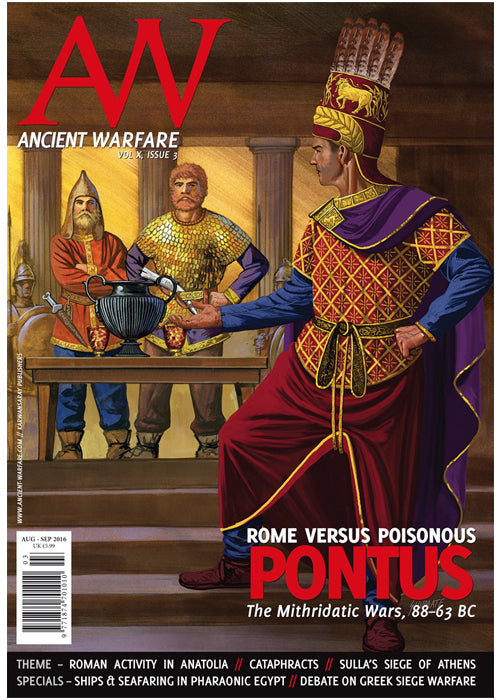
Ancient Warfare Magazine Vol X.3 - The Mithridatic Wars
Sold outEste productos se enviará: 7-10 Day Shipping
Choose options
Este productos se enviará: 7-10 Day Shipping
Este productos se enviará: 7-10 Day Shipping
Gift Ancient Warfare Magazine Vol X.3 - The Mithridatic Wars
The ancient war of the Roman Republic against a defiant Greco-Persian ruler of a small but wealthy kingdom on the Black Sea involved some of the largest armies and bloodiest battles of classical antiquity.
The source: michael j. taylor, imperial greeks on the mithridatic wars - ancient voices
In the city of Chaeronea, there was a statue of the Roman general Lucius Licinius Lucullus. The reason a Boeotian village would honor a Roman general was as follows: during the Mithridatic Wars, the commander of the Roman garrison occupying Chaeronea made sexual advances to a local youth, who in turn murdered the officer and fled to the hills.
Topic: cristian violatti, romans in anatolia before the wars - divide and conquer
In the early 1st century BC, Pontus became stronger and more confident in the face of Roman interference in Anatolia. Tension rose to the point where open confrontation became inevitable. But what were the Romans doing in Anatolia during the years leading up to the outbreak of the Mithridatic Wars?
Topic: nicolas rostaing, pontic imitation legions used by mithridates - lost pontic legions
Mithridates of Pontus made use of a variety of different troops in his armies, of which perhaps the most notable were the so-called imitation legionaries, inspired by the Roman infantry. These troops are mentioned by a small handful of ancient writers.
Topic: sidney e. dean, heavy cavalry of the mithridatic wars - cataphracts
Cavalry was an important part of the Pontic army, with the heavy cataphract cavalry being considered especially important. The Pontic ruler Mithridates VI had so many cataphracts that he appears to have sent a considerable contingent to Athens as bodyguards and enforcers for his client, the tyrant Aristion. Cataphracts were also the backbone of the armed forces of Armenia, which was an ally of the Pontic kingdom.
Topic: alex zakrzewski, empire builder of armenia - tigranes ii
In the midst of the Mithridatic Wars, King Tigranes II of Armenia (r. 95-65 BC), also known as Tigranes the Great, briefly made his country the most powerful state east of Rome.
Topic: marc g. desantis, sulla and the siege of athens - double siege
The defensive walls of Athens and its port of Piraeus were some of the strongest in the ancient world. They blocked the powerful Spartans for many years in their attempts to subdue Athens in the Peloponnesian War from 431 to 404 BC. Centuries later, another army, this time from Rome, simultaneously besieged Athens and Piraeus in a protracted campaign that caused a huge loss of life in both cities.
Topic: aaron l. beek, mithridates' pirates - pontic sea wolves
There is no doubt that Mithridates VI of Pontus represented a threat to Rome in the 1st century BC, probably the greatest foreign threat of that century. The key to his success was his ability to mobilize an army and a fleet in a short time. How did Mithridates manage this mobilization? By employing pirates from the Mediterranean on a large scale.
Topic: adam johnson, a forgotten commander - lucullus
According to Cicero's Academica, Mithridates himself described Lucius Licinius Lucullus (ca. 118-56 BC) as a more important general than any he had ever read about. However, Lucullus is arguably less well-known than other prominent generals of the late Roman Republic, such as Marius, Sulla, Pompey, or Caesar.
Special: arnold blumberg, sea power and the egyptian state
The history of ancient Egypt is inextricably linked to the use of boats and ships, thanks to the importance of the Nile River.
With their experience navigating the great river, sailing ships also ventured along the coasts of the Mediterranean and the Red Sea, eventually extending the pharaoh's authority far beyond the borders of Egypt.
The debate: owen rees, the ineptitude of greek siege warfare - tearing it down
Scholars of classical Greek warfare usually focus heavily on land battles, especially pitched engagements. Recently, there has also been a resurgence of interest in Greek battles fought at sea. However, interest in Greek siege warfare tends to be limited. Furthermore, in modern scholarship, the Greeks have an abysmal reputation when it comes to defeating cities. Do they deserve this bad reputation?
Hollywood Romans: david l. reinke, interpretations of robert graves' books - i, claudius
Robert Graves, one of the 'war poets' who emerged from the trenches of the First World War, was a writer of prodigious talent. Today, Graves is best known for his works of historical fiction, especially I, Claudius (1934) and Claudius the God (1935). But it wasn't until 1976, when the BBC undertook a television adaptation of the book, that Claudius finally made his screen debut.
At Todo Medieval we have thousands of medieval and other historical products. Discover them!
Free shipping
The entire Iberian Peninsula from €60 (*Does not include islands) and worldwide shipping check our rates
Customer service
We are available from Monday to Friday to answer your questions.
Secure Payment
We comply with all regulations to ensure Secure Payment
Contact us
Need to contact us? Simply send us an email at [email protected]
