





Ancient Warfare Magazine Vol X.1 - The Archidamian War
€11,94 EUR
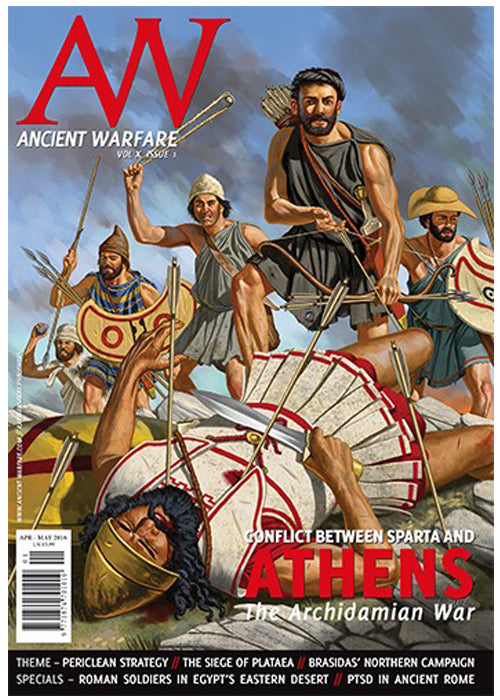
Ancient Warfare Magazine Vol X.1 - The Archidamian War
Este productos se enviará: 7-10 Day Shipping
Choose options
Este productos se enviará: 7-10 Day Shipping
Este productos se enviará: 7-10 Day Shipping
Get Ancient Warfare Magazine Vol X.1 - The Archidamian War
Ancient Warfare Magazine Vol >
Thucydides of Athens wrote the history of the war between the Peloponnesians and the Athenians, beginning at the moment it broke out, and believing that it would be a great war, and more worthy of relation than any that had preceded it. […] indeed, this was the greatest movement yet known in history, not only of the Hellenes, but of a large part of the barbarian world - I had almost said of mankind (Thuc. 1.1).
Topic: Gareth Williams, Pericles' strategy: pacifist or pragmatic?
Did the Periclean strategy adopted by Athens at the outbreak of the war advocate a peaceful or a fundamentally defensive reaction to the Peloponnesian invasions of Attica? Could we consider Pericles naive in concluding that the war could be won with such a plan? Or was Pericles much more astute in his approach?
Topic: Friedrich Wilhelm Miesen, A new type of hoplite, for a new type of war - fighting for Athens
The origin of the Peloponnesian War is largely rooted in Athens' ambition to gain control over the Hellenic world. An ambition that the city's arch-rival, Sparta, could not tolerate. Like no other war before it, the Peloponnesian War was fought with decided ruthlessness. But the armies in this conflict did not rely solely on well-armored hoplite phalanxes.
Topic: Konstantin Nossov, Innovations in ancient Greek siege warfare - Siege of Plataea
The siege of Plataea was one of the major events at the beginning of the Peloponnesian War (431-404 BC). Thucydides' account of the siege became the first detailed description of a siege in the ancient world left by a historian. His interest in this siege can likely be explained by the innovative siege methods introduced by the Spartans.
Topic: Murray Dahm, Talk the talk and walk the walk - Socrates at war
Philosophers are not usually associated with military prowess. In ancient Greece, however, even philosophers had to take their place in the phalanx with their fellow hoplite citizens. Socrates, arguably the most famous philosopher of all, went beyond the mere fulfillment of his duty and had a justly deserved military reputation. Moreover, his military conduct is actually very informative for the philosopher Socrates.
Topic: Owen Rees, Brasidas and his northern campaign - The heart of Achilles
At a time when Sparta was crumbling under the weight of its own fear and Athens could drag the strongest military power over the embers—while still recovering from the devastating plague that had decimated its own population—it was only Brasidas who stepped forward and offered a solution. In doing so, he embarked on the greatest solo campaign to honor the Peloponnesian wars.
Topic: Josho Brouwers, The Temple of Athena Nike - Victory written in stone
The Acropolis of Athens served as the religious heart of the city during the classical period. Its main temple, the Parthenon, is justifiably famous. However, there is also a smaller temple, located just outside the main monumental entrance to the Acropolis, which is just as interesting. It is the Temple of Athena Nike.
Topic: Roel Konijnendijk, The battle for supremacy in the Peloponnese, 420-418 BC - Clash of titans
Throughout its war with Athens, Sparta kept a watchful eye on a much larger rival: Argos. For more than a century, Sparta and Argos had fought periodically for land and influence in the Peloponnese. Since the crushing defeat of Argos at Sepeia in 494 BC, Sparta was firmly on top, but Sparta's reputation and power had suffered in the Archidamian War and an ancient truce between the two states was coming to an end. While Athens and Sparta discussed peace, Argos prepared for war.
Special: Konrad and Livia Stauner, Roman soldiers in Egypt's Eastern Desert - Letters from Didymoi
The praesidium of Didymoi, one of several stations along the road from Koptos to Berenike, was founded by the prefect of Egypt, Lucius Julius Ursus, who in the ninth year of the reign of Vespasian, while returning from a trip to Berenice, gave instructions for a well to be sought at that place and, after having found it, ordered a fort and cisterns to be built under the direction of Marcus Trebonius Valens, praefectus montis Berenicidis (I. Did. 1).
The debate: Joseph Hall, Psychological trauma and Rome's soldiers - A Roman PTSD?
Much of the recent debate over whether ancient combatants suffered from PTSD has focused on the Greek hoplite, but what about the Roman legionary? Is there also evidence of PTSD in the Roman world? And if so, how should this evidence be interpreted?
Hollywood novels: David L. Reinke, Queen Boudicca, we hardly knew ye - The Viking Queen (1967)
Director Don Chaffey enjoyed a long career in Hollywood, particularly in television where he directed multiple episodes of series like The Prisoner, The Avengers, and Mission Impossible. He had a sensibility for television, a talent that is unfortunately not displayed in his feature films. In addition to Jason and the Argonauts, Chaffey's other two well-known films are One Million Years B.C. and The Viking Queen.
At Todo Medieval we have thousands of medieval and other era products. Discover them!
Free shipping
The entire Iberian Peninsula from €60 (*Does not include islands) and worldwide shipping check our rates
Customer service
We are available from Monday to Friday to answer your questions.
Secure Payment
We comply with all regulations to ensure Secure Payment
Contact us
Need to contact us? Simply send us an email at [email protected]
