





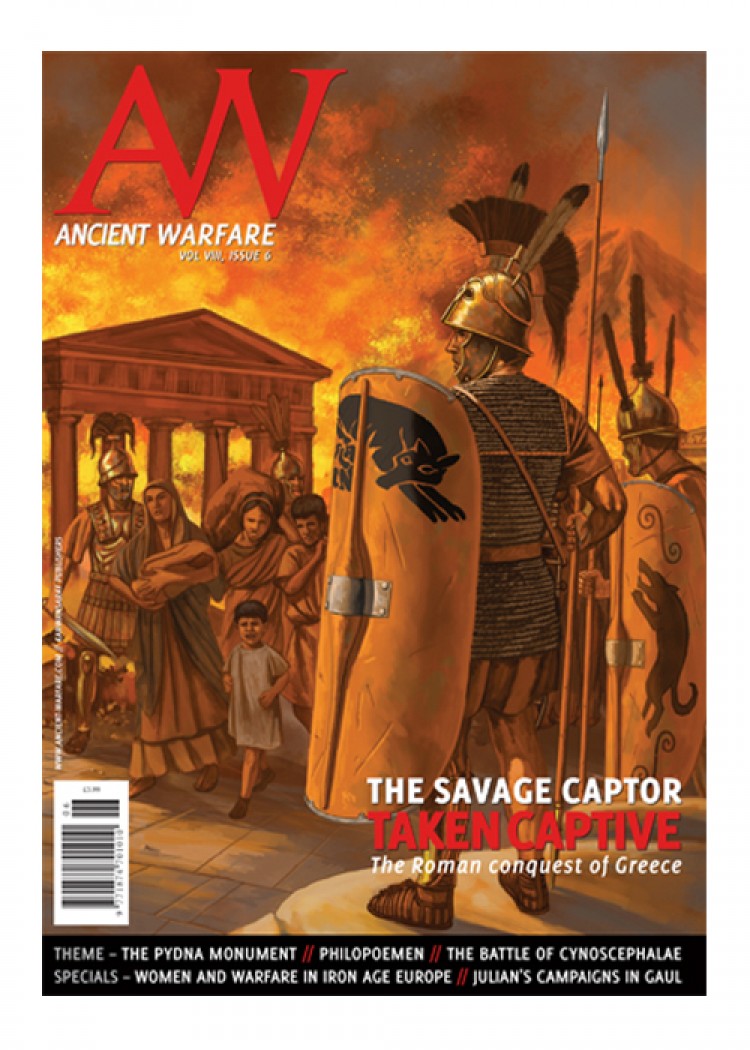
Ancient Warfare Magazine Vol VIII-6 - The Roman Conquest of Greece
Sold outEste productos se enviará: 7-10 Day Shipping
Choose options
Este productos se enviará: 7-10 Day Shipping
Este productos se enviará: 7-10 Day Shipping
Discover Ancient Warfare Magazine Vol. VIII-6 - The Roman Conquest of Greece
Ancient Warfare VIII.6
Topic: The Roman conquest of Greece
Topic: Joseph Hall, The Roman conquest of Greece - historical introduction
From the rivers and plains of northern Macedonia to the southern heart of the peninsula—among whose rugged mountains and plateaus lay the venerable poleis of ancient Greece—countless kingdoms, city-states, leagues, and tribes fought alternately for supremacy and survival in a constantly shifting flow of alliances. Into this world, already ancient before its arrival, crashed the young Roman Republic, which, although relatively unknown at first, eventually came to dominate a region that was once so fiercely independent.
The Source: Michael J. Taylor, The Pydna Monument at Delphi - carved in stone
After defeating and capturing Perseus, the last king of Macedonia, and imposing a postwar settlement, Aemilius Paullus embarked on a grand tour of Greece, a combination of religious pilgrimage, imperial reconnaissance, and a well-deserved vacation. His itinerary inevitably included the great Panhellenic sanctuary of Apollo at Delphi, and there, among the other monuments, he gazed at a pillar that Perseus had been building for himself; at the top was a platform where a royal statue was to be located. Paullus promptly ordered the incomplete pillar to be reworked as a monument to himself, with his own statue installed in the place of the deposed king's image.
Topic: Gabriel Baker, Greek reactions to the Roman war: the vilest violence and anarchy
In 200 BC, the Roman Republic declared war on King Philip V of Macedonia for the second time. Although the Macedonian force had diminished since the reign of its most famous monarch, Alexander the Great, Philip was still formidable and maintained an iron grip on the southern Greeks through a network of alliances, garrisons, and fortified cities. Seeking to loosen this grip and expand their enemy's resources, a Roman expeditionary force quickly crossed the Adriatic, striking targets throughout Greece and the neighboring regions. Before the year was out, many Greeks saw legionaries walking through their fields and the sails of Roman warships waving in their waters.
The Reenactor: Jasper Oorthuys, Two Roman legionaries of the Republic - soldiers of Rome
Everyone immediately recognizes the Roman Republican soldiers on the right. Chainmail, short sword, helmet, scutum, and let's not forget the caligae, mark these men as legionaries. To locate them chronologically, it is necessary to examine their equipment.
Topic: Owen Rees, The last of the Greeks - Philopoemen
At a time when the history of Greece is traditionally in the shadow of its Macedonian superiors, a small ray of light emerges with the life and career of one of the greatest innovators of warfare produced by any of the Greek states. Philopoemen does not stand out as the best of a bad bunch. He was a man of resilience, fortitude, and cunning; a man who could match the military ingenuity of generals like Iphicrates and Alexander the Great with a fraction of the budget. He was loved by the Greeks, respected by the Romans, and feared by his enemies. It is time for his story to be better known.
Topic: Michael Park, The Battle of Cynoscephalae, 197 BC - the dog heads
The fog, although it dissipated from the ridge tops, clung to the ground and rolled into the Enipeus valley to the south. Although the shouts and cries of the combatants could be heard from the slopes, little could be discerned. On his side, the Macedonian King Philip V wavered between committing or retreating. The Illyrian and mercenary thureophoroi (all his auxiliary troops, apart from the Thracians), as well as more than half of his cavalry, had been engaged in the growing "encounter" skirmish that had turned into a battle for the heights of Cynoscephalae (Dog Heads), a ridge of rugged hills with parallel outliers that stretches into the plain of Pharsalus.
Topic: Ruben Post, Greek arms, armor, and society - weapons make the man
For the Greeks of the Iron Age and the Archaic period, weapons were among the most powerful symbols of the place one occupied in society. Elites openly carried weapons in daily life and decorated their homes with expensive arms, while most of the poor fought with whatever rudimentary weapons they could make or obtain. Examining the role of weapons in society is of equal importance for the historian of the Greek city-states of the late Classical and early Hellenistic period.
Topic: Sidney E. Dean, Equipment of the Roman-Macedonian wars - pilum vs pike
Rome's final victory in the wars with Macedonia has been attributed to superior organization and tactics. Organization and tactics are inherently linked to the weaponry and armor deployed by each combatant. The versatility and flexibility of the legions were possible because Roman weapons and shields allowed soldiers to move quickly from one threat to another and traverse difficult terrain without breaking formation. The Macedonian reliance on the pike as the main offensive weapon made their army difficult to handle, an opportunity the legions quickly took advantage of.
Special: Alberto Pérez Rubio, Women and war in the late Iron Age - fight like a woman
Half of the warriors were women! Shield maidens are not a myth! In the wake of the success of the TV series Vikings, a 2011 article by Shane McLeod examining the sex ratio of Nordic immigrants in eastern England received wide, albeit distorted, publicity. McLeod compared skeletal evidence from several burials with their grave goods, confirming that a woman could be buried with "masculine" goods, such as weapons: a notion already widely recognized among archaeologists.
Special: Matthew Beazley, Julian's campaigns against the Alamanni - reclaiming eastern Gaul
Flavius Claudius Julianus (Julian) was appointed Caesar by Emperor Constantius II in 355 AD. Before his appointment, Julian had held no prior political or military office. However, he was one of the last surviving relatives of Constantius. The emperor, who was fighting in the East, needed someone to deal with border issues along the Rhine. For too long, the Alamanni had been raiding and living within Gaul without any real retaliation.
In Todo Medieval we have thousands of medieval and other period products. Discover them!
Free shipping
The entire Iberian Peninsula from €60 (*Does not include islands) and worldwide shipping check our rates
Customer service
We are available from Monday to Friday to answer your questions.
Secure Payment
We comply with all regulations to ensure Secure Payment
Contact us
Need to contact us? Simply send us an email at [email protected]
