





Ancient Warfare Magazine Vol VIII-2 - War, Trade and Adventure
€11,94 EUR
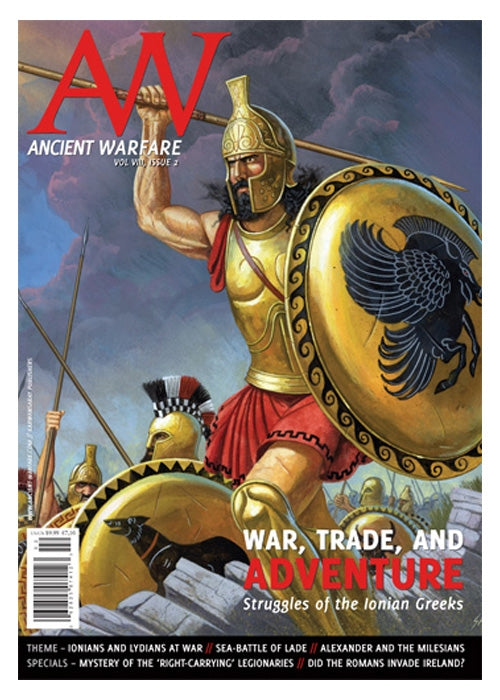
Ancient Warfare Magazine Vol VIII-2 - War, Trade and Adventure
Este productos se enviará: 7-10 Day Shipping
Choose options
Este productos se enviará: 7-10 Day Shipping
Este productos se enviará: 7-10 Day Shipping
Acquire Ancient Warfare Magazine Vol VIII-2 - War, Trade, and Adventure
Ancient Warfare Magazine Vol VIII-2 - War, Trade, and Adventure - Struggles of the Ionian Greeks
Written by Christy Beall
Theme: War, Trade, and Adventure - Struggles of the Ionian Greeks
Introduction: Josho Brouwers, 'Historical Introduction: Struggles of the Ionian Greeks'.
Illustrated by Maxime Plasse.
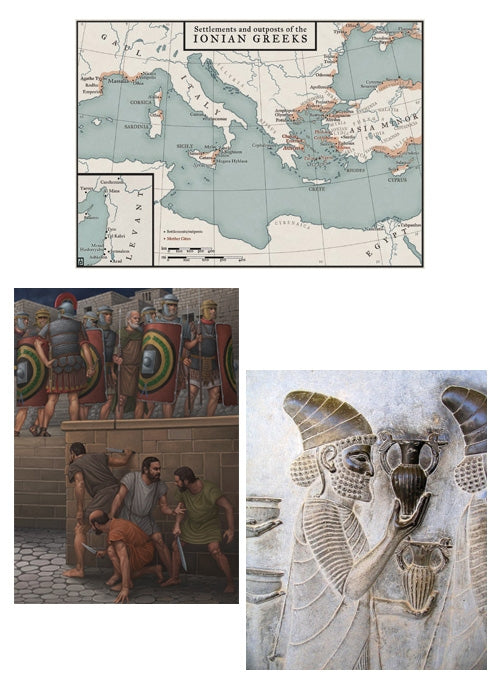
The ancient Greeks were originally divided into four main tribes: the Dorians, the Aeolians, the Achaeans, and the Ionians. Each of these tribes also spoke a distinct dialect (Doric, Aeolic, Ionic), in addition to the Achaeans, who used a form of Doric. The Athenians believed themselves to be the original Ionians and spoke a variant of the dialect called Attic. The central theme of this issue is the Ionian Greeks. Outside of Attica, Ionians lived on the island of Euboea, in the Cyclades, and in colonies settled in the central part of the western coast of Asia Minor, as well as on the islands off its coast, such as Chios and Samos.
The Source: Cezary Kucewicz, 'The Ionian Greeks in the Archaic Period: Pirates, Raiders, and Soldiers of Fortune'.
Archaic Ionia was at the very center of the early Greek world. The Ionian Greeks were pioneers in trade and colonization and explored every corner of the Mediterranean. However, reconstructing the early Ionian overseas ventures is not an easy task, as the surviving historical sources are scarce. A careful combination of fragments of literary evidence (including poems, inscriptions, and accounts by later historians) with the surviving archaeological record reveals an epic history of Ionian pirates, raiders, and soldiers of fortune, who fought for almost every kingdom of the Near East.
Theme: Patrick Lowinger, 'Conflicts between Ionians and Lydians: The Hunger of Lions'.
Illustrated by David McCallister
Almost seventy years before the Battle of Thermopylae, Ephesus, the last jewel of Greek independence in Ionia, was added to the crown of the Lydian Empire. When most people think of Lydia in antiquity, they think of its legendary wealth or the birthplace of gold coins adorned with symbolic lions. The lion was not just an artistic feature depicted on coins: it characterized the ambition, power, and cruelty of the Lydian rulers.
Theme: Vassilis Pergalias, 'Adventures of the Phocaeans - Ionians in the West'.
Braving the treacherous waves of the Aegean in their sturdy fifty-oared vessels, traveling beyond the Strait of Messina toward the western end of the Mediterranean, Ionian merchants and colonists set sail from the city of Phocaea during the 7th and 6th centuries BC to establish trading posts and colonies along the coasts of Corsica, Gaul, and Iberia. Of all the Ionians of Asia Minor, the Phocaeans became famous for their skilled naval abilities that allowed them to gradually explore the coasts that extended beyond the Pillars of Hercules. Their presence and success in this part of the world ultimately provoked an aggressive response from other major players in the region: the Carthaginians and the Etruscans (known as Tyrrhenians by the Greeks), which made conflict inevitable.
The Reenactor: Spyros Bakas, 'A Toxarchos from the Nereid Monument - Commander of the Archers'.
The toxarchos or toxarchis was the commander or officer of a group of archers (toxotai). The toxarchoi are mentioned both by Thucydides, in the conflict between Athenians and Aetolians, and by Arrian, in his description of the war between Macedonians and Thebans. On the Nereid Monument of Lycia, dated to 390 BC, we see a unique representation of a heavily armed archer, who is likely the leader of the other archers appearing in the scene. He is fighting alongside a hoplite, similar to the entaxis or parentaxis, in which men with projectile weapons accompany the hoplites in battle.
Theme: Sidney E. Dean, 'Battle of Lade, 494 BC - Triremes and Betrayal'.
Illustrated by Radu Oltean.
In 494 BC, the Ionian Revolt was going badly for the Greeks. The Persian Emperor Darius I had sent a large expeditionary army, augmented with a strong fleet, which had retaken numerous secessionist cities and islands. On the mainland, Miletus remained the strongest of the free Greek cities. As the starting point and political center of the rebellion begun in 499 BC, it was important both strategically and symbolically. The Persians decided to take the city, hoping that the revolt would collapse with the fall of Miletus. The Ionian Greeks agreed that the fight for Miletus would be the decisive battle of the Ionian Revolt.
Theme: Michael Park, 'Athens, Sparta, Persia, and the Greeks of Asia: Between Great Powers'.
In the aftermath of the Battle of Mycale in the late summer of 479 BC, and with the confirmation of the neutralization of the pontoon bridges of the Hellespont, the Spartan king and commander of the allied fleet, Leotychides, sailed home along with the Peloponnesian allies. While the Spartans thought the work of the campaign season was done, the Greeks of Ionia, the Hellespont, and Aeolis thought otherwise. These "Greeks of Asia" had been subject to Persian rule since the time of Cyrus and, as a result of the Persian defeat, had rebelled. Rejecting Leotychides' view that they should move to Greece, they, along with the Athenians and the islanders under the command of the Athenian general Xanthippus, spent the winter successfully defeating Sestus (Hdt. 9.104; Thuc. 1.89.2).
Theme: Mark McCaffery, 'Alexander, Miletus, and the Branchidae: A Master Strategist'.
Illustrated by Jason Juta.
As a leader, Alexander ranks among the greatest in the ancient world, both in the opinion of modern and ancient minds. Of course, this is not to say that he did not make tactical errors during his career. However, in general, the decisions made and policies practiced were calculated with short- and long-term repercussions in mind. Two scenarios that reflect this are the capture of Miletus in 334 BC and the massacre of the Branchidae in the summer of 329 BC.
Features
Special: Murray Dahm, 'What Did the Dexter Legionaries Carry? - Literal Dexiolaboi'.
Illustrated by Ángel García Pinto.
Sometimes nuggets of gold from military history can be unearthed in the most unlikely places. In the New Testament, Acts 23:23 records that the tribune (chiliarch), Claudius Lysias, summoned two centurions to form a personal guard for the Apostle Paul that would be composed of 200 soldiers, 70 cavalrymen, and 200 dexiolaboi. This force was to escort Paul at the third hour of the night to Antipatris on the way to the procurator Felix in Caesarea. From Antipatris, the infantry returned to Jerusalem and only the cavalry accompanied Paul to Caesarea.
The Debate: Duncan B. Campbell, 'Did the Romans Invade Ireland? - Roman Soldiers in Ireland'.
The idea of a Roman invasion of Ireland has periodically intrigued scholars since it was first suggested in the late 19th century. However, more than a century of research has failed to find the kind of clues that reveal the presence of the Roman army elsewhere. Nevertheless, in some circles, the idea of a Roman incursion continues to be defended, if not as a certainty, then as a high probability. So, what are the reasons for suggesting that the Romans invaded Ireland?
At Todo Medieval we have thousands of medieval products and items from other eras. Discover them!
Free shipping
The entire Iberian Peninsula from €60 (*Does not include islands) and worldwide shipping check our rates
Customer service
We are available from Monday to Friday to answer your questions.
Secure Payment
We comply with all regulations to ensure Secure Payment
Contact us
Need to contact us? Simply send us an email at [email protected]
