





Ancient Warfare Magazine Vol Vii-2 - Fight For Control
€11,94 EUR

Ancient Warfare Magazine Vol Vii-2 - Fight For Control
Este productos se enviará: 7-10 Day Shipping
Choose options
Este productos se enviará: 7-10 Day Shipping
Este productos se enviará: 7-10 Day Shipping
Discover Ancient Warfare Magazine Vol VII-2 - Struggle for Control
Ancient Warfare - VII.2
Theme: struggle for control - wars in sicily
Introduction: matthew beazley, 'historical introduction: wars in sicily'.
Illustrated by carlos garcía.
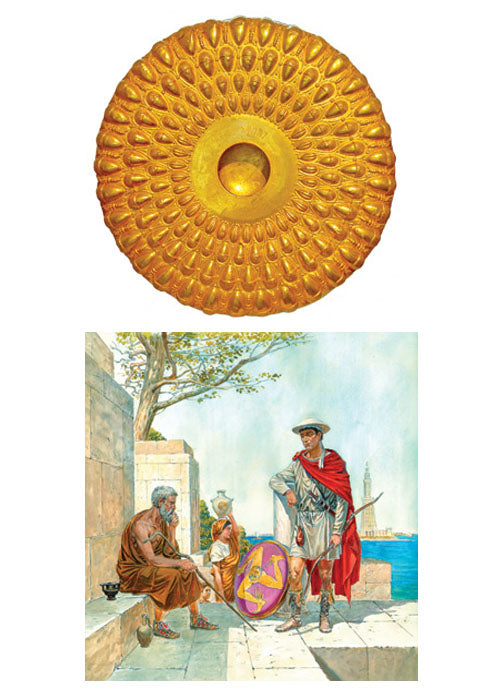
Created by the gods and the land of giants, sicily was a rich but deadly prize hanging before many ancient powers. the ill-fated island would be subjected to a seemingly endless series of wars fought by peoples from all over the ancient mediterranean. for centuries, the greeks and the carthaginians battered each other to exhaustion out of a desire to dominate the island. heeding the siren song, the power of athens would crash against the rocks of sicily. like a lover forced to choose between two suitors, sicily would choose rome over carthage and thus hasten the
Demise of the latter.
Theme: konstantin nossov, 'military architecture as a source: sicilian greek fortifications'.
Greek fortifications appeared in sicily along with greek immigrants in the 8th century bc. the first city founded by greek colonists, naxos, boasts the oldest known examples of greek fortifications in sicily. beautiful examples of later fortifications can be found in syracuse, selinus, and gela. greek fortifications in sicily shared similarities with greek military architecture found elsewhere, but there were also notable differences. the fortifications of sicily reached their zenith in the period between 405 bc, when dionysius i rose to power, and 211 bc, when syracuse and the rest of the island were captured by the romans.
Theme: paul mcdonnell-staff, 'savior of sicily - timoleon of corinth'.
Illustrated by ángel garcía pinto.
Between 1907 and 1938, parts of the pedestal of a bronze statue of poseidon were recovered on the isthmus of corinth. the inscription on the pedestal reads: the corinthians and timoleon, their general, freed the greeks living in sicily from the carthaginians and thus dedicated this thank-offering to the gods.
Theme: annelies koolen, 'athenian cavalry in sicily: an underestimation of the enemy cavalry'.
Illustrated by josé antonio gutiérrez lópez.
During the peloponnesian war (431-404 bc), the athenians did not only fight intensely against the spartans and the boeotians. between 415 and 413 bc, they also undertook a rather bold enterprise: a military expedition to the island of sicily.
Theme: nicholas sekunda, 'a regiment of cretan mercenary archers - in the service of the tyrants of syracuse'.
Illustrated by igor dzis.
After their defeat by hannibal at the battle of trebia in december 218 bc, the romans asked for help from hiero ii, tyrant of syracuse. according to polybius (3.75.7), he sent them 500 cretans and one thousand peltophoroi. these latter troops were typical hellenistic "peltasts," armed with pikes and a small bronze shield (pelte). they could fight as light infantry in special operations or in phalanx formation. after the battle of lake trasimene, which was fought the following year, it is recorded that hannibal released the latin-allied prisoners (livy 27.7.5); the cretans were sent back to the syracusan army. hiero sent more reinforcements, composed of one thousand archers and some slingers (livy 22.37.8). he also sent supplies of corn to rome after this battle, knowing that the romans even employed foreigners to fight in those roles.
Theme: filippo donvito, 'sow the wind and reap the whirlwind - siege of motya by dionysius i, 397 bc'.
Illustrated by johnny shumate.
A traveler who had arrived in syracuse at the dawn of the 4th century bc would have been very impressed by the appearance of the city. in reality, it did not look like the usual greek polis, but rather like some kind of giant open-air military factory, full of barracks and fortified places that echoed with the metallic clinking of blacksmiths producing thousands of suits of armor. the best engineers from all over the mediterranean were inventing war machines that had never been seen before. all this was not just a way of showing off. the tyrant of syracuse, dionysius, was planning to capture the most formidable carthaginian fortress in sicily: motya.
Theme: sidney e. dean, 'agathocles of syracuse and the third greco-punic war: treachery, tyranny, and terror'.
Illustrated by ángel garcía pinto.
Agathocles (361-289 bc) became tyrant of syracuse in 317 or 316 bc. between 316 and 314 bc, he conquered numerous greek cities in eastern and central sicily and forced others to become allies of syracuse. only the major cities of gela, acragas, and messana were able to resist by forming an alliance and asking for support from carthage. in 314 bc, hamilcar, the carthaginian military governor of western sicily, negotiated a "peace agreement" that recognized the hegemony of syracuse over the eastern two-thirds of sicily. the generosity of hamilcar is not surprising. he and agathocles seem to have forged a personal pact in 317 bc with the commitment of the syracusans to support hamilcar against his political enemies in africa. when agathocles' greek opponents complained directly to carthage in 314, the punic government blamed hamilcar, who died before they could be withdrawn from sicily.
Features
The find: vincent van der veen, 'roman ownership inscriptions: keep your filthy paws off my stuff!'.
In 2011, the het valkhof museum in nijmegen, netherlands, bought a roman helmet from a private individual who had discovered it in a field. the helmet was of the so-called coolus type and could be dated to the first three quarters of the 1st century ad. although damaged, all the pieces were recovered. the dome and the neck guard were manufactured from a single sheet of bronze, while the conical crest knob was welded and the peak reinforcement was riveted. the cheek pieces were originally attached to the helmet by two hinges.
Special: korneel van lommel, 'refusal of military service in ancient rome: i would rather cut off my thumb'.
In the span of a few centuries, rome went from being a small settlement to a great empire that stretched from scotland to mauritania and from the iberian peninsula to the caspian sea. the roman army was a crucial factor in the establishment of the empire. this may give the impression that the romans were a warrior society, where every roman was willing to risk his life. however, this ideal mischaracterizes roman civilization. various sources refer to young men who did not want to enlist in the army and, instead, deliberately mutilated themselves to be rejected on medical grounds. in this article, these testimonies are placed in the proper time and context. i will explain in more detail the refusal of military service, the motives of young men to self-mutilate, and the legal repercussions of this act of desertion.
The debate: duncan b. campbell, 'what really happened at the river granicus? - alexander's great cavalry battle'.
Illustrated by pablo outeiral and julia lillo.
In the spring of 334 bc, alexander the great, then 21 years old, crossed into asia minor at the head of a macedonian army of 35,000 men to begin the conquest of the persian empire. barely 80 kilometers into his journey, he encountered the first persian opposition at the river granicus and overcame it convincingly. however, our main sources of information do not agree on the course of the battle and only give a vague idea of the terrain. so, is it possible for us, more than two millennia later, to trace exactly what happened at the river granicus?
At Todo Medieval we have thousands of medieval and other era products. Discover them!
Free shipping
The entire Iberian Peninsula from €60 (*Does not include islands) and worldwide shipping check our rates
Customer service
We are available from Monday to Friday to answer your questions.
Secure Payment
We comply with all regulations to ensure Secure Payment
Contact us
Need to contact us? Simply send us an email at [email protected]
