





Ancient Warfare Magazine Vol Vii-1 - Warriors of the Nile
€11,94 EUR

Ancient Warfare Magazine Vol Vii-1 - Warriors of the Nile
Este productos se enviará: 7-10 Day Shipping
Choose options
Este productos se enviará: 7-10 Day Shipping
Este productos se enviará: 7-10 Day Shipping
Enjoy Ancient Warfare Magazine Vol VII-1 - Warriors of the Nile
Ancient warfare magazine vol vii-1
Theme: warriors of the nile - conflict in ancient egypt
Introduction: josho brouwers, 'historical introduction - warriors of the nile'.
Illustrated by carlos garcía and arianna sacco.
One of the world's first civilizations, the culture of ancient egypt flourished along the banks of the nile river. around 3000 b.c., the country was already a unified kingdom ruled by a single king. its powerful rulers built impressive monuments in the form of famous pyramids during the so-called old and middle kingdoms, many of which still endure to this day. egyptian civilization would reach even greater heights during the new kingdom (1549-1069 b.c.), when its warrior kings ventured more boldly beyond the safety of their own borders to forge a real empire.
The source: bridget mcdermott, 'sources of ancient egyptian warfare: images, objects and words'.
Modern accounts of ancient military history are largely dominated by the study of greek and roman wars. however, egyptian military history provides a fertile and much-neglected field of research. texts, iconographic sources and archaeological findings of military equipment provide rich, if sometimes difficult, sources of historical research.
Theme: arianna sacco, 'the hyksos and their contributions to egyptian warfare: the rulers of foreign lands'.
Illustrated by rocío espín.
The egyptian middle kingdom (2066-1650 b.c.) was a period of political and cultural flourishing. the central authority embodied by the king was strong. successful military campaigns extended egypt's borders. fortresses were built in lower nubia, on the banks of the nile river, to keep the newly conquered territory under control; they also served as warehouses for goods traded in that region and as checkpoints for travelers. the arts flourished. the most famous works of ancient egyptian literature were created in this period and represent the classical phase of the egyptian language. but the middle kingdom would eventually give way to the second intermediate period (1650-1549 b.c.), during which egypt was ruled by a group of people of foreign descent: the hyksos.
Theme: sigrid m. van roode, 'egypt's strategic border defenses: from the walls of the ruler to the belly of the stones'.
Illustrated by julia lillo.
Year 22, fourth month of winter, day 25. his majesty was in tjaru on his first victorious campaign that his father amun had granted him, to extend the borders of egypt, in valor, in victory, in power and in justification. with these words begins the account of the campaigns of pharaoh thutmose iii (r. 1479-1424 b.c.) in syria and palestine. egyptian accounts of military expeditions sent to nubia in the south and to palestine and syria in the northeast list the number of enemies killed, prisoners and livestock taken, cities conquered, sacked and burned. most of these accounts do not dwell on what was presumably considered common knowledge: the available military infrastructure from which to launch these victorious campaigns.
Theme: bridget mcdermott, 'ramesses ii faces the hittites - the battle of kadesh'.
Illustrated by josé daniel cabrera peña and josé antonio gutiérrez lópez.
Ramesses ii was the son of seti i and ruled egypt during the years 1279-1212 b.c. he was a prominent ruler in the ancient world. he adopted the title "usi-ma-re" ("strong in right is re"), along with the epithet "great in victories". his goal was clear: ramesses had a passion for battle and for glory. he learned warcraft at an early age and, as a teenager, fought in nubia at his father's side. ramesses, faithful to his father's policies, wished to emulate thutmose iii and was determined to surpass the military achievements of his predecessors. in doing so, he would fulfill his obligations to amun, the most prominent deity of new kingdom egypt, and earn a reputation as one of the great military rulers of the ancient world.
Theme: paul mcdonnell-staff, 'the weapons of tutankhamun: a pharaoh's arsenal'.
Luxor, valley of the kings, egypt, november 24, 1922. lord carnarvon asks howard carter anxiously: can you see anything? to which carter replied: yes, wonderful things.
Theme: josho brouwers, 'letters to the royal court in egypt - conversations of great kings'.
The late bronze age was a remarkable period for the ancient near east. there were four great kingdoms that maintained, together, a delicate balance of power among themselves. these were the kingdoms of egypt, the people of the land of hatti (the hittites), babylon, and the mitanni. this last kingdom was eventually absorbed by a fifth great kingdom, assyria, which emerged in the final stages of the late bronze age. the rulers of these kingdoms were all great kings, who referred to themselves as "brothers". letters were written that reveal much about the contemporary political and military situation.
Features
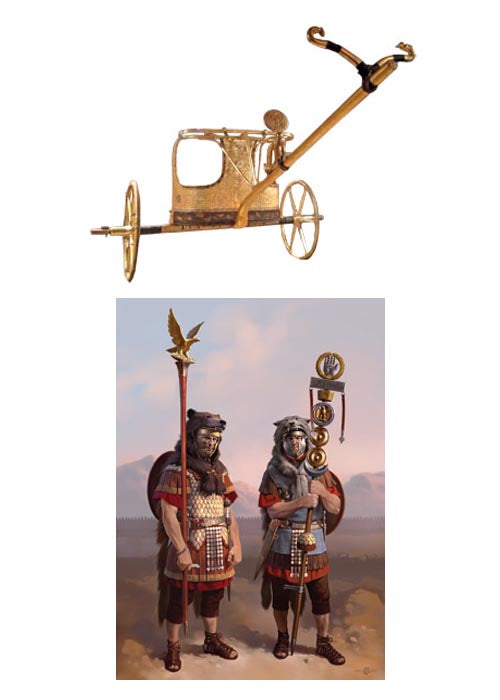
Special: jessica a. billing, 'symbolic objects of ideology, veneration and belief: the military standards of the legions'.
Illustrated by nikolai zubkhov.
The legions of the roman army capture our imagination, even today. the image of their armor, large shields, swords and cloaks are prominent to us and instantly recognizable, with their eagle standards burning high, as depicted in stone on the iconic column of trajan. the image of the eagle more than any other has endured and has been used by people like napoleon bonaparte centuries after the fall of the roman empire. but what did the eagle standard, and indeed the others, mean to the soldiers who carried them? what did they symbolize? why were they venerated?
The debate: j. albert morales, 'could the han chinese have defeated the macedonian army? - the war of the heavenly horses'.
Illustrated by josé antonio gutiérrez lópez and mark churms.
Alexander the great and his father philip had created a combined armed force that maximized the lethality of heavy cavalry, armored phalangites and peltasts. alexander marched this army five thousand kilometers across asia and stopped just a thousand kilometers from the only force that could have challenged him: the army of imperial china.
At Todo Medieval we have thousands of medieval and other era products. Discover them!
Free shipping
The entire Iberian Peninsula from €60 (*Does not include islands) and worldwide shipping check our rates
Customer service
We are available from Monday to Friday to answer your questions.
Secure Payment
We comply with all regulations to ensure Secure Payment
Contact us
Need to contact us? Simply send us an email at [email protected]
