





Ancient Warfare Magazine Vol Vi - 1 From Hereos to Hoplites
Sold outEste productos se enviará: 7-10 Day Shipping
Choose options
Este productos se enviará: 7-10 Day Shipping
Este productos se enviará: 7-10 Day Shipping
Give Away Ancient Warfare Magazine Vol VI - 1 From Heroes to Hoplites
Ancient Warfare Magazine Vol VI - 1 From Heroes to Hoplites: Warfare in Archaic Greece
Theme: From Heroes to Hoplites: Warfare in Archaic Greece
Introduction: Sean Hussmann, 'Introduction to the theme'.
With the exception of the New Testament, it is difficult to think of another literary work that has had such an enormous influence on European culture and self-conception as the writings of Homer. While it is still hotly debated whether Homer was the sole author of the Odyssey and the Iliad, whether he simply compiled older poems into two great epic works, whether both epics were composed by the same hand or were rather the works of two or more anonymous authors, or even whether a poet named Homer ever existed, it cannot be doubted that his works—especially the Iliad—have fascinated and influenced both scholars and laymen for millennia. The scientific works written on this subject in the 20th century would probably fill an entire library, while the works of art and fiction inspired by Homer (novels, films, paintings, plays, and even songs) could easily fill another.
The Source: Owen Rees, 'Using Homer as history - poetic license'.
There are few sources more revered throughout history than Homer. He has captured the imagination of every generation that has had the privilege of viewing his works. Whether because of the content of his poetry or the elusive nature of his identity, it is fair to say that he has been the dominant feature in the historiographical debate dating back to the scholars of Alexandria and before. The debate remains current today.
The Reenactor: Dimitrios Katsidis, 'Walking statues: a recreation of early hoplites'. Theme: Cezary Kucewicz, 'The rules of war in archaic Greece: era of the heroes?'.
Illustrated by Christos Giannopoulos.
The famous war between Chalcis and Eretria, which took place on the island of Euboea around 700 BC, was the largest and most remembered military conflict of the early archaic Greek period. According to Thucydides, the Lelantine War, as we call it today, was the first ancient war in which the rest of the Hellenic world joined one side or the other (History of the Peloponnesian War 1.15.3). The unique place of this conflict in the history of Greek warfare is further confirmed by a tradition recorded by the ancient geographer Strabo, who reported that in the course of the war the contending parties formally agreed to prohibit the use of ranged weapons (i.e., slings, bows, javelins). And although the historical authenticity of this agreement is unclear, it has led modern historians to suspect that warfare in the archaic Greek period could have been governed by similar rules and conventions.
Theme: Paul McDonnell-Staff, 'The origins of the hoplite phalanx: where fighting is hand-to-hand'.
Illustrated by the staff of Rory McDonnell.
When someone asked why they shamed those among them who had lost their shields, but not those who had lost their helmets or breastplates, he said: "Because they put these on for themselves, but the shield for the sake of the whole line." Thus the exiled Spartan king Demaratus explained the cohesion of the Greek phalanx to his Persian audience (Plutarch, Moralia 220a (2)).
Theme: Vassilis Pergalias, 'The First Messenian War - the dawn of Spartan expansionism'.
Illustrated by Igor Dzis and Carlos García.
For nearly twenty years, the group of villages that formed the political system of Sparta fought against the people of neighboring Messenia in circumstances surrounded by historical mystery. The war, fought during the transition period at the beginning of Greece's archaic age, allows us to explore the origin of the hoplite phalanx along with the origins of Spartan militaristic society.
Theme: Gareth Williams, 'Tyranny and the hoplite reform: from rags to riches'.
For many, the introduction of hoplite armor and the Greek phalanx at the end of the archaic period is evidence of a rising middle class that, due to its increasing wealth, could now afford to buy the hoplite panoply and thus fight shoulder to shoulder with the aristocratic elite. Their increasing role in the defense of the polis fueled an egalitarian spirit and a desire for political parity. The elites were not willing to satisfy these social impulses, which allowed a "champion of the people," the tyrant, to emerge in several cities. These tyrannies openly supported and backed the grievances of this new, politically active class. But is this true? Is there evidence that this new "middle class" sought political equality because of their new role as hoplites? Who did the tyrants actually recruit to seize power in a polis?
The Theme: Murray Dahm, 'Twins, chariot warfare and late geometric art: deceived!'.
Illustrated by Andrew Brozyna.
The frieze on a unique Late Geometric oinochoe (wine jug) found near the tholos in the Athenian Agora in 1935 (P4885) seems to depict Siamese twins in combat; two killers attack while the twins dismount from their chariot. Such an extraordinary scene is, to say the least, fascinating. However, if investigated further, this figure is not at all what it seems.
Features
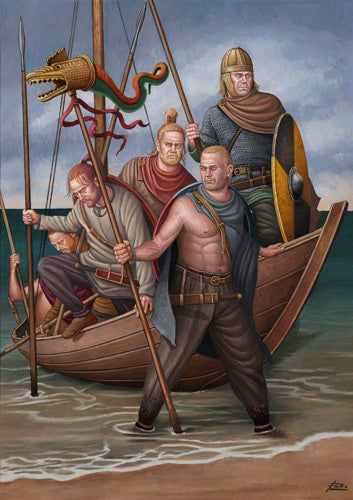
Special: Arnold Blumberg, 'Germanic piracy during the 3rd and 4th centuries AD - assault from the sea'.
Illustrated by Ángel García Pinto.
Pirates and piracy are recurring themes in Roman literature; murder, looting, and kidnapping by maritime raiders were familiar terrors to many inhabitants of the empire throughout its history. The perpetrators of these acts, defined as armed robbers whose activities normally involve the use of ships, were, and remain, called pirates. The problem of piracy had long plagued the empire. Although it was never eradicated, it was more or less under control during the Principate (31 BC – 284 AD). However, with the internal destabilization of the 3rd century AD came an increase in piracy caused in part by the Germanic peoples who had taken to the sea.
The Debate: Duncan B. Campbell, 'Did the Sasanians use chemical warfare? Death in the dark at Dura-Europos'.
Illustrated by Andy Brozyna
The ruined city of Dura-Europos, the "Pompeii of the Syrian desert," has several reasons to be famous. Students of ancient military equipment are fascinated by the rich assembly of weapons and armor recovered through excavations in the 1930s. Historians of warfare are captivated by the city's defenses, particularly the many-towered "desert wall," which still stands to its maximum height in many places. Both focus on important features of the site. However, much rarer in the annals of ancient wars are the Sasanian tunnels, hidden in the depths, which were designed to undermine the wall and infiltrate the city. A recent theory has suggested an additional distinction for Dura-Europos, as the site of the first recorded use of chemical warfare. But can the evidence support such a sensationalist claim?
At Todo Medieval we have thousands of medieval and other era products. Discover them!
Free shipping
The entire Iberian Peninsula from €60 (*Does not include islands) and worldwide shipping check our rates
Customer service
We are available from Monday to Friday to answer your questions.
Secure Payment
We comply with all regulations to ensure Secure Payment
Contact us
Need to contact us? Simply send us an email at [email protected]
