





Ancient Warfare Magazine Vol. IX.6 - The Aftermath of the Battle
€11,94 EUR
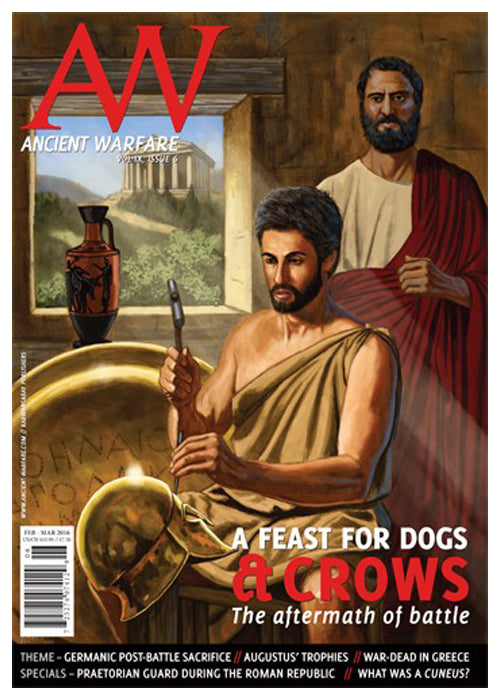
Ancient Warfare Magazine Vol. IX.6 - The Aftermath of the Battle
Este productos se enviará: 7-10 Day Shipping
Choose options
Este productos se enviará: 7-10 Day Shipping
Este productos se enviará: 7-10 Day Shipping
Enjoy Ancient Warfare Magazine Vol IX.6 - The Aftermath of Battle
Ancient warfare magazine vol ix.6 - the aftermath of battle
Topic: josho brouwers, the aftermath of battle - historical introduction
When we think about war in the ancient world, the first thing that probably comes to mind is images of men, dressed in armor, fighting each other. battles often attract a lot of attention and there have been many heated discussions about the nature and mechanics of combat. by comparison, there is often less interest in what happens after the battle has been decided and the dust has settled. but the consequences of conflict are no less interesting than the fighting itself, as this issue of ancient warfare magazine will demonstrate.
The source: friedrich wilhelm miesen, spoils of war in ancient greece - the spoils of war
War for the ancient greeks was a common occurrence. for civilians, there was an unstable mix of hardships, including the risk of being robbed by passing armies. for those who served their city or their king, battle meant the risk of being wounded or killed in single combat or in the claustrophobic shuffle of phalanx formations. survivors would face the devastations of the battlefield. here, on the fields where the day's slaughter had ended, the victorious side would search for and collect clothing, armor, weapons, and other valuables from the bodies of friends and foes alike.
Topic: sidney e. dean, post-battle germanic human sacrifice - bog bodies and broken swords
Religious ceremonies following battles have always been an integral part of warfare. survivors thank their god or gods for sparing their lives, the victors rejoice for their divine favor, and the losers pray for better luck next time. what varies from one era to another and from one culture to another are the forms of post-battle worship. pledges of conduct, libations of wine, and dedications to temples seem civilized enough. but too often expressions of faith have shown a darker side. when the germanic gods invested in the victor's cause, they wanted their share of the loot, that is, the sacrifice.
Topic: p. lindsay powell, celebrating victory the augustan way - a proud trophy of you
After a battle, victorious roman troops would erect a series of captured weapons and armor and dedicate them with gratitude to the gods. after the battles of actium and alexandria that eliminated his rivals, caesar augustus developed the temporary display of war spoils into lasting symbols (presented on coins, inscriptions, and public monuments) to celebrate the glory of his conquests and the peace achieved through his victories.
Topic: mark mccaffery, the gates of janus - geminae belli portae
Following the victory over antony and cleopatra in august of 30 b.c., the senate of rome lavished numerous expressions of praise and reward upon octavian, among which was his new title of augustus. some of these were politely declined by the absent victor, who would remain in the eastern mediterranean resolving issues until the following summer. however, according to dio cassius (51.20), the decree that pleased octavian most was the decision made by the senate in his absence to close the gates of janus, which was done in a ceremony held on january 11, 29 b.c., as recorded by verrius flaccus in the fasti praenestini.
Topic: gareth williams, defeat and surrender in ancient greece - flight
Once a confrontation with hoplites had begun, what was the "protocol" for those who fled or surrendered? were there unwritten laws or customs that dictated the activities of the greeks during these final stages of battle? was hoplite warfare dominated by such constructs, or could they be overridden by more pragmatic objectives?
Topic: cezary kucewicz, war dead in ancient greece - ancestral custom
After the battle, those who survived were left contemplating a gruesome spectacle. what they faced was a scene of distorted humanity: a field of mangled bodies, abandoned weapons, and the plaintive cries of the wounded and dying. birds circled expectantly overhead, while dogs scavenged anxiously on the periphery. the field itself was filled with the dead of both sides, now indistinguishable in their shared final fate. indeed, the ancient greeks offer us a complex image of the glories and triumphs of war, but few scenes impact the modern reader as much as the pathos of the aftermath of battle.
Topic: owen rees, unspoken homecomings in ancient greece - the lost nostoi
All soldiers go home. it is a reality that every survivor of every conflict throughout history has faced: all soldiers must return home. from the victory parades of the roman empire to the triumphal marches of napoleon, the image of a victorious homecoming is synonymous with military power and domination. in classical greece, a land and period that idolized the military - and the hoplite in particular -, images of homecoming, of victory and the pride and glory felt by the individual or the state should have been prolific. however, this was not the case.
Special: arnold blumberg, praetorians during the roman republic - the personal guard of a roman general
The praetorian guard rose to power during the late republic, becoming the most famous and controversial unit of the imperial army. its name became synonymous with intrigue, greed, conspiracy, treason, and assassination. quickly assuming the status of the real power behind the imperial throne, it was responsible for the overthrow, abandonment, or assassination of fifteen of the 48 emperors between 27 b.c. and 305 a.d. however, the original purpose of the praetorian guard, at least since the 3rd century b.c., was far from the brutal history it eventually left behind.
The debate: michael j. taylor, a look at the roman wedge formation: what was a cuneus?
Almost all roman reenactment patterns inevitably involve the group of romans forming a lazy 'v' and running across a field. this demonstration purports to replicate an actual roman infantry tactic, the cuneus or "wedge." the wedge is attractive to reenactors partly because it can be done with a small number of available members: while at least sixteen are needed to make a respectable testudo, a group of about five hardy souls will suffice for the wedge. cuneum facite is one of the standing orders from the latin drill manual of the famous Ermine Street Guard.
At Todo Medieval we have thousands of medieval and other era products. Discover them!
Free shipping
The entire Iberian Peninsula from €60 (*Does not include islands) and worldwide shipping check our rates
Customer service
We are available from Monday to Friday to answer your questions.
Secure Payment
We comply with all regulations to ensure Secure Payment
Contact us
Need to contact us? Simply send us an email at [email protected]
