




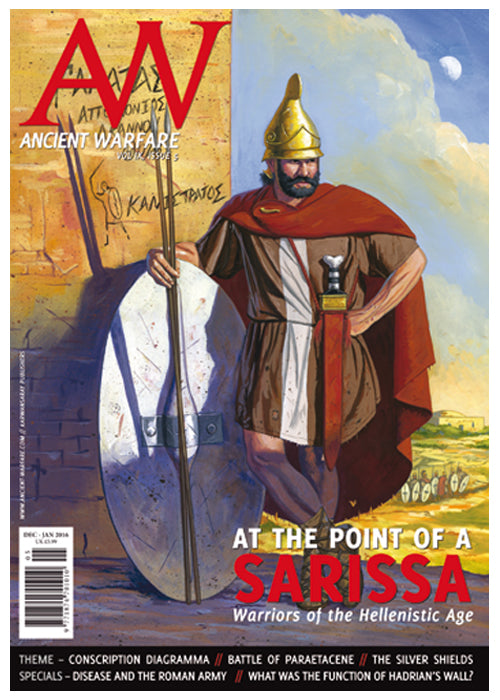
Ancient Warfare Magazine Vol. IX.5 - A Punta De Sarissa
Choose options
Enjoy Ancient Warfare Magazine Vol. IX.5 - At the Tip of Sarissa
Ancient Warfare Magazine Vol. IX.5 - At the Point of Sarissa
Warriors of the Hellenistic period
Topic: Paul Johnson, at the tip of Sarissa - Historical Introduction
When Alexander fell ill in Babylon, he was lord of a vast but fragile empire and commander of a large and experienced army, but he lacked a ready heir. On his deathbed, the warrior king is reported to have said that his empire should pass to the strongest (Arian 7.26.3; Diodorus 17.117.4), anticipating the violent power struggle that consumed the following decades.
Source: Michael J. Taylor, The Macedonian Conscription Charta - Children and the Elderly
Macedonia's position as a Hellenistic power rested on its ability to mobilize large national armies of rugged Macedonian peasants. Indeed, only when Philip II began to assemble a massive infantry army did Macedonia transform from a weak and venal state into a major international player. The Antigonid dynasty (277–168 BC) inherited the military organization and recruitment patterns of Philip and Alexander. However, by the beginning of the 2nd century BC, the Macedonian king desperately needed to muster troops to counter a new threat: Rome.
Topic: Manousos e. Kambouris, one identity, three units, and many functions - the hypaspist body
The elite Hypaspist Corps was a special unit inherited by Alexander along with the other components of the Macedonian army. The importance of these troops, not only during the great battles of Philip and Alexander, has aroused the interest and curiosity of many scholars.
Subject: Andrew Hillen, The Rise and Fall of the Achaean League - Citizen Soldiers in the Hellenistic Age
The army of the Achaean League stands in stark contrast to the royal armies that appeared after Alexander's death. More than anything, the Achaeans represent the continuing evolution of classical citizen soldiers. In the war-torn world of the Hellenistic kings, the citizen soldiers of the League fought to defend themselves with all the strength they had. Though they pale in comparison to other standing armies of the time, the efforts of these soldiers helped create a new kind of Greek community.
Subject: Haggai Olshanetsky, Jewish soldiers in Hellenistic armies - warriors of Zion
Jewish service in ancient armies remains a rarely discussed topic, especially in the case of armed service under Hellenistic rule. One reason for the silence surrounding this topic is the way Jews tend to remember the Seleucid Empire, one of the major kingdoms of the Hellenistic period. Jews celebrate Hanukkah annually in commemoration of their victory over the Seleucids and their achievement of independence in the second century BC.
The Reenactor: Kurt Schrauder, a Late Hellenistic Macedonian Officer - Splendid and Glorious
During the Cleomenean War (228–222 BC), Macedonia under King Antigonus III joined a coalition with the Achaean League against Sparta, which attempted to restore its former hegemony over Greece for the last time. While actual fighting was confined to the Peloponnese Peninsula, it took several years before the coalition could claim victory. In 222 BC, the united forces of the Achaean League and the Kingdom of Macedonia marched into the homeland of their Laconian enemies and achieved a decisive victory at Sellasia.
Subject: Sidney E. Dean, Alexander's Fight for Asia - The Battle of Paraetacene
The Battle of Paraetacene (or Paraitakene) was part of the larger power struggle among Macedonian generals following Alexander the Great's death in 323 BC. Perdiccas initially became regent for Alexander's heirs, his mentally ill brother Philip III and Alexander's infant son, Alexander IV. When Perdiccas attempted to marry Alexander's sister and thus attain power,
For the crown itself, several rival generals led by Antipater rebelled (322 BC). Alexander's secretary, Eumenes, now satrap of Cappadocia and Paphlonia, supported Perdiccas. This conflict, known as the First Diadochian War, ended with Perdiccas' death in May 320 BC and Antipater's accession to regent. The victors condemned Eumenes to death.
Subject: Marc G. Desantis, The Silver Shields after Alexander - The War of the Old Men
Alexander's hypaspistai (shield-bearers) played a crucial role in Alexander's grand ensemble of battles at the Granicus, Issus, and Gaugamela. Since the hypaspists were relied upon to hold the Macedonian battle line as it thinned, they probably carried equipment more suitable for open-order combat, such as the 7- to 8-foot-long boat and large hoplite shield, than that employed by the ordinary members of the phalanx, who wielded the longer, two-handed pike sarissa.
The Hypaspists most likely gained the regiment's nickname of Argyraspides, or "silver shields", at the beginning of the Indian campaign in 327 BC.
Topic: Robert Holmes, Desertion, and the Hellenistic Soldier - To the Strongest
During the Hellenistic period, entire units and common soldiers routinely deserted to the enemy and joined the opposing army. Hellenistic soldiers could choose to desert before a battle, or even in the middle of one. On many occasions, captured soldiers were incorporated en masse into the army after a battle. Desertion to an enemy army was a regular part of the Hellenistic soldier's experience and was encouraged by the nature of Hellenistic warfare.
Special: Brian Burfield, Disease and the Roman Army: Fighting the Hidden Enemy
Our image of the Roman soldier is usually that of a strong and robust individual, ready for work and battle.
Yet we rarely imagine a haggard-faced legionary waking one morning from a feverish, fitful sleep with his tongue so swollen and dry that he cannot speak. As the illness has left him too weak to walk alone, he has to be helped to the latrine. Having become too weak to even remain upright on the wooden seat, he soon collapses, face down, on the floor. Later, he is found where he had fallen, amid the filth and stench, dead. For a legionary, it was far more likely to succumb to an illness than to die or be wounded by a sword or a crossbow. Until very modern times, it was a disease that killed and rendered unfit for action more soldiers than any of the weapons of war.
The debate: Duncan B. Campbell: Military defense or customs barrier? - The role of Hadrian's Wall
A recent book claims that Hadrian's Wall is larger and grander than was strictly necessary. This analysis, however, raises a more fundamental question: how do we know what was strictly necessary on the border of Roman Britain in 120 AD? Why are some scholars certain that Hadrian's Wall was designed to a higher standard than its purpose required? Ultimately, what was the purpose of Hadrian's Wall?
Hollywood Novels: David L. Reinke, Following in the Footsteps of Quo Vadis? - Silver Chalice
Based on the best-selling novel by Thomas Costain, The Silver Chalice (1954) was Warner Brothers' attempt to cash in on the popularity of sword-and-sandals films pioneered by MGM's 1951 box office hit, Quo Vadis. However, almost from the first frame, it's clear that Warner Brothers and its director, Victor Saville, had no idea what they were doing.
At Tienda Medieval, we have thousands of medieval and other period products. Discover them!
+48 Reseñas
vicentaFue fantástico 100℅ recomendable
FernandoCalidad del producto, seriedad y rapidez en el envío.
Santiago AlejandroMuy buen producto, punta lanza es muy bonita y vino bien embalada y protegida.
JOSE ALEJANDROun excelente producto una excelente atención les recomiendo 100%
RicardoExcelentes productos y una magnífica atención por su parte, totalmente recomendable, seguiré comprando
AdriánUn indudable 5, súper fácil de comprar ya que la página es muy intuitiva al buscar productos y hacer los pagos. Aproveché la increíble oferta que pusieron para la Anduril (me di cuenta gracias al maravilloso TikTok) y sin duda una pieza increíble, unos detalles muy muy bonitos y nada mas agarrarla se nota la calidad del producto. Muchísimas gracias por el servicio, ya se que se puede confiar plenamente en tiendamedieval para cualquier pieza de dicha época e incluso de la ficción. Gracias de nuevo, buenas tardes 😊
AntonioRápido, cómodo y seguro....buen producto, lo recomiendo...
MiguelUn producto muy bueno, mejor de lo que me esperaba, muy buena calidad , 100% recomendable
AarónExcelente producto
Jose MaríaExcelente un producto 100% lo recomiendo
Envío gratis
Toda la península Ibérica a partir de 60€ (*No incluye islas) y envíos a todo el mundo consulta nuestras tarifas
Servicio al cliente
Estamos disponibles de lunes a viernes para resolver tus dudas.
Pago Seguro
Cumplimos con todas las normativas para asegurar el Pago Seguro
Contacta con nosotros
¿Necesita contactarnos? Simplemente envíenos un correo electrónico a [email protected]