





Ancient Warfare Magazine Vol. IX.3 - Powerful Rulers of Anatolia
€11,94 EUR
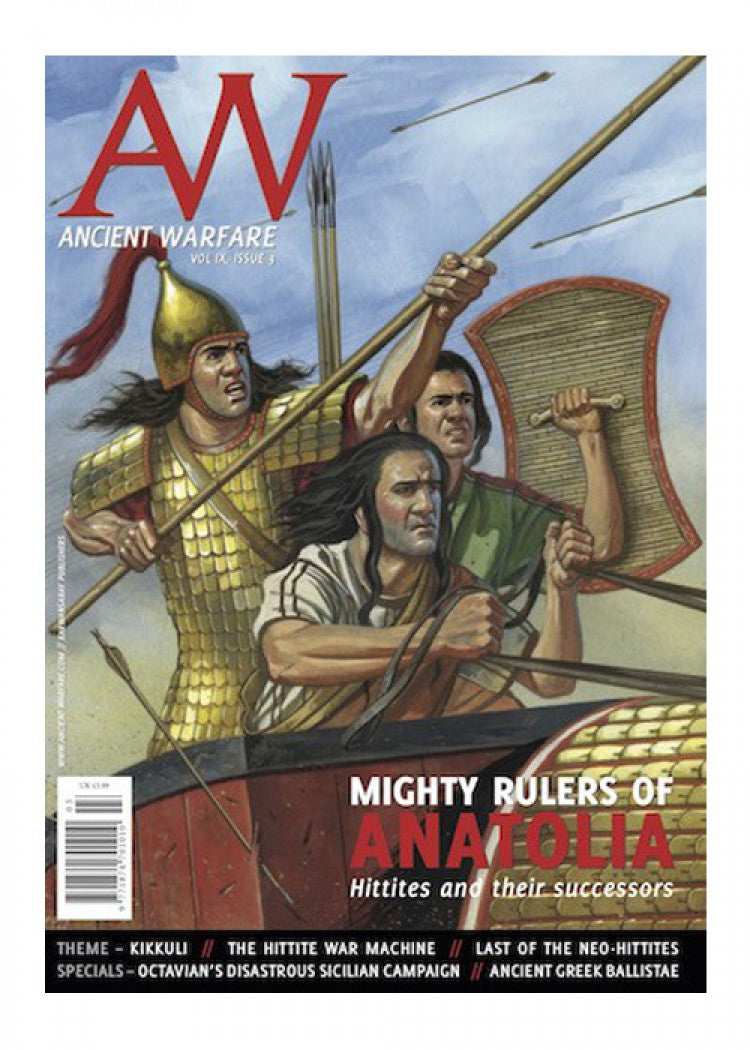
Ancient Warfare Magazine Vol. IX.3 - Powerful Rulers of Anatolia
Este productos se enviará: 7-10 Day Shipping
Choose options
Este productos se enviará: 7-10 Day Shipping
Este productos se enviará: 7-10 Day Shipping
Purchase Ancient Warfare Magazine Vol IX.3 - Powerful Rulers of Anatolia
Ancient warfare magazine vol ix.3 - powerful rulers of anatolia: the hittites and their successors
Topic: arianna sacco, the hittites and their successors: historical introduction
Anatolia juts out from Asia and constitutes an important gateway to Europe. It is essentially a large peninsula, bordered by Syria to the south, Mesopotamia to the east, and the Aegean to the west. Over time, it has been home to a remarkable number of distinct peoples, who spoke a wide variety of different languages. In the second millennium BC, a powerful kingdom arose whose leaders rubbed shoulders with powerful rulers from other parts of the Near East: the Hittite kingdom.
The source: sean manning, reading a hittite clay tablet: the governance of the hittite guard
Organizers of parades, magazines, and ceremonial guards must deal with the tension between human fragility and the desire for security and order. The Hittites were no exception. Sometime in the mid-second millennium BC, an anonymous official proclaimed how one of these conflicts was to be resolved (tr. jared l. miller): however, if someone is worried about their bowels, then one comrade tells another comrade, so that this also reaches the chief of the personal guard (thus): 'can he go to urinate?' then the chief of the guard will say: "he may go." any bodyguard who goes to urinate (without asking),
Although his majesty will take note.
Topic: konstantin nossov, the art of bronze age fortification - hittite defensive structures
The Hittites were matchless builders of fortifications. The defenses of their cities, particularly those of Hattusa, demonstrate the perfect development of the art of fortification in the Near East in the Bronze Age. The formidable defensive structures of the Hittites encompassed all the achievements of the Near East of the time. Today they lie in ruins, but with the help of archaeology, we can attempt to reconstruct them.
Topic: steven weingartner, a master of mitanni horses - kikkuli
Sometime between the late 15th and 14th centuries BC, a master of Mitanni horses named Kikkuli entered Hittite service to train horses for the Hatti chariot. In accordance with this task, he wrote a training manual that established a seven-month regimen designed to prepare young horses both physically and psychologically for chariot combat. Preserved mainly on four clay tablets (plus a fragment of a fifth) and written primarily in the Hittite language, the 1,080 lines of cuneiform inscriptions that constitute the so-called "Kikkuli text" exhibit a genius for horse care and conditioning that anticipated the scientific advances of modern-day equine behaviorists.
Topic: sidney e. dean, the hittite war machine, 1700-1200 bc - bronze age superpower
During its span of approximately 500 years, the Hittite kingdom (old and new) repeatedly rose to the rank of regional superpower. Hittite armies sacked Babylon, destroyed the Mittani empire, occupied northern Syria and Lebanon, and repelled the Egyptian army. At its peak, the Hittite empire extended from western Anatolia to upper Mesopotamia and the northern Levant. The effective Hittite war machine made this possible.
Topic: erich b. anderson, rise and fall of minor kingdoms - the last of the neo-hittites
When the last king, Suppiluliuma II, abandoned the royal city of Hattusa in 1185 BC, the Hittite empire collapsed. However, the land of Hatti did not vanish; rather, it changed and transformed into several independent kingdoms and city-states spread throughout southeastern Anatolia and northwestern Syria. With Carchemish, the ancient provincial capital of a Hittite viceroy, at the center of the region, these Neo-Hittite states thrived for several centuries with very little external intervention. However, in the 9th century BC, foreign enemies gradually forced the small kingdoms to submit, until the revitalized Assyrian empire finally completely eradicated their sovereignty and turned the entire region into several imperial provinces.
Topic: robert holmes, a greek tradition of anatolian invention - the armorers of caria
While the hoplite panoply is a hallmark of the ancient Greek soldier, a Greek tradition dating back to before the time of Herodotus attributes to the Carians, a non-Greek people of Anatolia, the invention of several of the key features of the panoply. Although various ancient sources attest to this tradition, the archaeological evidence is virtually nonexistent.
Special: marc g. desantis, the disastrous first expedition of octavian to sicily - against pompey
In 40 BC, Rome was groaning under the pressure of endless wars, famine, and economic upheaval. Although the civil war of Julius Caesar and the Senate had ended some time ago, with Caesarian forces achieving victory, there was still much fighting and misery throughout the empire. Octavian, as heir to the now-deified Caesar, had assumed the mantle of the fallen dictator in his own bid for supreme power after the assassination of his great-uncle in 44 BC. Mark Antony, Caesar's brave and trusted officer during his campaigns in Gaul and the civil war, was also seeking power.
The debate: duncan b. campbell, what was the ballista really like? - euthytones & palintones
Even after a century and a half of academic research, the names by which the ancients identified the different types of catapult still cause confusion. But no two terms have proven so intractable and have generated as many theories and explanations as "euthytone" and "palintone." Ancient writers claimed that all two-armed catapults fell into one or the other of these categories. There has always been consensus on the design of the euthytone arrow-thrower, but over the years, scholars have disagreed on the design of the palintone, its stone-throwing counterpart, known to the Romans as the ballista. So, will we ever be able to say with precision what the ancient ballista was really like?
Hollywood novels: david l. reinke, the eternal queen - cleopatra
Despite not being very significant historically speaking, Cleopatra has always been popular with modern audiences, a fact that would please her greatly. In recent years, new biographies about the Ptolemaic queen have been published, along with the release of several works of historical fiction, including a well-received young adult novel by Vicky Alvear Schecter about Cleopatra's daughter. Hollywood has not sat idly by either, with new feature films in development.
In Todo Medieval we have thousands of medieval and other era products. Discover them!
Free shipping
The entire Iberian Peninsula from €60 (*Does not include islands) and worldwide shipping check our rates
Customer service
We are available from Monday to Friday to answer your questions.
Secure Payment
We comply with all regulations to ensure Secure Payment
Contact us
Need to contact us? Simply send us an email at [email protected]
