





Medieval Warfare Vol. 6 - The Masses Are Rising
€11,14 EUR
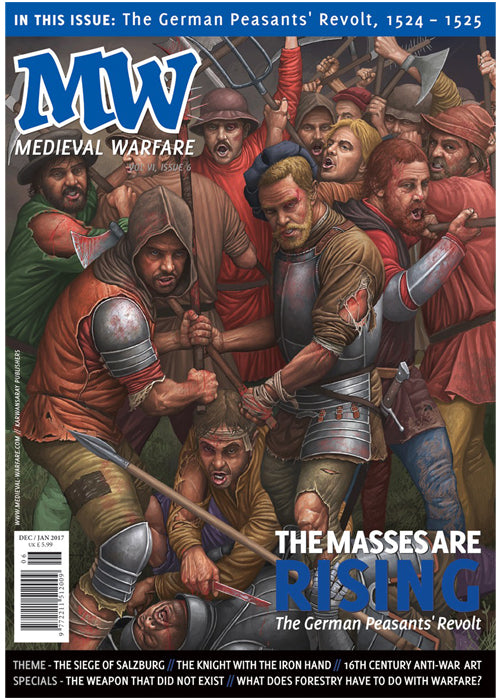
Medieval Warfare Vol. 6 - The Masses Are Rising
Este productos se enviará: 7-10 Day Shipping
Choose options
Este productos se enviará: 7-10 Day Shipping
Este productos se enviará: 7-10 Day Shipping
Delight in Medieval Warfare Vol VI.6 - The Masses are Rising
Medieval Warfare Vol VI.6 - The Masses are Rising
The German Peasants' War
Topic: Kelly DeVries, A Look at the German Peasants' Revolt - Lucifer and His Angels
Why would the peasants revolt? The answer once given by historians influenced by Marxist economic and historical thought was that they were oppressed by those who, in a pre-industrial historical context, essentially owned them. This ownership gave these lords the right to determine a near-daily regime of hard agricultural labor for their peasants, whose only respite came from work.
The moments when they were worshipping in their churches or participating in church holy days and other activities. The peasants were simply rebelling against this oppressive forced labor.
Topic: Erich B. Anderson, Landsknechts in the German Peasant Armies - Wildcards
In early April 1525, the peasant army known as the Lake Band broke through across Upper Swabia, seizing a considerable number of precious castles from their aristocratic enemies. Led by Dietrich Hurlewagen of Lindau and Hans Jacob Humpis of Senftenau, the formidable group of peasants originated near Rappertsweiler on Lake Constance with 12,000 armed men. The large and well-equipped force met little resistance until the morning of April 15, when the 7,000 soldiers of the Swabian League confronted them on the outskirts of Weingarten. At first, the two sides exchanged artillery fire, but then, instead of ordering an attack on the peasant troops, the League commander, Georg, Truchsess von Waldburg, carried out a tactical withdrawal behind the village of Gaisbeuren. On April 17, the Steward still refused to fight a pitched battle and decided he preferred to sign a treaty with the band, for one important reason: the many Landsknecht within their ranks.
Topic: Jean-Claude Brunner, The Prince-Archbishop Against the People - The Siege of Salzburg
In July 1525, the Prince-Archbishop of Salzburg looked down from the imposing Hohensalzburg fortress at his angry subjects in the city below. Would the relief force, led by the famous father of the Landsknechts, Georg von Frundsberg, arrive in time?
Topic: Sidney E. Dean, Götz von Berlichingen, Reluctant Leader - Knight of the Iron Hand
Faithful knight, oath-breaker, robber baron, incorrigible feudalist, mercenary, landowner: Götz von Berlichingen was all of those things. In 1525 he added insurgent leader to his list of monikers, becoming a captain and commander of one of the largest popular armies of the Peasants' War.
Topic: Iason-Eleftherios Tzouriadis, Pacifist Propaganda in the 16th Century - Death, Violence, and Sex
As the Middle Ages drew to a close, artists crossed borders to take their work to new horizons. Media and exploring new themes. Some were now eager to show us both the absurdity and the horror of war as they saw it. What they produced was striking and profound.
The Source: Murray Dahm, Engels on the German Peasants' War - Through Modern Eyes
Friedrich Engels' *The Peasant War in Germany* was first published in 1850, inspired by the recent events of the 1848 revolution in Germany. Engels saw parallels between the two events and considered that the same forces (socio-economic and political rather than religious) were at play. It became, and remains, the most prominent history of the war, but it must be read with caution.
Special: Danny Lake-Giguere, Royal Forests During the Hundred Years' War - Seeds of War
Historians have been increasingly examining the logistics of medieval warfare. For example, armies needed wood to build everything from ships to crossbows. By the late Middle Ages, the demand for this wood would be so great that governments had to find ways to manage their supply.
The Weapon: Paul B. Sturtevant, The Medieval Weapon That Never Existed - The Military Flail
Anyone interested in the Middle Ages, from hobbyist to professor, probably knows what a military flail is. It is one of the most iconic weapons of the era. It has a short handle (approximately the length of a forearm), a long chain, and a spiked head at the end, and is wielded with one hand. They are everywhere: movies, museums, weapon reproduction shops. They also never existed.
Knights of the Cinema: Murray Dahm, Silent, Dirty, and Oppressed - Peasants in Film
At Todo Medieval we have thousands of medieval and other era products. Discover them!
Free shipping
The entire Iberian Peninsula from €60 (*Does not include islands) and worldwide shipping check our rates
Customer service
We are available from Monday to Friday to answer your questions.
Secure Payment
We comply with all regulations to ensure Secure Payment
Contact us
Need to contact us? Simply send us an email at [email protected]
