





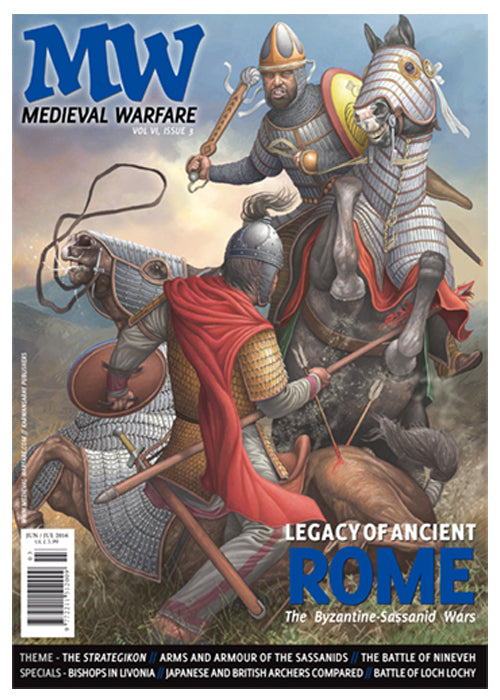
Medieval Warfare Vol. VI.3 - Legacy of Ancient Rome
Sold outEste productos se enviará: 7-10 Day Shipping
Choose options
Este productos se enviará: 7-10 Day Shipping
Este productos se enviará: 7-10 Day Shipping
Gift Medieval Warfare Vol VI.3 - Legacy of Ancient Rome
Medieval Warfare Vol VI.3 - Legacy of Ancient Rome
The Byzantine-Sasanian Wars
Topic: William E. Welsh, The Byzantine-Sasanian Wars - Bitter Rivals
From the ashes of the Parthian Empire, razed by the Roman legions in 224 AD, emerged a more aggressive successor state. The Sasanian kings were as skilled in diplomacy as they were in war. At the end of the 5th century, the Sasanians initiated a series of prolonged wars with the Byzantines along their heavily fortified common border. After a series of limited border wars, the rivalry exploded into all-out war.
The Source: Murray Dahm, The Strategikon and the Sasanians - Learning from the Enemy
The Strategikon, a Byzantine military manual supposedly written by Emperor Maurice (r. 582-602), offers remarkable insights into the stakes of war between the Sasanian and Byzantine empires. In Book 11.1, the author of the work distills everything he has observed and learned about how the Sasanians make war. Not only that, but he follows this with advice on how a commander could defeat such an enemy.
The Reenactor: Nadeem Ahmad, Arms and Armor of Sasanian Iran - Arming the Shahs' Knights
The Sasanian dynasty ruled Iran, much of the Near East, and parts of Central Asia between the mid-3rd and mid-7th centuries AD. They followed the Arsacid (Parthian) dynasty and were a conduit for many Central Asian influences into Iran and Europe. Their influence can be felt even today, as they helped shape the way nations, states, and courts functioned throughout Asia.
Topic: Haggai Olshanetsky, Justinian's Army at War - Fields of Byzantium
Some claim that Justinian I (r. 527-565 AD) was effectively the last of the Roman emperors. This is based on the nature of Justinian's rule: legislation and the desire to impose his rule on territories lost after the collapse of the Western Roman Empire in 476 AD, when Emperor Romulus Augustulus was deposed by the Gothic leader Odoacer (also known as Odovacer or Odovacar).
Topic: Daan Nijssen, Historical Background of the War 602-628 - What Inspired Khosrow?
The ancient dispute between Romans and Persians reached a climax in the war of 602-628. This surpassed all previous Roman-Persian wars in scale and destructiveness. The main cause of this escalation was the fanaticism of Khosrow and his unwillingness to make peace in 610. Instead of accepting Heraclius's peace offer, Khosrow decided to exhaust his reserves of wealth and manpower in a (self-)destructive war to destroy Byzantium. What inspired him to make this decision?
Topic: Sidney E. Dean, Battle of Nineveh, December 12, 627 AD - Byzantium's Pyrrhic Victory
After a decade of defense against the seemingly unstoppable Sasanians, Byzantine Emperor Heraclius I launched a counter-offensive in 622 AD. Between 624 and 626, he defeated five Persian field armies, including one led by Shah Khosrow II himself. Heraclius devastated parts of the northern Sasanian Empire, encouraged his Göktürk allies to do the same, and campaigned in the Caucasus to capture or neutralize Persian client states. In 627, he felt prepared to launch a decisive strike against his weakened enemy.
The Weapon: Owen Rees, Comparing Archers of Japan and Britain
An examination of two societies and the position of the archer within them can reveal great insight not only into the archer, but also the place of the bow within the wars of the era. By comparing two different cultures, a contrast and an exploration of the different roles the archer can play can be produced, something that cannot be fully appreciated using only one example.
Special: Artis Aboltins and Santa Jansone, Crusades in the Eastern Baltic Region
When the crusades are mentioned, most people immediately think of events in the Holy Land and tend to overlook the events that took place in Northern Europe in the late 12th and much of the 13th century. However, those "Northern Crusades" played a very important role in shaping the history of the entire region.
The Battle: Ross Cowan, The Battle of Loch Lochy, 1544 AD - More Like Lions Than Men
On July 15, 1544, Hugh Fraser, the 3rd Lord Lovat, marched north along the shore of Loch Lochy. The chief of the Frasers was accompanied by his son and heir, Simon, Master of Lovat, and his nephew, Ranald Gallda, a claimant to the title of Captain of Clanranald. They were followed by 400 warriors, selected from the principal gentlemen and able-bodied men of the Clan Fraser. This host was about to fight one of the most famous battles in Highland history.
Movie Knights: Murray Dahm, Medieval Warfare in Film - King Arthur II
In our last Movie Knights article, we briefly examined general depictions of King Arthur in film. This time we will delve into the details of several films and examine their portrayal of warfare: especially John Boorman's Excalibur (1981), Monty Python and the Holy Grail (1975), and Knights of the Round Table (1953). >
At Todo Medieval we have thousands of medieval and other era products. Discover them!
Free shipping
The entire Iberian Peninsula from €60 (*Does not include islands) and worldwide shipping check our rates
Customer service
We are available from Monday to Friday to answer your questions.
Secure Payment
We comply with all regulations to ensure Secure Payment
Contact us
Need to contact us? Simply send us an email at [email protected]
