





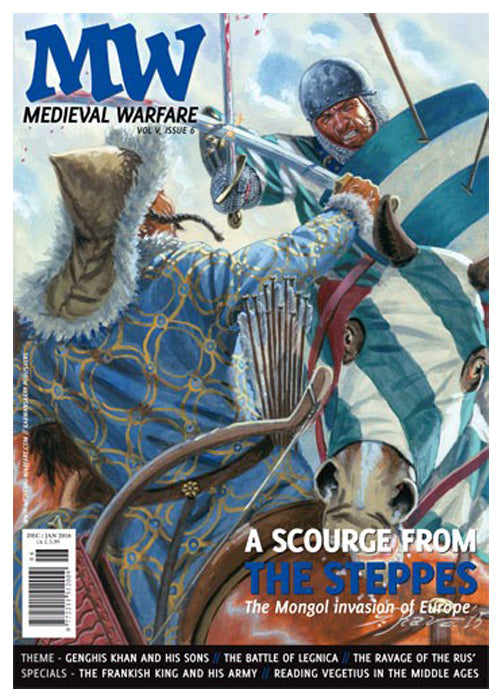
Medieval Warfare Vol V.6 - The Mongol Invasion of Europe
Sold outEste productos se enviará: 7-10 Day Shipping
Choose options
Este productos se enviará: 7-10 Day Shipping
Este productos se enviará: 7-10 Day Shipping
Purchase Medieval Warfare Vol V.6 - The Mongol Invasion of Europe
Medieval Warfare Vol V.6 - The Mongol Invasion of Europe
Topic: Paul Sjöberg, Historical Introduction - The Scourge of God
In the 13th century, perhaps the most rigidly religious period in the history of the Old World, the most transcendental event
imaginable occurred in the lands of Islam and Christendom. From the east came a wave of destruction and savagery: Genghis Khan and his Mongol warriors had subdued the Chinese civilization and would soon rain death upon thousands of devout Muslims and Christians. Both soldiers and civilians would perish in the wake of the Mongol armies as they advanced toward the heart of Christendom, undefeated and seemingly unstoppable.
The Source: Filippo Donvito, The Travels of Giovanni da Pian del Carpine - Mission to the Great Khan
In December 1241, after the devastating conquest of Russia and the destructive invasions of Hungary and Poland, the Mongols disappeared mysteriously (and miraculously) from Europe. To discover the truth behind these terrible and unexpected events, Pope Innocent IV organized the first mission to the heart of the Mongol Empire.
Topic: Kurt Hamilton, Genghis Khan and His Sons - All in the Family
As the nations of Europe waged a back-and-forth struggle against each other, Genghis and his descendants razed city after city, bringing the greatest empires of the time to their knees. It would be under the command of two charismatic Mongols, Batu and Subutai, that Europe would recognize the magnitude of the destruction galloping toward them. These two commanders had great success in their initial advance into Europe, but withdrew to Mongolia after only five years of campaigning.
Topic: Borja Pelegro, Arms and Armor of the Mongol Warrior - Storm of the Steppes
Everyone must possess at least the following weapons: two or three bows, or at least one good one, three large quivers full of arrows, an axe, and ropes for transporting war machines. As for the rich, they have swords that are pointed at the tip but sharpened only on one side and somewhat curved, and they have a horse with armor; their legs are also covered and they have helmets and breastplates. The monk Giovanni de Pian del Carpine, who visited their capital in the year 1246, wrote this description of the arms and armor of a Mongol warrior. With the Golden Horde advancing ever further westward, European rulers considered any information about the Mongols and their way of life to be invaluable.
Topic: William E. Welsh, The Mongol Devastation of Poland - The Battle of Legnica
In February 1241, Orda, brother of Batu Khan, led 10,000 Mongol warriors into Poland, a weak kingdom divided among four quarreling dukes. Their mission was to prevent Polish and German forces from marching to the aid of the Hungarian King Béla IV, whose kingdom was the primary target of a Mongol invasion of Eastern Europe. After leaving a wide swath of destruction in southern Poland, Orda's forces clashed with those of Duke Henry II the Pious of Silesia in a battle near Legnica. Although the Poles initially drove the Mongols back, the fearsome horse archers employed cunning tactics to crush Henry's Polish army.
Topic: Konstantin Nossov, The Mongol Western Campaign - The Ravages of Rus
A new threat appeared in Central Asia in the late 12th century: the Mongols. Having united all the Mongol tribes, Temujin was renamed Genghis Khan (the Khan of the World) in 1206. At first, neighboring countries did not pay much attention to the event. However, soon Genghis Khan's army attacked them, causing death and devastation.
Special: Jukka Salonen, Reputation in Medieval Scandinavia - Law and Honor
The Scandinavian Medieval period was violent, but it was governed by strict, almost legal codes of conduct. One could not strike a man down and think it would go unnoticed, but everything depended on who you and the victim were. The way you were viewed by other people meant everything. A man would stand or fall based on his honor and reputation. An examination of how the laws and written and unwritten conventions of the Viking Age functioned shows that High Medieval Scandinavia was not the unruly and barbaric backwater it is often thought to be.
Special: Peter van Dop, Frankish Armies in the 6th Century - The King's Tool
In 582 AD, the Frankish kingdom was torn apart by civil war as an alliance between Guntram, King of Burgundy, and Childebert, King of Austrasia, came to an end. The Merovingian territories were divided into three kingdoms: Neustria, approximately present-day Normandy, led by King Chilperic; Burgundy, ruled by his brother Guntram; and Austrasia, now the northern part of Western Europe, where his nephew, Childebert, was king. Chilperic, King of Neustria, took advantage of the moment to start a war against Guntram, as Guntram was now alone. This information reaches us through the eyes of the medieval bishop Gregory of Tours, as he wrote it in his History of the Franks.
Special: Murray Dahm, The Use of Vegetius in the Middle Ages - Learning from the Romans
The late Roman military treatise known as De Re Militari by Flavius Vegetius Renatus was immensely popular in the medieval period. Although it was not the only Roman treatise known to medieval writers and commanders, it is worth remembering to what extent ideas dated back to this late Roman treatise.
At Todo Medieval we have thousands of medieval and other era products. Discover them!
Free shipping
The entire Iberian Peninsula from €60 (*Does not include islands) and worldwide shipping check our rates
Customer service
We are available from Monday to Friday to answer your questions.
Secure Payment
We comply with all regulations to ensure Secure Payment
Contact us
Need to contact us? Simply send us an email at [email protected]
