





Medieval Warfare Vol V.1 - Betrayal and Treachery
€11,14 EUR
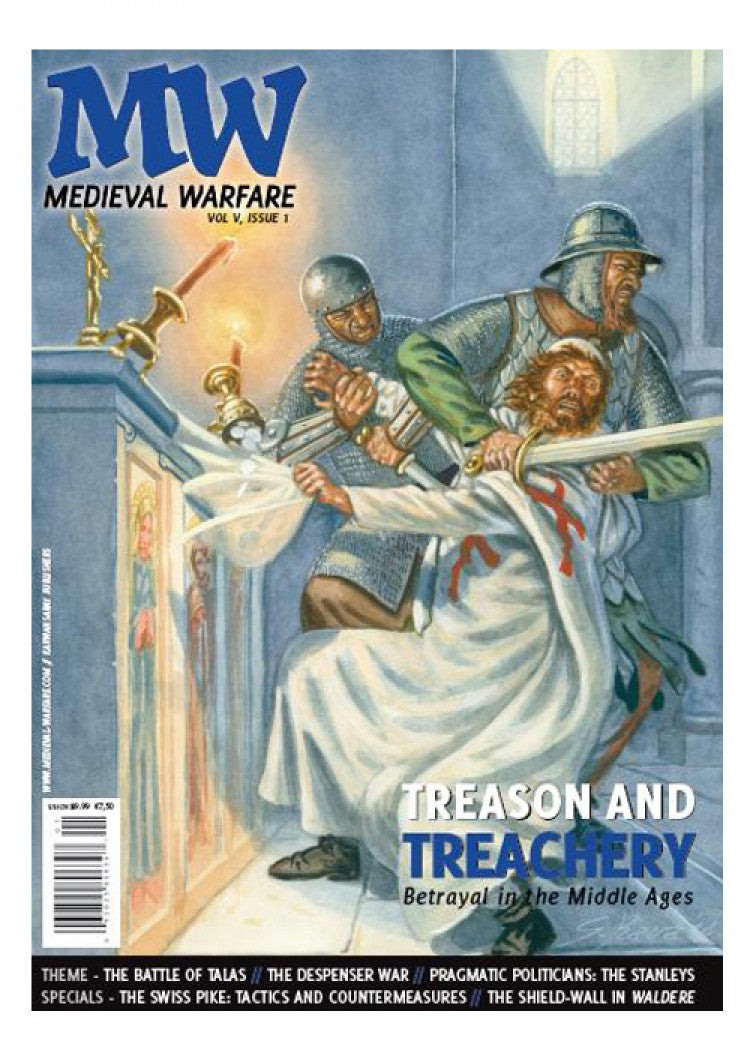
Medieval Warfare Vol V.1 - Betrayal and Treachery
Este productos se enviará: 7-10 Day Shipping
Choose options
Este productos se enviará: 7-10 Day Shipping
Este productos se enviará: 7-10 Day Shipping
Delight in Medieval Warfare Vol V.1 - Traitors and Treachery
Medieval Warfare Vol V.1
Theme: Traitors and Treachery - Treason in the Middle Ages
The new year has begun, which means a new issue of Medieval Warfare is out. Volume V begins with a topic that may be familiar to some of you who also read our sister magazine, Ancient Warfare: Traitors and Treachery. A while ago, my colleague came up with this idea, and we soon agreed to do an ancient version first, and a medieval one shortly after. The nature of the theme allowed us to cover different topics throughout medieval history, in Europe and the Near East, and I must say that I am very happy with the selection of articles we have chosen.
After a brief introduction, Kenneth Cline begins the theme of the issue by taking a close look at perhaps the most illustrious family in Byzantine history: the Doukai. By showing how various members of the Doukas family made intelligent use of Byzantine court politics, which included betraying their adversaries several times, Cline provides us with an enlightening picture of how Byzantine politics was perfectly suited for ambitious and treacherous aristocrats. In the end, it is quite possible that the actions of a few Doukai altered the course of Byzantine history forever, setting it on a path to ruin. The next article, written by Martin Dougherty, focuses more on an overview of medieval siege tactics; more specifically, it addresses several of the less conventional methods used to take a fortified city or fortress. Through various anecdotes, Dougherty teaches us that victories were not always a matter of attacking or starving; castles could easily be lost through mutual agreement, forged orders, and, of course, treachery from within. This is followed by Nils Visser's account of politics in the Low Countries in the early fifteenth century. While medieval politics may have been dominated by men, that does not mean that women played no role (as we have already seen in Medieval Warfare IV-2). In fact, due to the nature of medieval politics, women could have been even more susceptible to political treachery than men. Visser describes how this was the case for Jacqueline of Hainault, who was backstabbed by both her family and her husbands.
While the focus of this issue is clearly on events closer to Europe, Filippo Donvito takes us much further, to the borders of the Chinese Tang Empire. Although actual Asian warfare is not something we plan to cover in detail in Medieval Warfare, the clash between the Near and Far East remains important to our Europe- and Middle East-focused approach. After all, it is quite possible that the outcome of such conflicts had an impact on the battlefield closer to our theme. This seems to have been the case for the conflict between Tang China and the Abbasid Islamic Caliphate. In the end, it was the Tang Empire that would be defeated; not directly through conventional tactics, but through the massive treachery of the Chinese Turkish auxiliaries. Donvito explains the historical background, ending with the course of the confrontation between East and further East: the Battle of the Talas River. With the Far East covered, regular contributor Sidney Dean takes us back to English politics, analyzing the Despenser War and the way King Edward II betrayed, and was in turn betrayed by, his nobles and allies, including even his wife, Isabella of France. The events surrounding the Despenser War paved the way for the rise of Edward III, who eventually had to turn against his own mother and take control of the country by force. Last but not least, regarding the theme, comes Joseph Hall, with his article on perhaps the most famous of medieval traitors: the Stanley family. Hall explains how the Stanleys, although they started as a minor family, managed to reach the top through marriage politics and, most importantly, a clever use of political maneuvering and backing the right claimant. Thus, they managed to survive English politics during the chaotic events surrounding the Wars of the Roses; in fact, they would prove to be fundamental in deciding who would finally win the throne.
As for the non-themed articles, we once again offer a varied selection. We start with a rather unconventional article, in which Morgan Kuberry analyzes some of the problems one encounters when moving a large collection of medieval objects from one museum to another. She does so based on her experiences moving the Higgins Armory Museum collection (the second largest arms and armor collection in the US) to its new home at the Worcester Art Museum. The next non-themed article is written by specialist Olivier Bangerter. While Swiss units and some of their weapons have been discussed before in Medieval Warfare, we felt it was time to shed more light on perhaps the most important weapon in their arsenal: the pike. In his article, Bangerter covers the most important aspects, including not only shape, size, and tactics, but also those countermeasures that would eventually break the pike's dominance on the medieval battlefield. Murray Dahm closes this issue with his 'The Debate' style article on the possible reference to shield wall tactics in the Anglo-Saxon poem Waldere. Finally, Gareth Williams explains the cover scene, talking about an event that is actually the origin of our own Friday the 13th.
At Todo Medieval we have thousands of medieval and other historical products. Discover them!
Free shipping
The entire Iberian Peninsula from €60 (*Does not include islands) and worldwide shipping check our rates
Customer service
We are available from Monday to Friday to answer your questions.
Secure Payment
We comply with all regulations to ensure Secure Payment
Contact us
Need to contact us? Simply send us an email at [email protected]
