





Medieval Warfare Vol III-6 - Heroic Legends in the Middle Ages
€11,14 EUR
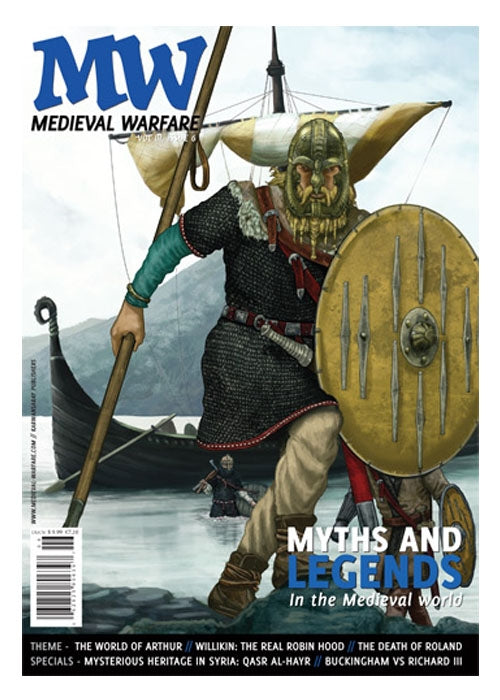

Medieval Warfare Vol III-6 - Heroic Legends in the Middle Ages
Este productos se enviará: 7-10 Day Shipping
Choose options
Este productos se enviará: 7-10 Day Shipping
Este productos se enviará: 7-10 Day Shipping
Enjoy Medieval Warfare Vol III-6 - Heroic Legends in the Middle Ages
Medieval Warfare Vol III-6 - Heroic Legends in the Middle Ages
Heroic legends in the Middle Ages
Theme: Nils Visser, 'Historical Introduction - Larger Than Life'.
The theme of this issue, legendary heroes, may seem simplistic at first glance, but scratching the surface reveals multi-layered complexities. This makes the theme of this issue difficult and requires a careful approach for several reasons.
Theme: Kai Grundmann, 'The Ancient Warrior and His Medieval Legacy - Theodoric the Great'.
Theodoric, who ruled the Goths from 471 to 526, led them to Italy and built a strong successor kingdom to the Roman Empire. He almost reached imperial power and his Roman subjects appreciated emperors like Trajan, while his Goths revered him for his astute strategy and his bold charges against enemy lines when he was younger. Theodoric quickly became a character in early medieval legends and sagas, a role model for Charlemagne and noble knights, but he was also condemned by the Church for being an Arian heretic who had let Pope John I die in prison and had executed the innocent and noble Symmachus.
Theme: Patrick S. Baker, 'The Battle of the Pass of Roncevaux - The Death of Roland'.
Illustrated by Carlos García and Ru-Mor.
Roland, Charlemagne's paladin and the bravest of all French knights, was dying. He and his fellow Christian warriors had killed tens of thousands of Saracen enemies, but of the 20,000 men under his command, only Roland remained alive. After blowing his horn and placing his unbreakable sword, Durendal, nearby, Roland lay down and died like a conqueror, facing the enemy (The Song of Roland, trans. by A. S. Way, p. 92), without having been touched by an enemy weapon. Or so says the chanson de geste, the song of heroic deeds. But what is the story behind the legend?
Theme: Nicholas Whaley, 'Blades of Victory, Symbols of Freedom: The Swords of Grunwald'.
How is it possible that a pair of simple, bare swords, crafted over 600 years ago, become a national symbol of freedom that persists to this day? The swords were not crafted by a master blacksmith, nor were they wielded by a fierce warrior. In fact, these swords never entered battle, although they did incite one, a battle that would decide the fate of nations, and the swords became an immortal symbol of victory and independence: the Grunwald swords.
Theme: Sidney E. Dean, 'The Arthurian Legend in Light of Military History: Dux Bellorum, Comes Brittaniarum?'.
King Arthur. Two simple words that stir the imagination and the soul. And raise questions. Was there really an individual war leader (not necessarily a king or bearing the name Arthur) who organized an effective resistance against the barbarian invaders? If there was a leader, was he Roman, British, both, or, as some theories suggest, neither? How did he train and organize his forces? Exploring all these questions and the many competing (and equally valid) theories would occupy a book (and there are many such books available). Instead, this article will examine the earliest chronicles of the Arthurian cycle and compare their content with the known military situation in sub-Roman Britain.
Theme: Sean McGlynn, 'William of Kensham - Hero of the Resistance'.
Illustrated by Maxime Plasse and José Daniel Cabrera Peña.
William of Kensham is one of England's great unsung heroes. A guerrilla fighter who led a very effective resistance against the French invaders, his lack of noble status has deprived him of the full recognition he deserves. However, in his lifetime, he was an inspiring figure mentioned by contemporary chroniclers, who recognized his role in a largely forgotten war.
Theme: Filippo Donvito, 'A Mysterious Letter to the Christian West - The Legend of Prester John'.
Illustrated by Milek Jakubiec.
Between 1155 and 1175, various versions of a strange letter circulated through European royal courts. They were addressed to the most powerful rulers of the Christian West: the two emperors, the Pope, and the King of France. The author called himself "Prester John" and claimed to be the monarch of a virtually unlimited kingdom stretching from Babylon to India, where contemporary scholars located the Garden of Heaven.
Theme: Jean-Claude Brunner, 'An Austrian Giant Cut Short - Andreas Baumkircher'.
Illustrated by Ganbat Badamkhand.
A humble beginning, an outstanding physique, brave actions, and a sudden, violent end: the life of the Austrian condottiero and rebel Andreas Baumkircher (1420-1471) includes all the elements of a tragic hero. Despite his personal enmity with the Holy Roman Emperor and his subsequent execution (a fate shared by his fellow military entrepreneur Albrecht Wenzel Eusebius von Wallenstein), Baumkircher is honored, as one of Austria's 56 great commanders, with a statue in the entrance hall of the Vienna Military History Museum.
Special Offers
The Castle: Dr. Konstantin Nossov, 'Mysterious Heritage in the Middle of the Syrian Desert: Qasr al-Hayr'.
Illustrated by Vladimir Golubev.
Qasr al-Hayr (also known as Qasr al-Heir) East and Qasr al-Hayr West are twin structures, separated by 200 kilometers, located east and west of Palmyra in Syria. Qasr al-Hayr means "walled castle" in Arabic. In fact, both structures in plan resemble a Roman fort in the desert: a rectangular space surrounded by defensive walls reinforced with towers. Their evidently defensive character, together with their architectural decoration and their location in the middle of the Syrian desert, provoked much debate in the 20th century. They were taken, on the one hand, for palaces, and on the other, for fortified outposts in the heart of a desert, some as caravanserais and others as castles.
The Rebellion: Elizabeth Norton, 'The Uprising That Threatened Richard III's Throne: The Buckingham Rebellion'.
Illustrated by Juhani Jokinen.
The brief reign of Richard III in England came to an end in August 1485 by Henry Tudor at Bosworth Field. What is less known is that Tudor was involved in another conspiracy two years earlier, which could easily have overthrown the last king of the House of York. It was only Richard's quick thinking, as well as some luck with the weather, that ensured the Buckingham rebellion, one of the most widespread conspiracies of the late medieval period, failed without a single battle being fought.
In Todo Medieval we have thousands of medieval and other era products. Discover them!
Free shipping
The entire Iberian Peninsula from €60 (*Does not include islands) and worldwide shipping check our rates
Customer service
We are available from Monday to Friday to answer your questions.
Secure Payment
We comply with all regulations to ensure Secure Payment
Contact us
Need to contact us? Simply send us an email at [email protected]
