




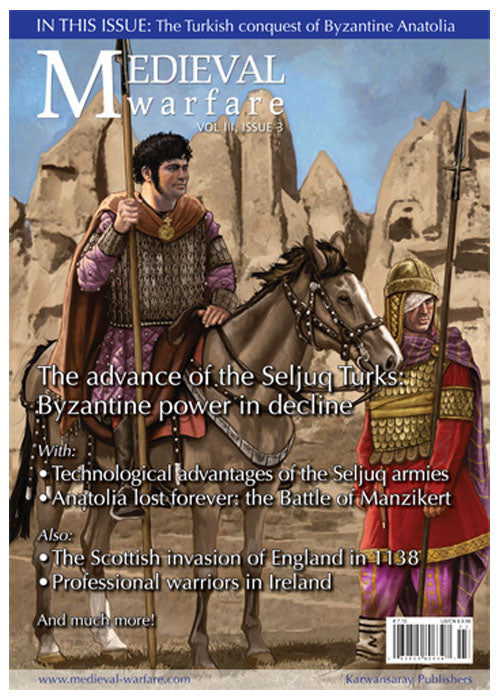

Medieval Warfare Vol III-3 - The Seljuk Turks Advancing
Sold outEste productos se enviará: 7-10 Day Shipping
Choose options
Este productos se enviará: 7-10 Day Shipping
Este productos se enviará: 7-10 Day Shipping
Delight in Medieval Warfare Vol III-3 - The Seljuk Turks Advancing
Medieval Warfare - III.3
Topic: The advance of the Seljuk Turks: Byzantine power in decline
Introduction: James Gilmer, 'Historical introduction: a storm gathering'. Illustrated by Carlos García.
At the death of Basil II in 1025, the Byzantine Empire was the strongest it had been in centuries. To the west, the Byzantines had achieved some control over all the land south of the Danube River and east of the Alps. In the east, Byzantine forces had occupied a line stretching south from the Black Sea along the Taurus Mountains, extending briefly into Syria to include the territory around Antioch. Militarily, the empire surpassed any of its contemporaries, with an available force of nearly a quarter of a million men.
Topic: Lukasz Rózycki, 'The works of Bryennios and Attaleiates - the art of Byzantine historiography'.
The work of every historian depends on good sources. Historians of the Byzantine Empire, both medievalists and specialists in antiquity, cannot rely on as many materials as those specializing in modern times. As such, every Byzantine historical source is of great value in providing information. When attempting to recreate the past from such sources, we must bear in mind that each author had different motives for writing. It could have been to ingratiate himself with the ruler, keep the memory of his ancestors alive, or fulfill the duty of a chronicler. Accounting for the motives that guided the authors, their sympathies and antipathies, allows us to identify unreliable sections of historical texts. The best results can be achieved by analyzing several accounts of a given event.
Topic: Joshua Gilbert, 'The Battle of Dandanaqan: we won it in Merv and lost it in Merv'.
The Battle of Dandanaqan, fought in the year 1040 between the Seljuk Turks and the forces of the Ghaznavid Sultanate, is one of the most decisive battles in eastern Islamic history. As a result, the Ghaznavids lost control of Khorasan and their western domains, which became the core of the Great Seljuk Empire.
Topic: Murat Özveri & Nils Visser, 'Technological advantages of the Seljuk armies - arrows, arrows, everywhere!'. Illustrated by Graham Sumner.
The roots of Seljuk archery go back to the first millennium BC and the practices of the Scythians, the Huns, and other early Asian traditions. Central Asian steppe horse archers have used very similar archery equipment and battle tactics throughout the centuries. This can sometimes lead to confusion when contemporary chroniclers had to record the identity of one tribe or another.
Subject: Dr. Konstantin Nossov, 'Seljuk fortified caravanserais in Anatolia: protecting travel and trade'. Illustrated by Vladimir Golubev.
Caravanserai means a building intended to house a caravan. The word 'caravan' derives from karban ('the one who protects trade'). To protect themselves against bandits, traveling merchants often grouped together; hence the word "caravan," which in European languages designates a group of merchants traveling together. The word "caravanserai," however, was rarely used in the East. The word used in Arabic was khan, which can also mean house and small inn. In Turkish-speaking areas, a caravanserai is called a han. Saray, a Turkish word of Persian origin (sarai), means palace or large house. Thus, caravanserai can be translated as “house/palace for caravans”.
Topic: Raffaele D'Amato and Kenneth Cline, 'When Anatolia was lost forever: the Battle of Manzikert'. Illustrated by Jason Jutaña and José Antonio Gutiérrez López.
It was getting late and his men were tired, having spent most of the day frustratingly chasing the cunning Turkish horsemen. As shadows lengthened over the parched plain near the city of Manzikert in Anatolia, the Roman Emperor Romanos IV Diogenes considered his options. He could continue the fruitless march to engage the main body of the enemy army, or he could retreat to his camp to try again tomorrow. The approaching twilight and the general exhaustion of his troops resolved the matter and Romanos ordered the imperial standard to be reversed, a signal for his troops to begin an orderly retreat. At that sign, the Roman army began to disintegrate and the Battle of Manzikert, until then practically tied, would culminate in a catastrophic defeat, resulting in the loss, within a decade, of much of Anatolia, the heart of the empire.
Topic: Stephen Bennett, 'The development of the Byzantine army: the Komnenian response to Seljuk victories'. Illustrated by Julia Lillo.
Between the mid- and late-11th century, a combination of internal imperial politics and a new strategic context demanded substantial changes in the fiscal and military organization of the Eastern Roman Empire.
Topic: Sidney Dean, 'The Battle of Myriokephalon - Byzantium's final offensive'. Illustrated by Milek Jakubiec.
After the Byzantine defeat at Manzikert (1071), Constantinople lost control of most of Anatolia to the Rum Seljuks. Toward the end of the 11th century, Byzantium resumed an aggressive policy of expansion, reconquering (over decades) territories on various borders of the empire. In 1161, Sultan Kilij Arslan II agreed to a peace treaty that favored Byzantium. The Seljuks retained control over central Anatolia, but the sultan accepted the pro forma status of a Byzantine vassal. However, this peace was not to last.
Features
The campaign: Sean McGlynn, 'The Scottish invasion of England in 1138: a no-holds-barred war'. Illustrated by Ru-Mor
For centuries, Anglo-Scottish relations were marked by invasions from south to north and vice versa. Two of the largest Scottish incursions occurred after the Middle Ages: in 1651, a large army marched as far as Worcester, before being crushed there by the republican forces of Oliver Cromwell; and, in 1745, the Scottish Jacobite army reached Derby before turning back. However, the medieval period saw the most frequent Scottish invasions of England.
The warrior: Arnold Blumberg, 'A new generation of professional soldiers (1250-1475): medieval Irish warriors'. Illustrated by Marc Grunert.
Forged in the crucible of the Viking onslaught and later the Anglo-Norman invasion and conquest, the Irish adapted to the changing mode of warfare that their enemies brought to their shores, forming professional mercenary armies.
In Todo Medieval we have thousands of medieval and other period products. Discover them!
Free shipping
The entire Iberian Peninsula from €60 (*Does not include islands) and worldwide shipping check our rates
Customer service
We are available from Monday to Friday to answer your questions.
Secure Payment
We comply with all regulations to ensure Secure Payment
Contact us
Need to contact us? Simply send us an email at [email protected]