





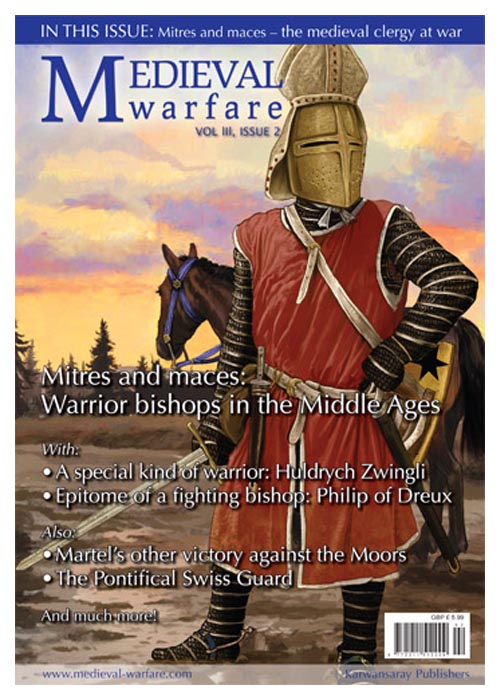
Medieval Warfare Vol III-2 - Warrior Bishops in the Middle Ages
Sold outEste productos se enviará: 7-10 Day Shipping
Choose options
Este productos se enviará: 7-10 Day Shipping
Este productos se enviará: 7-10 Day Shipping
Treat Yourself to Medieval Warfare Vol III-2 - Warrior Bishops in the Middle Ages
Medieval Warfare Vol III-2, 2013
Topic: Warrior Bishops in the Middle Ages
Introduction: Jonathan Sneddon, 'Historical Introduction: Warrior Bishops in the Middle Ages'.
Warrior bishops were present as early as the 10th century, as can be seen in Otto the Great's commitment of his bishops to the German Empire for military purposes. When one speaks of medieval bishops and priests, one imagines holy individuals in ecclesiastical robes, praying or preaching to their flocks. However, one could see bishops and archbishops leading their own retinues into battle, sometimes in full armor.
Topic: Sidney E. Dean, 'Odo, Bishop of Bayeux, Earl of Kent - Brothers in Arms'.
Illustrated by Pablo Outeiral.
Rogue and regent, conspirator and crusader, priest and strategic planner: Odo, the younger half-brother of William the Conqueror, was all of this and more. Odo, a driving force during the Norman invasion of England, remained William’s right-hand man on the island. That is, until Odo’s primordial ambition eclipsed even William’s wildest aspirations.
Topic: Gregory J. Liebau, 'War and Politics during the Italian Campaigns - Barbarossa and his Bishops'.
Illustrated by Johnny Shumate.
On May 29, 1167, before the walls of Tusculum, a battle took place between a communal army of Romans, numbering in the thousands, and a small German force sent to remind Pope Alexander III of his temporal loyalty to the Holy Roman Emperor, Frederick Barbarossa. The imperial leaders, who were ordered to secure the region surrounding Rome for Frederick’s arrival, were bishops: Reinald of Dassel, Archbishop of Cologne and Imperial Chancellor, and Christian I, Count of Buch and newly appointed Archbishop of Mainz. Reinald’s men-at-arms, numbering less than two hundred, had been inside Tusculum awaiting Christian’s reinforcements to lift the Roman siege, and when negotiations failed, the imperial soldiers overwhelmed and defeated their adversaries, opening Frederick’s path to Rome.
Topic: Jean-Claude Brunner, 'A Special Kind of Warrior: Huldrych Zwingli'.
Illustrated by Mark Churms.
Huldrych Zwingli (1484-1531), the Swiss leader of the Reformation, was a man whose life and work marked the transition between the Middle Ages and the early modern period, although his is not an obvious place among the warrior bishops of the Middle Ages. He was not a bishop per se, as the city of Zurich did not have its own bishop, being for historical reasons part of the Diocese of Constance. Zwingli's background of not belonging to a noble or patrician family would have made his election unlikely for such a remunerative position, had it existed. It is not known if he personally shed blood in battle, although he participated in three battles and died during the last one. The Zwingli monument, in front of the Water Church in Zurich, shows him as a man of the Bible and the sword.
Topic: Stephen Bennett, 'A Man More Devoted to Battles than to Books: Philippe de Dreux, Bishop of Beauvais'.
Illustrated by Julia Lillo and Jason Juta.
Philippe de Dreux (1158-1217) was the epitome of the warrior bishop. An ally and cousin of King Philip II of France, the Bishop of Beauvais was an active opponent of Richard the Lionheart in northwestern Europe, both before and after his participation in the Third Crusade. He first campaigned in the Holy Land as part of Henry of Champagne's expedition in 1180, but he also joined his brother, Count Robert II of Dreux, on the crusade against the Albigensians in 1200. He fought again at his brother's side at the Battle of Bouvines in 1214. Philippe captured William Longespée, Earl of Salisbury.
The Source: Filippo Donvito, 'The Bishop of Arezzo and the Battle of Campaldino - Dante at War'.
Illustrated by José Antonio Gutiérrez López.
One afternoon in March 1289, Dante Alighieri was walking down a street in Florence with a couple of friends. Suddenly, they were struck by a very strong smell of burning. The men who were laying waste to the fields around Florence were soldiers sent by Guglielmino degli Ubertini, Bishop of Arezzo, who was a great warrior (Giovanni Villani, Nuova Cronica VIII.131). At that time, Florence was ruled by the pro-papal Guelph party, and the only city that threatened its position of leadership in Tuscany was the Ghibelline city of Arezzo, still loyal to the imperial cause.
Features
Special: Dr. Konstantin Nossov, 'Russian Artillery of the 14th-16th Centuries: The Rise of a New Combat Weapon in the East'.
Firearms caused a revolution in warfare. We are still reaping its fruits: firearms continue to hold a dominant position among all types of weapons. Thanks to the massive use of firearms, the transition from medieval methods of warfare to Renaissance battles took place.
The Battle: Patrick S. Baker, 'Charles Martel’s Other Great Victory over the Moors: The Battle of the River Berre'.
Illustrated by Carlos García.
The conflict between the Muslim Moors of Al-Andalus (modern Spain) and the Christian Franks of France (present-day northern France and the Benelux countries) over who would rule Western Gaul was inevitable. Both were politically and culturally vigorous, resourceful, and motivated by territorial and religious ambitions. Furthermore, both sides had sufficient military power to make those ambitions a reality.
The Warrior: Vassilis Pergalias, 'Protecting the Bishop of Saint Peter - The Pontifical Swiss Guard'.
Illustrated by Graham Sumner.
At the time of the 1494 invasion of Italy by the articulated army of the French monarch Charles VIII, and the subsequent wars that ruthlessly engulfed the Italian peninsula, the Swiss mercenaries had earned an infamous reputation for their professionalism that would allow them to win lucrative contracts. On January 22, 1506, 150 Swiss infantrymen marched through Rome's Porta del Popolo until they reached St. Peter's Basilica, where they were jovially received by their new paymaster, Pope Julius II. With that fateful cold January day began a relationship that would last more than half a millennium, with the Pontifical Swiss Guard protecting the Pope ever since.
At Todo Medieval we have thousands of medieval and other period products. Discover them!
Free shipping
The entire Iberian Peninsula from €60 (*Does not include islands) and worldwide shipping check our rates
Customer service
We are available from Monday to Friday to answer your questions.
Secure Payment
We comply with all regulations to ensure Secure Payment
Contact us
Need to contact us? Simply send us an email at [email protected]
