





Medieval Warfare Vol III-1 - A Medieval Cold War in Spain
€11,14 EUR
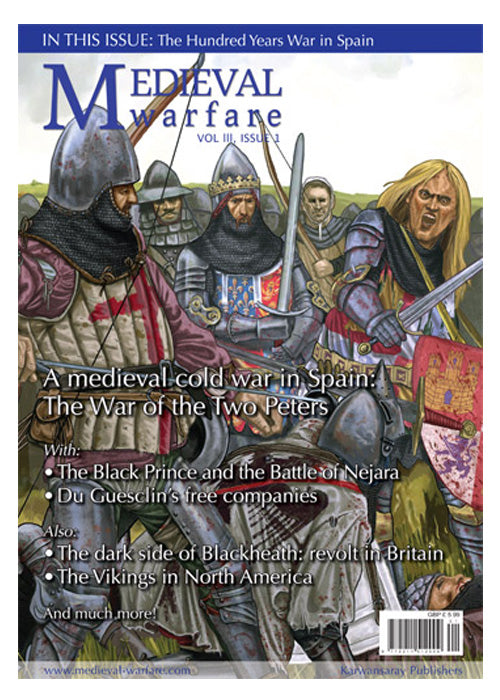

Medieval Warfare Vol III-1 - A Medieval Cold War in Spain
Este productos se enviará: Shipping 7-10 Days
Choose options
Este productos se enviará: Shipping 7-10 Days
Este productos se enviará: Shipping 7-10 Days
Get Medieval Warfare Vol III-1 - A Medieval Cold War in Spain
Medieval Warfare iii.1, 2013
Theme: A medieval cold war in Spain: The War of the Two Pedros
Introduction: Owen Rees, 'The War of the Two Pedros'.
If Europe in the 13th and 14th centuries was a theatre of war, then France and England were the main protagonists; they had the best lines and the most time on stage. Other states played only a small part in the Anglo-French dialogue that still fills medieval history books today. This has led us to ignore the background, the mixed 'extras' that built the atmosphere and allowed the light to shine so brightly on the two lead roles. In this issue, we will be firmly fixed on the outer wing of the stage, the dark corner that our actors enter only infrequently; but, when they do, the whole stage explodes into activity. We turned our eyes to the Iberian Peninsula and had very little knowledge about it. And yet, one of the most famous medieval battles took place in the context of this war.
Theme: Alberto Raúl Esteban Ribas, 'Naval warfare in the Kingdom of Aragon - Les ordinacions sobre lo fet de la mar'.
The ordinances of the fleets of the Crown of Aragon are a collection of public rules drafted in the times of Peter IV of Aragon (Peter III of Catalonia), around the mid-14th century. The core of this regulatory body is Les ordinacions sobre lo fet de la mar, written in 1354 by Bernat de Cabrera II, admiral of the fleet, which focused on describing ranks of command, weapons, and personnel in an aggressive military doctrine.
Theme: Gareth Williams, 'Siege warfare in the 14th century: By fair means or foul'.
Illustrated by Carlos García.
During the first part of his reign and throughout the wars with Aragon (1356-63), Peter I of Castile was willing to undertake a series of victories. Many were successful, resulting in the capture of several strongholds. How was this achieved? What conventions were observed during a medieval siege in the 14th century and what equipment was available?
Theme: Arnold Blumberg, 'Warriors on horseback of medieval Spain - The Jinete'.
Illustrated by Pablo Outeiral.
From the year 722 to 1492, during what history calls the Reconquista (or 'recapture'), various Christian kingdoms waged a relentless war to reconquer the Iberian Peninsula from the Islamic kingdoms established there, collectively known as Al-Andalus. The balance of power shifted between the conflicting participants in a bewildering manner. By the mid-13th century, the strategic advantage (and half the peninsula) was in the hands of the emerging Christian kingdoms. One of the reasons for their final success during the tumultuous period of the Reconquista was the employment of the Spanish light cavalry, the Jinetes, who performed multiple roles on and off the war-torn battlefields of medieval Spain and Portugal.
Theme: Stephen Bennett, 'A calamitous victory for the Plantagenet cause - The Black Prince in Spain'.
Illustrated by José Antonio Gutiérrez López and Jason Juta.
Although it represented a great battlefield victory for Edward, Prince of Wales (later known as the Black Prince), the 1367 campaign that ended with the Battle of Nájera was to have damaging and far-reaching strategic consequences for England, including the return of Castile and its powerful navy to the Valois cause, the loss of Aquitaine, and the disintegration of the Great Company (Grande Compagnie). At a tactical level, it is an excellent example of an English High Medieval army on the attack, including the use of longbowmen on the offensive, as well as a demonstration of the Black Prince's tactical brilliance.
Theme: Nils Visser, 'The Iberian campaigns of Bertrand du Guesclin - Demon's face, hero's heart'.
Illustrated by José Daniel Cabrera Peña.
The Castilian Civil War ended on March 23, 1369, at the gates of Montiel Castle. Like many events that occurred in Western Europe at the time, this was part of the geopolitical consequences of the Hundred Years' War. The death of Peter the Cruel (Peter I of Castile) on that date offers us a dramatic picture of rivalry and betrayal, but it would also have a profound influence on the later course of the war in general. Furthermore, it was one more milestone in the career of one of the most colourful participants in this war, a Breton of humble origin, who would rise to the post of Constable of France, second in command to the King of France: Bertrand du Guesclin, the 'Black Dog of Brocéliande', the 'Eagle of Brittany', and the scourge of the English.
Features
The Siege: Martin Mi?o, 'Inside a siege camp - The siege of Cabrad Castle'.
Illustrated by Rocío Espín.
In 1462, the flag of "The Brothers" flew over a castle situated on a cliff overlooking a large river bend, winding through a canyon carved deep into the surrounding plateau. High on the ridge connecting the castle cliff to the rest of the plateau, a palisade had been built under the banner of the Black Army and the flag of the Royal House of Hungary. King Matthias of Hungary had set up a siege camp at ?abra? (Tshabrag) Castle to ensure the free passage of this part of the important route.
The Revolt: Mike Ingram, 'England's forgotten battles: The dark side of Blackheath'.
Illustrated by Darren Tan.
Blackheath is an area of open high ground just outside the city of London, located between the districts of Greenwich and Lewisham. However, in medieval times, it was more than four miles to the southeast, and from its heights one could look out over London Bridge and the city itself. Across it, the Romans built Watling Street (now the A2), their road from Dover to London. It was the meeting place of the ancient hundreds of Blachehedfeld, whose name means the dark-coloured heathland. It became the favourite place for the mayors of London to greet triumphant kings, such as Henry V after the Agincourt campaign, and for royalty to receive visitors from the country. Its strategic importance was also quickly understood, and Blackheath became the focus and gathering point for many of the battles and rebellions in the city's turbulent history, starting with the Danes in 1013.
Special: Brian Burfield, 'Vikings in North America: Sagas, swords and Skraelings'.
Illustrated by Johnny Shumate.
A curious passage in the Grænlendinga saga mentions a battle between some Viking warriors, commanded by Thorfinn Karlsefni, and a certain people called 'Skraelings'. It was fought sometime around the year 1000. It was not a conflict with a traditional Nordic enemy, nor was it fought in known Viking territory, but rather it was a clash with Native Americans in a new and unknown land.
In Todo Medieval we have thousands of medieval and other era products. Discover them!
Free shipping
The entire Iberian Peninsula from €60 (*Does not include islands) and worldwide shipping check our rates
Customer service
We are available from Monday to Friday to answer your questions.
Secure Payment
We comply with all regulations to ensure Secure Payment
Contact us
Need to contact us? Simply send us an email at [email protected]
