



A dagger is a double-edged blade, designed primarily for stabbing.
Unlike knives, which can have a single edge and more practical uses, the dagger has a symmetrical, pointed blade, making it an effective combat tool at close range.
The dagger has been present in almost every culture in the world and has evolved according to the tactical, technological, and symbolic needs of each era.
Origin of the dagger
One of the earliest known forms of dagger was found in what is now the Hallstatt region of Austria.
This piece, found in a Neolithic tomb by Austrian archaeologists in the 19th century, is carved from flint and measures approximately 20 cm. Its flat shape, sharp on both sides, suggests both utilitarian and defensive uses.
The first daggers were made of stone, bone or antler, and their production required a high degree of technical skill for the time.

Daggers in Mesopotamia and Egypt
With the arrival of the Bronze Age, daggers became metallic objects.
In Mesopotamia, daggers have been found in the tombs of Ur (present-day Iraq), dating back to around 2500 BC. These daggers, made of bronze or gold, were richly decorated and associated with status and power.
In Egypt, one of the most famous daggers was found in the tomb of Tutankhamun (dating around 1323 BC). It has a blade forged from meteoric iron, making it one of the oldest known pieces of iron. The perfectly crafted blade and the richly ornamented handle indicate its symbolic and ritual function, also reflecting the great skill of Egyptian artisans.
The Dagger of Alaca Höyük
The Alaca Höyük bronze dagger deserves special mention. Found in northern Turkey in a Hittite funerary complex and dated to around 2500 BC, this dagger was discovered by Turkish archaeologists in 1930 and is distinguished by its elaborate ornamentation, with gold inlays and geometric decorations.
Its design reveals not only ceremonial use but also refined metallurgical knowledge.

Historical evolution of daggers
During the Iron Age and the Classical Age , daggers continued to be refined.
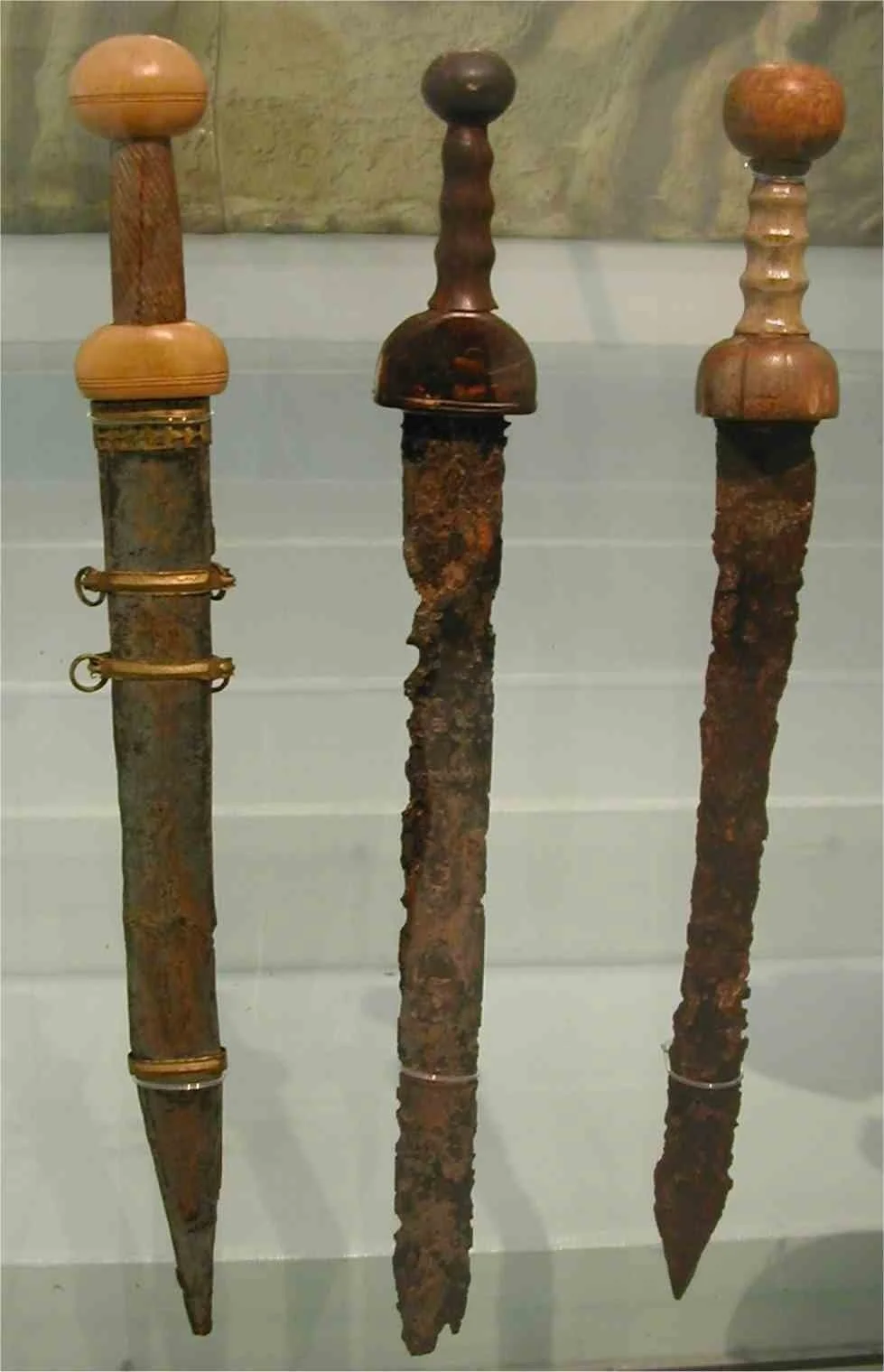
In ancient Rome, the "pugio" was the standard dagger of legionaries, with a wide, short blade, ideal for close combat.
In the European Middle Ages , the dagger became an essential weapon for knights. Variants emerged such as:
- The rondel dagger: With a circular guard and a sharp, narrow, and strong blade, it was used to finish off opponents between armor seams. It was also used as a symbol of nobility and as an everyday tool.
- The bollock dagger: Characterized by two protrusions on the pommel (hence its name), this 14th- to 16th-century dagger was both a weapon and a tool. It symbolized masculinity and courage, and was a precursor to the design of the Scottish sgian-dubh dagger.
During the Renaissance , the dagger also became a secondary weapon in sword combat. The "main gauche" or "left hand" was used to parry an opponent's attacks while counterattacking with the sword.
In the East , evolution followed different paths. The dagger known as the katar, in India, was developed with a crosswise handle and a wide blade, designed for piercing armor.
In the Arab world, the jambiya took on both a functional and symbolic role, with its curved blade and rich decoration.
During the 18th and 19th centuries , daggers were used by soldiers, sailors, and civilians in both combat and self-defense contexts.
By the 20th century , their use became specialized. Elite units during World War II used daggers like the Fairbairn-Sykes, designed for British commandos and renowned for its effectiveness in close-quarters combat.

Daggers have been more than just weapons; they have represented status, power, and technical skill throughout history. From Neolithic tools to ceremonial symbols and elite weapons, their evolution reflects the cultural and technological diversity of human civilizations. Studying daggers is like embarking on a journey through human history, understanding how an object can adapt and transform according to the needs and values of each time and place.
Don't miss the opportunity to see thecollection of Daggers we have to offer.