
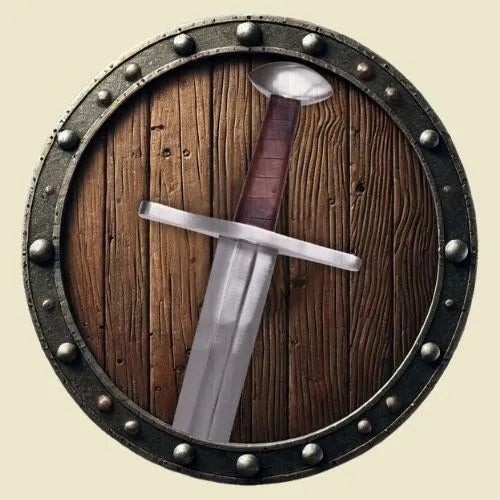




From the 1st century BC to the 5th century AD, the Roman Empire consolidated one of the most powerful armies of antiquity. Among its most iconic weapons is the Roman sword, not only as a tool of war but also as a symbol of dominance, status, and technological advancement.
Over the course of these six centuries, the Roman sword evolved from a weapon of close combat to a versatile tool adapted to the challenges of an expanding empire in constant defense.
The gladius hispaniensis: the sword of conquest
The most famous sword of the late Republican period and the beginning of the Empire was the gladius hispaniensis, adopted by Rome after the conflicts with the Celtiberian peoples in Hispania, in the 3rd century BC.
This short, straight, double-edged sword had a blade measuring between 50 and 60 centimeters, ideal for close combat. Its sharp point facilitated lethal thrusts, while its width allowed for effective cuts.
Its use reached its peak during the campaigns of Julius Caesar and the first emperors, being inseparable from the image of the Roman legionary.
The gladius was worn on a balteus or cingulum militare, belts decorated with metal plates.
The case, or scabbard, was often richly decorated with reliefs and brackets designed to also hold the pugio (short dagger).
Several examples of the gladius have been found in excavations in Germany, Britain, and Hispania, and are preserved in museums such as the British Museum, the Mainz Museum, and the National Archaeological Museum in Madrid.

The Mainz and Pompeii type gladius
During the High Roman Empire, variations of the gladius emerged, such as the Mainz type, with a wider blade and sharper point, and the Pompeian type, which was straighter and had more symmetrical ends. This latter model, dating from the late 1st century AD, offered greater efficiency in compact formations, making it easier for less experienced soldiers or in urban settings.
Both versions were manufactured from steels of varying quality, often using forging techniques that included tempering and pattern welding.
The spatha: sword of transition and defense
As Rome faced new threats on its borders and the role of cavalry increased, the gladius gave way to the spatha, a longer sword, between 70 and 100 cm.
Its use, initially exclusive to auxiliary cavalry, gradually extended to heavy infantry and border troops during the 2nd and 3rd centuries AD.
The spatha allowed for longer-range blows and was ideal against less organized enemies.
With the evolution of tactics and the decline of closed maniple or cohort formations, the spatha offered greater tactical versatility.
These long swords, usually made of wrought iron, were more difficult to maneuver in tight spaces but made up for this limitation with their greater reach.
Magnificent specimens have been found in the Rhenish and Danubian limes, several of which are currently in the Römisch-Germanisches Zentralmuseum in Mainz and the Hungarian National Museum.

Symbolic and funerary function
Beyond the battlefield, Roman swords served a symbolic and ceremonial function. They represented honor, discipline, and service to the Empire.
It was common for officers to decorate their scabbards with reliefs of victory, gods or commemorative inscriptions.
Upon death, many soldiers were buried with their swords, not only as part of their equipment, but also as a symbol of their rank and social status. Richly decorated swords have been found in officers' graves, with ivory or amber handles, or even inlaid with semiprecious stones.
On rare occasions, swords have been found dedicated as offerings in temples or thrown into sacred rivers, a practice inherited from pre-Roman traditions.
There are also documented cases of personalized swords being awarded by the emperor as a reward for extraordinary feats, reinforcing their role as a badge of imperial power and loyalty.
Legacy and conservation
The evolution of Roman swords reflects the changes in the Empire's military structure. From the effectiveness of the gladius to the adaptability of the spatha, each type of sword bore witness to and served as a tool in Rome's expansion, consolidation, and defense.
You can find more Roman Swords , and much more in our Medieval Shop.