




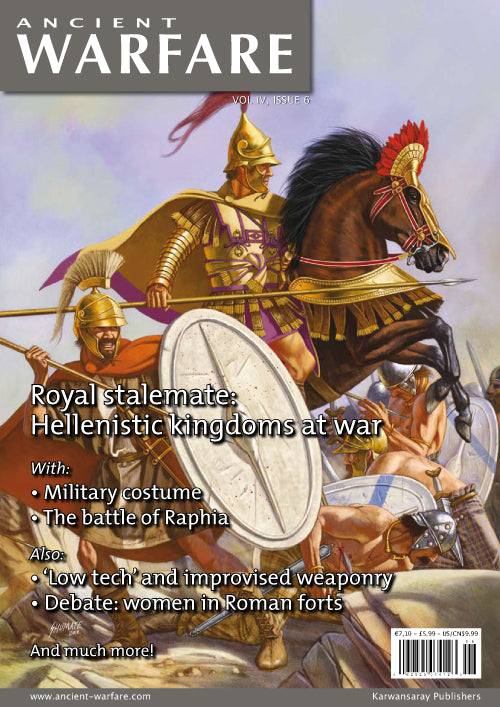
Ancient War Journal Vol IV -6 - Royal Stalemate - Hellenistic Kingdoms
€11,94 EUR
Ancient War Journal Vol IV -6 - Royal Stalemate - Hellenistic Kingdoms
Este productos se enviará: 7-10 Day Shipping
Choose options
Este productos se enviará: 7-10 Day Shipping
Este productos se enviará: 7-10 Day Shipping
Enjoy Ancient Warfare Magazine Vol IV-6 - Royal Stalemate - Hellenistic Kingdoms
Ancient Warfare IV.6, December 2010/January 2011
Released December 15th
Theme: Royal Stalemate - Hellenistic Kingdoms at War
Introduction: Bob Bennett and Mike Roberts, 'Introduction to the theme'. Illustrated by Carlos de la Rocha
In 300 BC, the world lying to the east of a line drawn from the Adriatic to Cyrene, and as far east as India, was the realm of Alexander the Great's heirs. In this world, three true Methuselahs took it upon themselves to settle their dynasties.
The Source: Michael J. Taylor, 'Disciplinary Measures - The Amphipolis Regulation'. As much as he admired the Roman army, the historian Polybius (c. 150 BC) described the Macedonian soldiers as highly disciplined and extremely effective: not only are they fearless in land combat, but they readily perform temporary service at sea, and are also diligent in digging trenches, erecting palisades, and all such hard labor, just as Hesiod represents the sons of Aeacus as having to "rejoice in war as if it were a banquet." (5.2.5-6, Loeb translation). Confirmation of this image was found in 1934, in the form of a badly damaged inscription from Amphipolis.
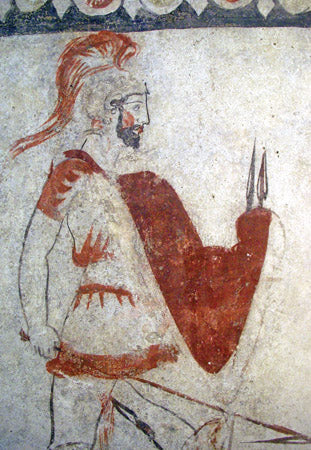
Theme: Ruben Post, 'Bright Colors and Uniformity - Hellenistic Military Costume'
The Hellenistic period was an era of widespread and increasingly professionalized warfare in the Eastern Mediterranean. Starting with Philip II, the Macedonian kings assembled powerful armies of mixed troops, composed of massive cavalry, mobile skirmishers, and a backbone of well-trained heavy infantrymen who formed the pike-armed "Macedonian" phalanx. The gradual expansionism of the second half of the 4th century BC exploded with Alexander the Great, who incorporated huge swaths of the western half of the Old World into his empire, but it came to an end with his death and the fragmentation of his domains into smaller warring states. As a result of the spread of Macedonian soldiers throughout the Hellenistic world, their costume became fashionable among soldiers everywhere.
Theme: Mateusz Lobaсz, 'On the Edge of Hellenism: Greek Armies in Bactria and India'. Illustrated by Ángel García Pinto.
After the death of Alexander the Great, his spear-won empire was shattered. One part of his empire was known as Bactria, a land previously known only from tales and myths. As a result of the population efforts of the Macedonian soldiers, this country became a thriving Hellenic community. The mountainous territories of present-day Afghanistan and southern Tajikistan formed a barrier between two completely different worlds of "civilized" sedentary peoples and, in the vast steppe wastelands, wandering nomadic tribes of Iranian origin.
Theme: Michael Park, 'Climax of the Syrian Wars: The Battle of Raphia, 217 BC'. Illustrated by Igor Dzis and Carlos de la Rocha
On the evening of June 22, 217 (all dates are BC), Ptolemy IV Philopator, likely at the insistence of his generals, resolved to take Antiochus III to battle. The two armies had camped facing each other for almost five days, and the failed assassination attempt on Ptolemy by Theodotus, his former governor of Coele-Syria now in the service of the Seleucids, was a product of this delay (Polybius 5.82.1; 81.1-6 - all references to this author unless otherwise noted). Two days earlier, Antiochus had shortened the distance between the two camps from 1.8 kilometers to just under a kilometer. As a result, there was frequent fighting at the watering holes, as well as infantry and cavalry skirmishes in the space between the camps (5.80.5-7).
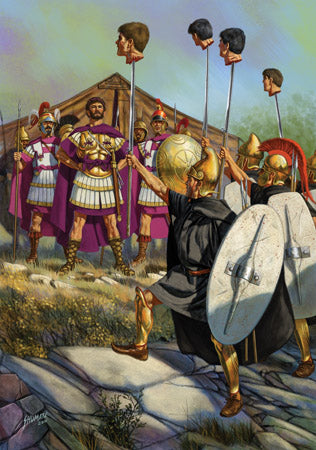
Theme: Paul McDonnell-Staff, 'Macedonia's Last Hurrah: The Third Macedonian War and Pydna'. Illustrated by Johnny Shumate. Thracians with heads on their romphaia - artwork by Johnny Shumate
When he saw this and observed that the rest of the Macedonians took the peltai hanging over their left shoulders and brought them in front of them, and all of them suddenly tilted their pikes against the shields of their enemies and considered the great strength. Seeing this wall of shields and the formidable appearance of a bristling front of weapons, he was astonished and alarmed; nothing he had heard before had been equal to it; and in later times he used to speak frequently of both the sight and his own sensations. (Plutarch, Life of Aemilius Paullus 19.1)
Readers will recall that in a previous article I described the demise of Sparta as a military power at the hands of Macedonia during the Battle of Sellasia in 222 BC (Ancient Warfare II.2). This article provides a sequel by describing the demise of Macedonia.
Theme: Christopher Webber, 'Fighting on All Sides: Thracian Mercenaries of the Hellenistic Era'
The Thracians were one of the most popular peoples to be employed as mercenaries or allies by the Hellenistic states: they were even used by the Romans. The Thracians were employed as light infantry (armed with bows, slings, or javelins), as medium infantry, and as light cavalry. Their unique combat capabilities and the strategic location of their homeland meant that they were involved in every conflict in the Eastern Mediterranean region. The Romans developed a great respect for the Thracians due to their ferocity and physical strength. Later, Thrace became Rome's third most important recruiting ground.
Special: Ross Cowan, 'Sticks and Stones: 'Low Tech' and Improvised Weapons'
Not all Greek and Roman soldiers went into battle equipped with helmet and breastplate, sword, spear, and shield. Many had no armor at all and were armed with the most basic weapons: sticks or sharpened clubs and stones they picked up from the ground or stream beds.
The Debate: Duncan B. Campbell, 'Women in Roman Forts: Residents, Visitors, or Entry Forbidden?' Illustrated by Andrew Brozyna
Twenty years ago, Margaret Roxan, known for her studies on Roman auxiliaries, raised the issue of women on the frontiers. Of course, it was never in doubt that women and children were part of the communities that often grew outside Roman forts, but recently there has been a tendency to postulate their existence inside the forts as well. Criticisms have been leveled at traditionalists, who view military garrisons as male-oriented environments in which the fort ditches formed a symbolic barrier between military and civilians. But is there any hard evidence to disprove it? Did women ever live in Roman forts?
At Todo Medieval we have thousands of medieval and other historical products. Discover them!
Free shipping
The entire Iberian Peninsula from €60 (*Does not include islands) and worldwide shipping check our rates
Customer service
We are available from Monday to Friday to answer your questions.
Secure Payment
We comply with all regulations to ensure Secure Payment
Contact us
Need to contact us? Simply send us an email at [email protected]