



The discovery of the Sutton Hoo sword, found in the famous 7th-century Anglo-Saxon ship burial in East Anglia, is one of the most important archaeological milestones in Europe.
This piece, fragmented yet extraordinarily refined, not only represents the craftsmanship of pre-Roman England, but also reveals the power, authority, and warrior ideology of the East Anglia kingdom's elite.
Considered by many to be the ceremonial weapon of King Rædwald, the sword remains a unique symbol of Anglo-Saxon identity.

The Sutton Hoo find: a treasure buried in a ship
The Sutton Hoo site was excavated in 1939, when the presence of a huge burial ship was revealed, its structure marked in the sand.
Inside the burial chamber, prestigious objects were found: a richly decorated helmet, a gold buckle weighing almost half a kilo, armor, ritual vessels, and the fragments of an exceptional sword.
The preservation of these remains was largely due to the anaerobic environment created by the tumulus, which allowed the metals and incrustations to remain in extraordinary condition.
Experts agree that the burial corresponds to a high-ranking individual, probably Rædwald, king of East Anglia, mentioned by Bede as a powerful ruler who adopted both Christian and pagan elements.

A sword fit for a king: symbolism and function
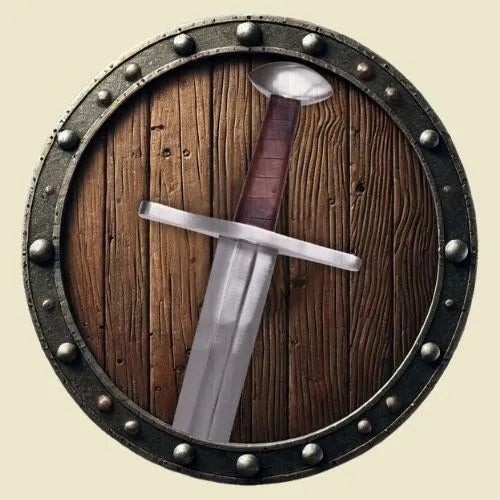
Although the blade is not intact, the fragments of the hilt and pommel offer essential clues about its function. It was not an ordinary weapon for combat, but a symbol of royal authority.
The golden knob was decorated with garnets, typical inlays of elite Anglo-Saxon art.
And the techniques employed —cloisonné, filigree and brass or precious metal plates— place the sword within the artisan tradition associated with the kings of the Heptarchy.
On the other hand, the presence of geometric motifs and stylized animals suggests a mixture of Germanic and Scandinavian influences, reflecting the cultural exchange of the period.
These characteristics show that the sword was probably used in rituals, oath ceremonies, and acts of legitimizing power.
Carrying such a sword was equivalent to demonstrating the connection between the leader and divine or ancestral protection.

The blade: Germanic tradition and refined technique
Fragments and scientific reconstructions indicate that the blade followed the classic design of early Germanic swords:
- Wide, straight and double-edged, designed for powerful blows.
- Longitudinal groove, which lightened the blade and improved flexibility.
- Alternating iron and steel forging, typical of the pattern techniques used by Anglo-Saxon craftsmen.
Although the Sutton Hoo blade is fragmented, its design matches other pieces found in Vendel, Valsgärde and other areas of northern Europe.
A sword that defines a civilization
The sword from Sutton Hoo is not just an archaeological artifact: it is a window into the political, religious, and military structure of 7th-century England. Its exquisite craftsmanship, symbolic value, and association with an Anglo-Saxon king make it one of the most important weapons ever discovered.
Today, preserved in the British Museum, it continues to reveal how power was forged both on the battlefield and in the craftsman's workshop.
You can find a replica of the sword of Sutton Hoo and much more in our Medieval Shop .