
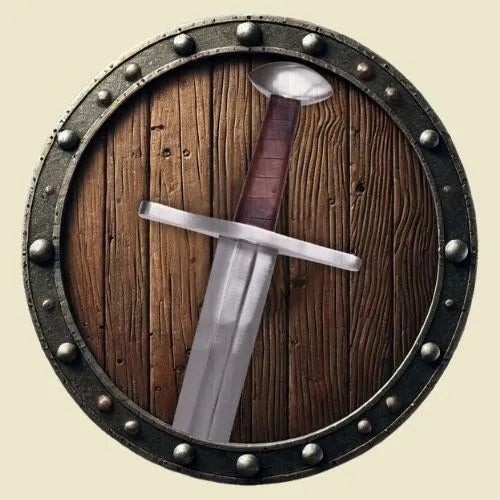




The Roman pugio was one of the most representative secondary weapons of the Roman army.
Although its size was modest, this legionary's dagger possessed remarkable symbolic, practical, and political value.
It was used in camps, rituals, close battles, and momentous episodes in the history of Rome.
Its design, cultural impact, and archaeological presence make it a fundamental object for understanding ancient military weaponry.
This article examines its origin, its development, and its role within the Roman military and social framework, based on current findings and studies.

Origin and early influences
The origin of the pugio lies in the Celtic daggers used by peoples of northern Hispania.
During the Roman campaigns of the 2nd century BC, legionaries adopted several indigenous weapons, including a short, sturdy dagger that would directly inspire the pugio.
Its wide shape and piercing ability perfectly suited the needs of close combat.
The term pugio derives from the Latin verb pungere , "to prick," a clear reference to its essential function: to wound precisely in close-quarters combat.
Physical characteristics of the Roman dagger
The first pugios were distinguished by their wide, double-edged blade with a sharp point, suitable for cutting and stabbing.
Its usual length ranged between 18 and 30 centimeters, and its width was greater than that of other Mediterranean daggers, giving it a solid appearance.
The handle, made of wood, bone, or metal, often displayed geometric decorations or animal figures. In the case of officers, these handles could be true luxury items.
The sheath, made of bronze or iron, featured reliefs and rivets that reflected both the skill of the craftsman and the status of the owner.
Thanks to the findings in Vindonissa, Haltern or Pompeii, different regional variants are known, which demonstrates the stylistic diversity of the weapon throughout the Empire.

Role within the legionnaire's team
During the 1st century BC and 2nd century AD, the standard equipment of a legionary included the gladius , the pilum , and the pugio. The latter, although not his primary weapon, played an essential tactical role. It was used in close combat in extreme situations, when the gladius could not be wielded effectively, and was also used as an everyday tool within the camp.
The pugio was usually placed on the left side of the cingulum , although officers and non-commissioned officers could wear it on the right, reinforcing its meaning as a military symbol.
Military and political symbolism
In addition to its practical use, the pugio acquired a remarkable symbolic value.
Many richly decorated examples found in officers' tombs indicate their ceremonial function.
Its political dimension is equally relevant: the assassination of Julius Caesar, narrated by Plutarch and Suetonius, is associated with weapons that may have been similar to the pugio.

Decline and historical legacy
From the 3rd century AD onwards, the pugio disappeared from standard equipment due to tactical changes and the transformation of the Roman army. Even so, its legacy endures in museums such as the British Museum, the National Archaeological Museum of Madrid, and the Roman-Germanic Museum, where preserved examples allow for the study of its military and cultural function.
An eternal symbol of Roman power
The Roman pugio was much more than a secondary weapon: it represented utility, identity, prestige, and power.
Its evolution reflects Rome's ability to adopt external influences and make them an essential part of its military system.
Today it remains a tangible testament to the legacy of the legionary and the Roman world.