







The Middle Ages was a period of nearly a thousand years (approximately 476–1453) in which conflicts, wars, and struggles between armies defined feudal Europe and other territories.
Within this context, diverse medieval weapons emerged for hand-to-hand combat, ranged warfare, or sieges. While there is no single weapon that dominated all medieval battlefields, certain weapons were more common due to their effectiveness, ease of manufacture, or versatility.
In this article, we analyze which weapons were most used in European medieval history and why.

Spears and pikes: the most common weapon in battle
The medieval spear and its longer version, the pike, were probably the weapons most used by infantry for much of the Middle Ages.
These polearms consisted of a metal point attached to a long wooden shaft, allowing the pikeman or foot soldier to keep the enemy at a distance.
Spears were relatively inexpensive to produce, required little training, and could be employed both in defense and in combat formations, especially against heavy cavalry. On the medieval battlefield, pikemen formed tight blocks that stopped cavalry charges or consolidated shield lines, making their use very widespread.

Swords: a symbol of status and a versatile weapon
The medieval sword is one of the most representative symbols of the Middle Ages, linked especially to knights and elite warriors.
Unlike spears, swords were more expensive, as they required good quality metal and specialized labor. Therefore, they were more common among nobles, officers, and well-trained soldiers.
Swords took several forms: from the single-edged sword to the two-handed longsword used in the 14th and 15th centuries.
Their versatility in hand-to-hand combat, capacity to cut and pierce, and their presence in chivalric culture made them an iconic weapon in the Middle Ages, even if their use was more limited and specialized.

Bows and crossbows: dominators of ranged warfare
Medieval archery was crucial in many campaigns and battles of the Middle Ages. Bows and crossbows allowed the enemy to be attacked from a distance, which was especially useful in sieges and skirmishes.
The English longbow, for example, was famous in the 14th and 15th centuries for its great range and penetrating power, capable of striking up to 200m away and bringing down mounted knights.
The crossbow became another essential long-range weapon. Easier to use than the traditional bow and capable of piercing armor, it was widely employed by professional infantry and fortress defenders.

Maces, hammers, and axes: brute force against armor
With the rise of metal armor from the 13th to the 15th centuries, blunt weapons designed to penetrate or fracture iron plates were developed.
The mace and war hammer were blunt weapons with a metal head designed to impact directly on armor, capable of causing damage even without piercing it.
The battle axe was also common, used by both infantry and horsemen, especially in regions like Scandinavia, where variants like the Danish axe had a significant presence.

Daggers and secondary weapons
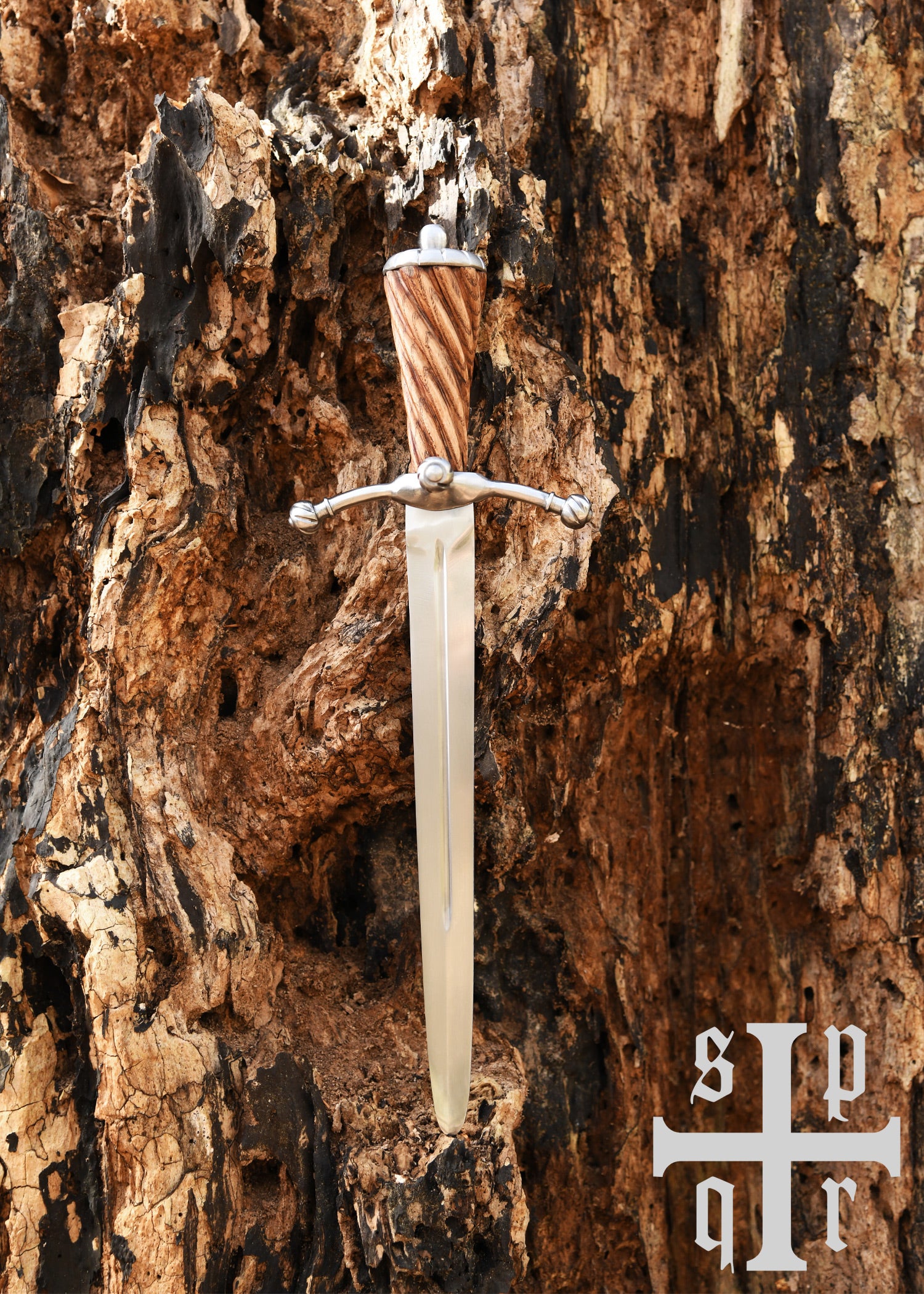
Medieval daggers, such as the rondel dagger, were used as a secondary weapon by soldiers and knights when their primary sword broke or was lost.
Simple ergonomics, ease of manufacture, and utility in tight spaces made the dagger a useful tool in both urban combat and skirmishes.

Siege weapons: catapults and trebuchets
In addition to personal weapons, medieval warfare included siege weapons. Machines like the trebuchet (an advanced version of the mangonel) and other ballistic machines were used to attack walls and fortresses, launching enormous projectiles over long distances.
Although they were not portable weapons, their use was key in prolonged campaigns, especially during wars of conquest and rivalries between feudal lords.
Of all of them, which was truly the most used weapon in the Medieval era?
Having reached this point, surely you have wondered which was the most used weapon in the medieval era...
If one considers how many combat units employed a certain weapon, the spear or pike was, in all likelihood, the most used in the Middle Ages, especially by the infantry that formed the backbone of feudal armies.
This also accounts for their ease of manufacture, which could make it the most widely produced weapon relative to the total population, if one takes into account the importance of the army in a context where wars abounded.
However, other weapons like the sword, bow, crossbow, mace, or axe played key roles in different contexts, from heavy cavalry to the besieging of fortresses.


