











To speak of Charlemagne and his sword is to delve into the heart of the European Middle Ages, a period in which weapons were not merely instruments of war, but symbols of authority, legitimacy, and political power.
Charlemagne, King of the Franks and Emperor of the Holy Roman Empire, was one of the most influential figures of the 8th and early 9th centuries.
His image as a ruler is closely linked to the ideal of the Christian warrior, and his sword became an emblem of that leadership.

Charlemagne: The Emperor Who Forged Europe
Charlemagne was born in the year 742 and ruled an extensive territory that encompassed much of modern-day France, Germany, Italy, and Central Europe.
Crowned emperor in the year 800 by Pope Leo III, this act symbolized the restoration of the Roman Empire in the West.
His reign was characterized by constant military campaigns, administrative reforms, and a powerful cultural surge known as the Carolingian Renaissance.
As a military leader, Charlemagne spearheaded numerous wars against the Saxons, Lombards, and other peoples.
In this context, the sword was an essential element both on the battlefield and in the representation of imperial power.

Charlemagne’s Sword: Between History and Tradition
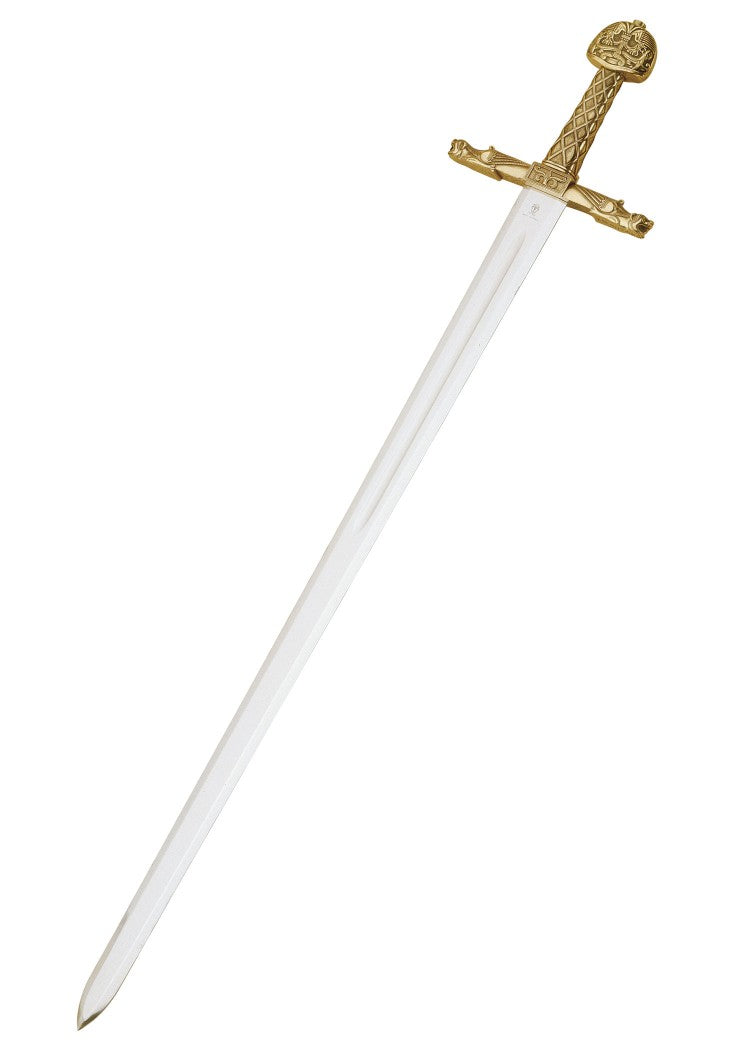
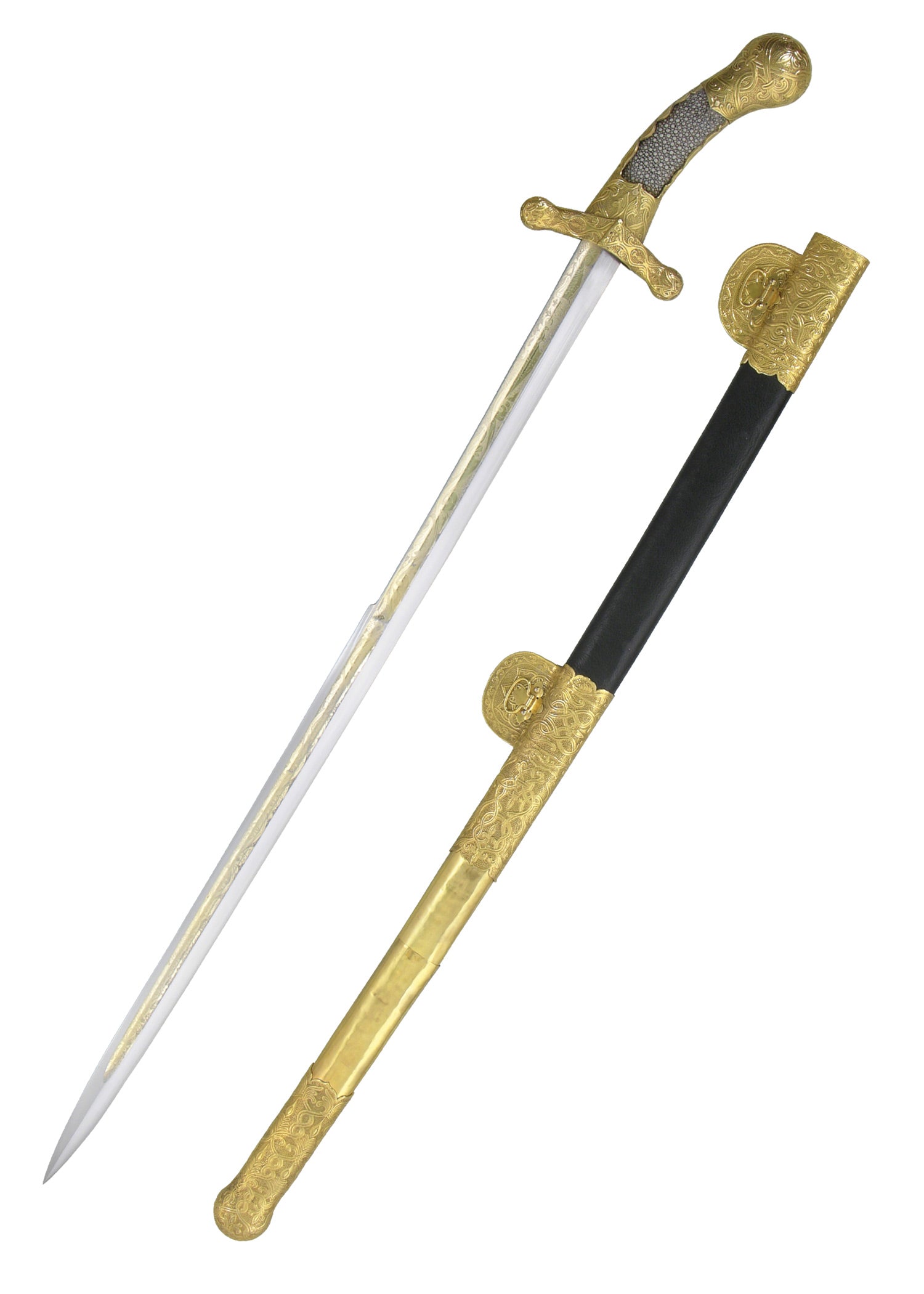
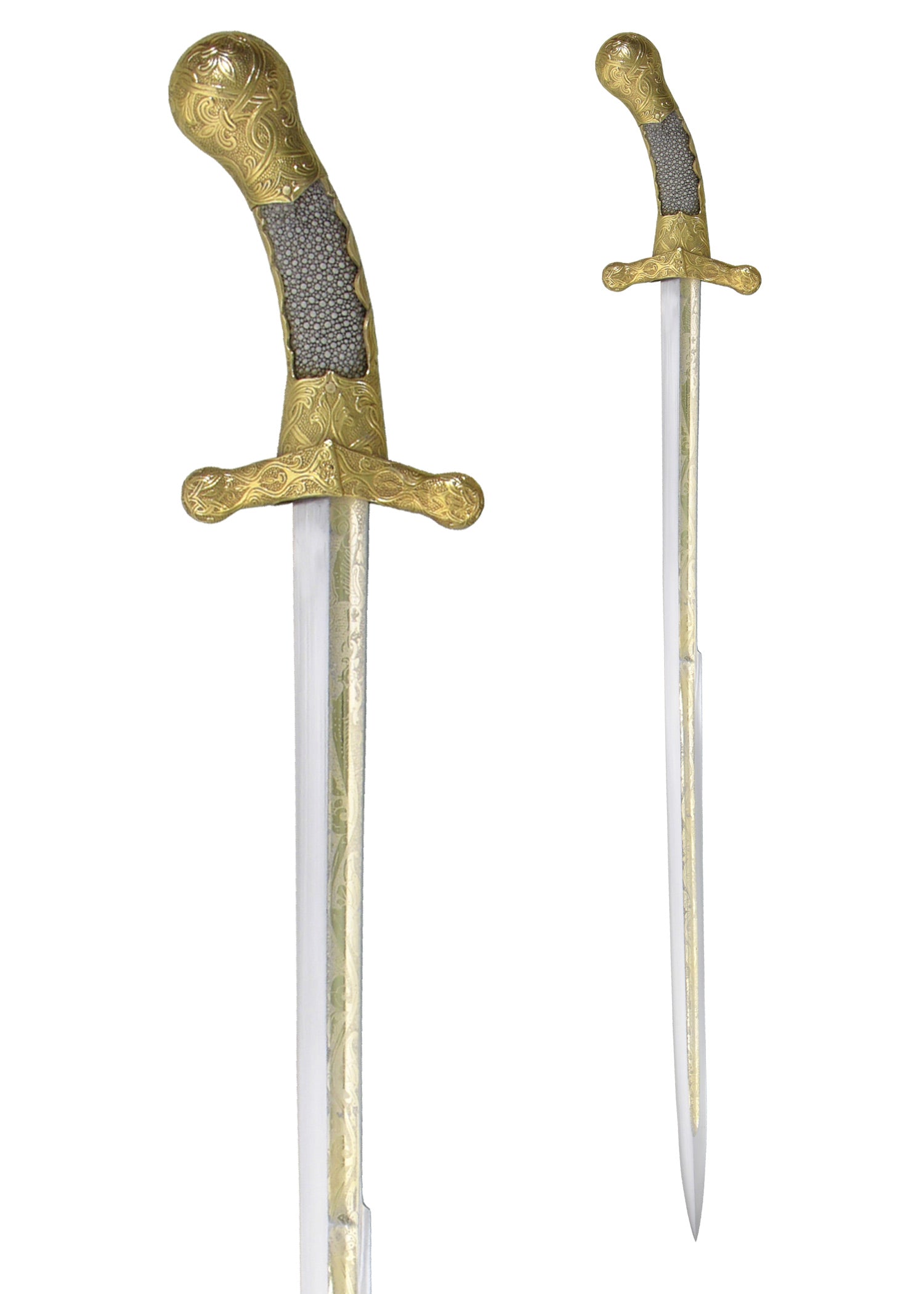
The personal sword that Charlemagne used in combat does not survive with certainty, but medieval tradition associates his weapon with a sword known as Joyeuse.
This name appears in medieval literary sources and epic poems, where the sword is described as an exceptional weapon, worthy of an emperor.
From a historical standpoint, Charlemagne’s sword would have been a Carolingian sword, a type of weapon common between the 8th and 9th centuries.
These swords featured straight, double-edged blades of considerable length, designed for hand-to-hand combat.
They were robust, effective, and expensive weapons, reserved for the military elite.
Characteristics of Carolingian Swords
Medieval weapons from the Carolingian period show a clear evolution compared to previous eras.
The swords usually measured between 85 and 100 centimeters, with a balanced blade and a simple hilt, composed of a straight crossguard and a compact pommel.
Their design prioritized functionality without sacrificing symbolism.
In the case of an emperor like Charlemagne, the sword served not only to fight but also to represent justice, order, and the protection of the realm.
For this reason, his weapon acquired a ceremonial value that grew as the centuries passed.

The Sword as a Symbol of Imperial Power
In medieval Europe, the sword was an object charged with meaning.
It represented the right to rule, the defense of Christianity, and the authority granted by God.
The sword associated with Charlemagne became part of the European political and cultural imaginary, later being used as a symbol in ceremonies and historical accounts.
This process of mythologizing does not imply that the sword was a fantastical object, but rather reflects how historical weapons could be transformed into enduring emblems of power.
The Historical Legacy of Charlemagne and His Sword
Today, Charlemagne is remembered as one of the fathers of Europe.
His figure has inspired literary works, historical studies, and medieval recreations.
Charlemagne’s sword, whether real or symbolic, continues to be a key reference within the study of historical swords and medieval weaponry.
To analyze it is to understand how history, politics, and culture are intertwined in an object that goes far beyond its military function.


