



Medieval Daggers: A Journey to the Edge of the Past
Introduction
Medieval daggers were among the most common and versatile weapons of the Middle Ages. Although often overshadowed by the sword, spear, or bow, their role was crucial in both warfare and everyday life. Their compact size, lethality in close combat, and social symbolism made them an indispensable tool for knights, soldiers, and civilians alike.

|
 |
 |
1. Origins and historical context
Daggers have a history spanning millennia, but it was during the Middle Ages that they achieved their own distinct development in Europe. From the 13th century onward, they began to differentiate themselves from common knives, becoming secondary weapons that complemented the sword.
Don't miss these medieval daggers
Advances in armor making and the type of combat at the time made daggers essential. When a sword broke, was lost, or was simply impractical in close quarters, the dagger became the warrior's last resort. It was also common among civilians as a weapon for self-defense.
2. Anatomy of a medieval dagger
A typical medieval dagger consisted of the following elements:
-
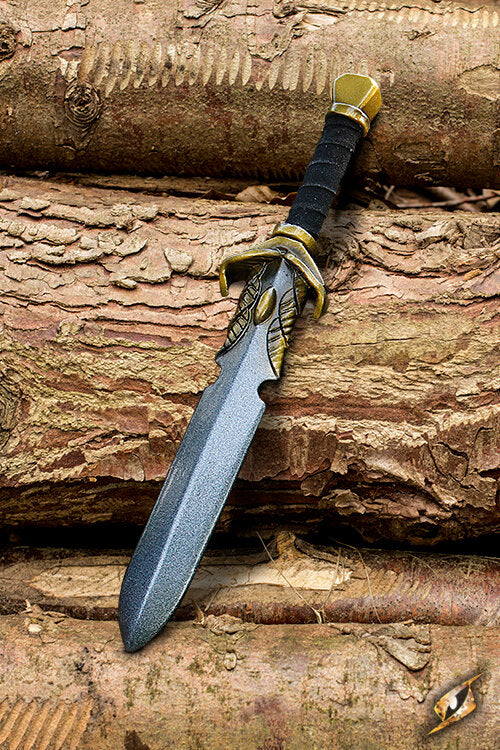
Blade: short, between 25 and 50 centimeters, with one or two edges and a sharp point designed for stabbing.
-
Guard or hilt: small, although in some models it was made more elaborate to protect the hand.
-
Handle: made of wood, bone or metal, adapted for a firm grip.
-
Pommel: balanced the weapon and served as a support when thrusting.
-
Sheath: allowed it to be carried on the belt or even hidden under clothing.
Depending on the type and context, it could be a practical and rustic weapon or a decorated piece with symbolic value and social status.
3. Main types of medieval daggers
Rondel Dagger:
It was one of the most popular weapons from the 14th century onwards. It was characterized by its circular guard and pommel, as well as a rigid, pointed blade ideal for penetrating the gaps in armor. It was a very effective close-quarters combat weapon.
Bollock Dagger:
Recognizable by its hilt with two lobes at the base, this dagger was common in England, Scotland, and Flanders between the 13th and 16th centuries. Its design was not only functional but also a symbol of masculinity and status.
Merciful:
Specialized for delivering the so-called "mercy blow," it was used to finish off enemies wounded in combat. Its blade was long, narrow, and extremely pointed, capable of piercing the joints of armor.
Cinquedea:
Of Italian origin, it emerged towards the end of the 15th century. It was distinguished by its wide blade at the base and its more urban use. Many were richly decorated and served both for defense and to display social prestige.
4. Uses and tactics in combat
On the battlefield, the dagger was the weapon of last resort. When a fight was reduced to hand-to-hand combat, the warrior could use it to find weak points in the opponent's armor or to finish off a fallen enemy.
It was also used in duels, assaults, and self-defense. Medieval fencing manuals contain specific techniques for fighting with a dagger, both alone and in combination with another weapon or a shield. In civilian life, its compact size made it ideal for everyday carry, even in urban settings.
5. Symbolism and everyday life
Beyond combat, the dagger played an important social and symbolic role. In many medieval cities, carrying a dagger was a sign of freedom and honor. Some were richly ornamented, with carved handles or inlays of precious metals, making them objects of prestige.
The upper classes often displayed decorative daggers during banquets or ceremonies, while commoners used them for everyday tasks or self-defense. Thus, this weapon represented both survival and social standing.
6. Evolution and decline
With the arrival of the Renaissance and the improvement of plate armor, daggers adapted to new needs. Thinner, pointed models appeared, such as the stiletto, specifically designed to pierce armor.
As firearms and new military tactics transformed the battlefield, daggers lost their military significance and became ceremonial or fashionable objects. However, their symbolism as a weapon of honor and self-defense endured for centuries.
Medieval daggers were not mere knives, but instruments that embodied the essence of their time: war, honor, defense, and identity. From knights' rondels to ornate Italian cinquedeas, each tells a distinct story of human ingenuity and survival.
Today, these weapons offer a fascinating glimpse into the past, where even the smallest tools could change the course of a battle or reflect the status of their wielder. Do you like medieval daggers? Visit our website!