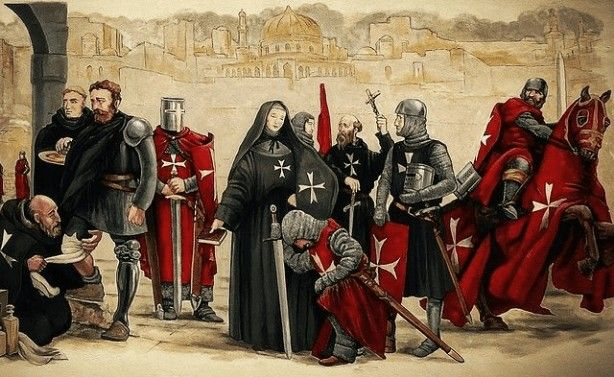




In medieval Europe, a black cross on a white background became the symbol of one of the most feared and organized military orders: the Teutonic Knights.
Founded in the context of the Crusades at the end of the 12th century, this Germanic order combined religious ideals with iron military discipline, becoming a decisive power in the Christianization and conquest of Eastern Europe.
Beyond its military role, its influence extended to the politics, culture, and architecture of the Baltic region, profoundly shaping the history of Poland, Lithuania, and Prussia.

Pious origin in the Holy Land
The Teutonic Order was born in 1190 during the Third Crusade, when German crusaders established a field hospital in Acre to care for their wounded compatriots.
First recognized by Pope Clement III and then converted into a military order by Innocent III in 1198, it combined monastic life with military functions under the protection of the Virgin Mary.
Its hierarchical organization and iron discipline attracted German nobles seeking glory and land, thus consolidating its influence on Germanic culture and politics.

The Crusade to the North:
expansion in Prussia and the Baltic
After a brief intervention in the Holy Land, the Teutonics turned their attention to Eastern Europe.
In 1226, Conrad of Mazovia requested their help against the pagan Prussians, initiating a papal-backed crusade to conquer and Christianize the Baltic.
They founded the Teutonic Monastic State, which lasted more than two centuries and included territories in present-day Poland, Lithuania, Estonia, and parts of Russia.
From their capital in Marienburg (Malbork), they built Gothic castles as symbols of their power and authority.
The decline after the Battle of Grunwald
The aggressive Teutonic expansion generated conflicts with the Grand Duchy of Lithuania and the Kingdom of Poland.
In 1410, the Battle of Grunwald (Tannenberg) marked a decisive defeat for the order against the Polish-Lithuanian alliance, initiating its decline.
The Thirteen Years' War (1454-1466) caused them to lose western territories, becoming vassals of the King of Poland.
In 1525, the last Grand Master secularized the Teutonic State, transforming it into the Duchy of Prussia under Protestant rule, while the religious order survived in the Holy Roman Empire.

Legacy and current presence
Although its political power has diminished, the Teutonic Order persists today as a religious institution based in Vienna, dedicated to pastoral and healthcare work.
The black cross remains an emblem of its complex history, combining Christian idealism, military discipline, and territorial ambition.
Swords, armor, manuscripts, and banners are preserved in museums such as the Deutsches Historisches Museum in Berlin and Malbork Castle, demonstrating their historical impact on Central and Eastern Europe.
Beyond the Sword:
a model of a military monastic state
The Teutonic Knights represented a unique model of a military monastic state, with an advanced administrative structure and a network of castles unparalleled in medieval Europe.
Although his methods of forced conversion have been the subject of historiographical criticism, his influence on Gothic architecture, territorial politics, and the culture of the Baltic region is indisputable.
The black cross symbolizes how in the Middle Ages religion and war were closely linked.
You will find many more products in our Medieval Store .