



During the Middle Ages, edged hand weapons were key instruments both in combat and as symbols of power. Used by nobles, soldiers, and sometimes peasants, these weapons represented not only strength but also status.
Its evolution responded to changes in the way of fighting, the development of more resistant armor, and increasing military specialization.
Below, we review some of the most emblematic ones.

The cutting legacy of medieval swords
From ancient times well into the Middle Ages, the sword was much more than a weapon: it was a symbol of power, status, and skill.
Its design evolved to adapt to the challenges of combat and innovations in armor, giving rise to a wide variety of shapes, sizes and functions.
· Armor sword: symbol of the medieval knight
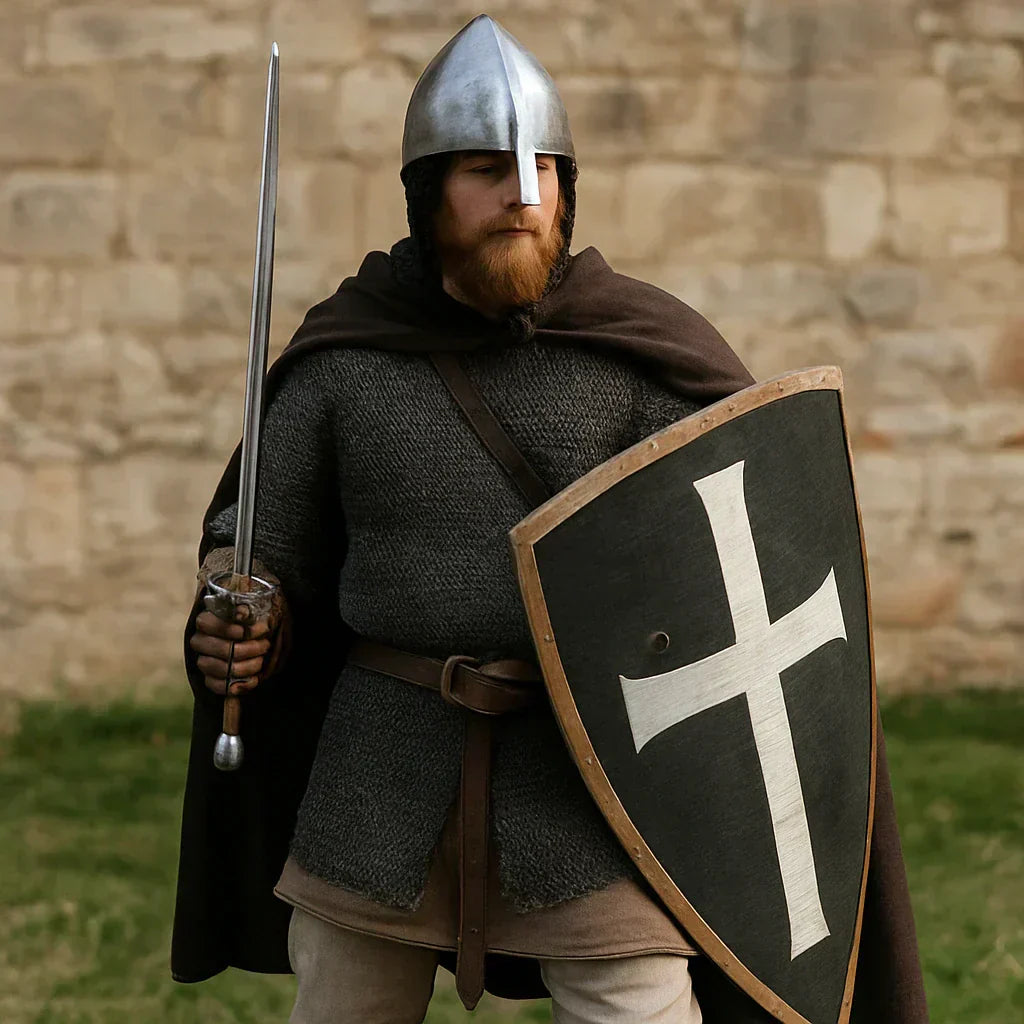
With a long, straight, double-edged blade, the arming sword was used one-handed and accompanied by a shield.
She was the knight's faithful companion between the 11th and 14th centuries.
In addition to their role in combat, they had a profound symbolic value: many were used in investiture or oath ceremonies.
· Longsword: reach and strength in combat
Designed to be wielded with two hands, the longsword became popular in the 14th century. Its extended blade offered greater power and reach, ideal for breaching defenses and dominating in close combat.
It required a high level of training, being common among swordsmen and elite soldiers.

· Broadswords: forcefulness on the battlefield
The so-called "broadswords" had a sturdier, wider blade. They were designed to deliver powerful slashes, capable of damaging even enemies with padded or metal armor.
These swords were especially effective on the battlefields of Northern Europe, where hand-to-hand combat was brutal.
· Falchion or scimitar: the strength of a blade
With its heavy, curved blade, the falchion combined the cutting power of an axe with the maneuverability of a sword.
Single-edged, it was ideal for facing lightly armored enemies.
Widely used in the Iberian Peninsula and North Africa, it was highly effective in delivering quick, powerful blows.

Daggers and knives: functions, differences and evolution
The dagger is a double-edged blade, specifically designed for stabbing. It was a vital secondary weapon in the Middle Ages, especially useful at close range or when primary weapons could not be used.
Medieval knives, on the other hand, tended to have a single edge, more intended for cutting, although they could also be used as weapons.
Since the 13th century, it is common to find representations of knights and soldiers with daggers or knives on their belts.
By the late 15th century, many had adopted ornate designs, with decorated scabbards and finely carved handles.
The dagger versus the armor: lethal precision
With the introduction of plate armor, the dagger acquired a specialized function: finishing off enemies in close combat. It was used to attack through helmet slits, armpits, or harness seams.
Techniques included inverted grips and ice pick strikes.
It was also used in assassinations or ambushes due to its discreet size.

Main types of medieval daggers:
· Anelaces
They were long daggers or short double-edged swords. They were worn across the back or in the sash.
In some cases, they were used in dual use in advanced fencing techniques.
· Stiletto heels (stilettos or misericords)
With their thin, blunt blades, these weapons easily pierced chain mail or armor. They were used to deliver the "coup de grâce" to fallen enemies.
Later, they also served as tools in artillery.
· Daggers
Light weapons, common among soldiers, duelists and travelers.
Their versatility made them useful in combat or as self-defense tools.
· Rondelles
Daggers with round pommels and guards. Their blades were long and rigid, perfect for stabbing between armor seams.
They were also used by civilians and merchants, and many versions were decorated in great detail.
Precision, power and symbol
The edged weapons of the Middle Ages were not only lethal instruments, but also a reflection of the societies that created them.
Swords and daggers evolved alongside combat tactics and military technology, adapting to new challenges.
Whether on the battlefield, in a duel, or as part of a nobleman's attire, these handheld weapons marked European history with blood, art, and steel.